

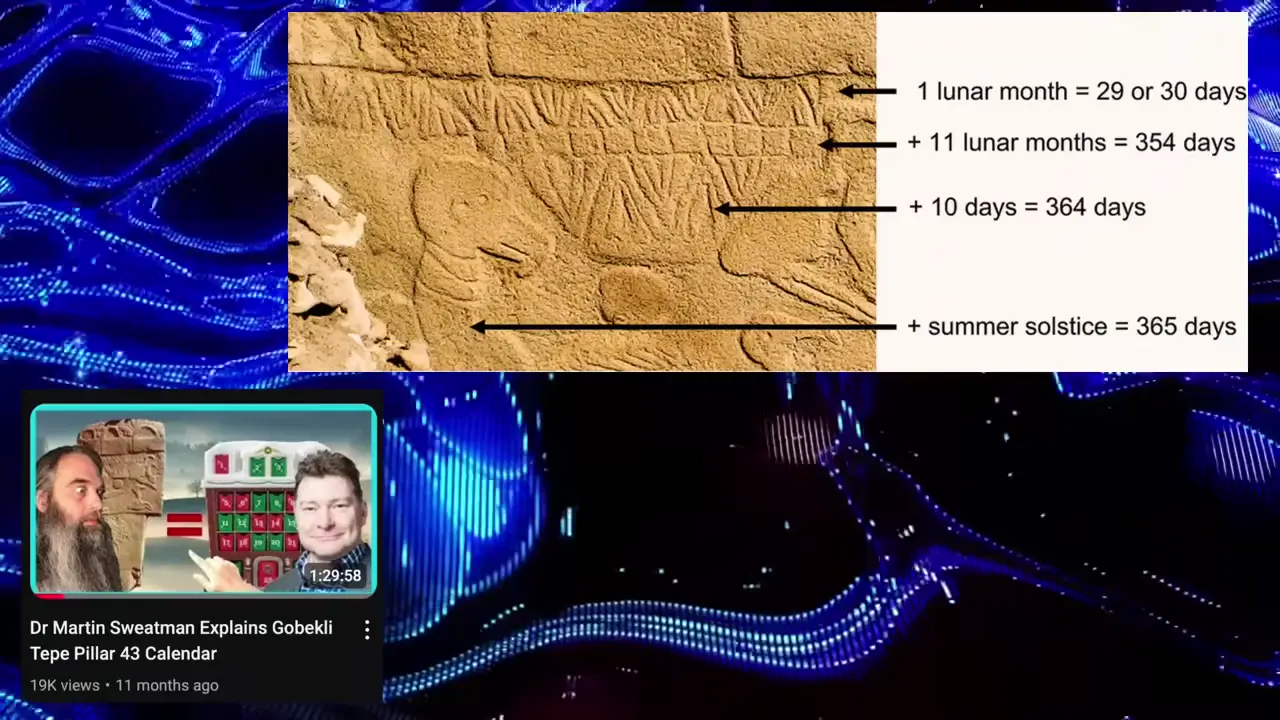
The video examines Taş Tepeler through archaeoastronomy. It argues that Göbekli Tepe's remote, inhospitable setting made it ideal for stargazing and interprets reliefs at Seğobükpınar as possible early depictions of Orion and Taurus. The video discusses Dr. Martin Sweatman's proposal that Pillar 43 encodes a summer-solstice constellation and date—an idea it describes as an astronomical clock. The Master of Beasts motif appears across cultures in the Old and New Worlds. The video also argues that human use of stars for navigation and timekeeping reaches further back than academics typically acknowledge.
Archaeoastronomy Theories at Taş Tepeler Sites
 TürkiyeArchaeoastronomy
Key facts
- The video examines Taş Tepeler through an archaeoastronomical lens.
- The video argues that Göbekli Tepe's remote, inhospitable setting was advantageous for stargazing.
- The video interprets reliefs at Seğobükpınar as possible early representations of Orion and Taurus.
- The Master of Beasts motif, often interpreted as a human dominating flanking animals, appears across the Old and New Worlds.
- Dr. Martin Sweatman proposes that Pillar 43 encodes a summer-solstice constellation and date; the video describes this proposal as an astronomical clock.
- The video argues that human use of stars for navigation and timekeeping reaches further back than academics typically credit.
Sources
Representations of calendars and time at Göbekli Tepe ...tandfonline.com
New paper submitted: Origin of some of the ancient Greek ...martinsweatman.blogspot.com
Pillar 43 — The Vulture Stone at Göbekli Tepegobekli-tepe.com
Göbekli Tepe and the Origins of Science - IIIcafemontaigne.com
Of animals and a headless man. Göbekli Tepe, Pillar 43tepetelegrams.wordpress.com
Was this story useful?
Keep exploring
Every site on this page sits on the globe, and the people who research them are on the Discord.
3D Globe · Sites by country · Story Archive · Research Library · Weekly Journal · Search
AI-generated text · images from the original sources · always verify with the sources.