

Ancient Egyptians worked granite and other hard stones with copper tubular drills and a quartz-sand-and-water abrasive. Predynastic stone vessels preserve concentric drill marks, while Old Kingdom reliefs show craftsmen using weighted and bow drills. Lucas’s Ancient Egyptian Materials and Industries (1926) and Petrie’s Tools and Weapons (1926) document the techniques; experiments show that abrasive-charged copper tubes can drill hard stone.
Ancient Egyptian Stoneworking: Copper Drills and Quartz Abrasives
Site mentioned
Key facts
- Predynastic Egyptian stone vessels from c. 4000–3100 BC preserve concentric tubular-drill marks; “lathe marks” is not the standard archaeological description.
- Copper tubular drills were used with crushed quartz sand and water as the abrasive to drill and hollow hard stone, including granite.
- Quartz, at Mohs 7, was chiefly used as a loose abrasive rather than as a drill bit.
- A suspended stone weight increased downward pressure and steadied the drill; describing it primarily as a flywheel is misleading.
- Lucas’s Ancient Egyptian Materials and Industries and Petrie’s Tools and Weapons were published in 1926. They were not a joint 1883 study; Lucas was born in 1875.
- Fifth-Dynasty Old Kingdom reliefs, including scenes in the tomb of Ti around 2450 BC, show craftsmen drilling stone with weighted and bow drills.
- Experiments demonstrate that copper tubes charged with quartz abrasive can drill granite, but the cited evidence does not establish “jewelled” tubes with emery points set inside them.
Sources
How did the ancient Egyptians drill holes into hard granite?gigazine.net
In 1883, Egyptologists A. Lucas and Flinders Petrie discussed the method by which tubular granite cores excavated from ancient Egyptian ruins were made.
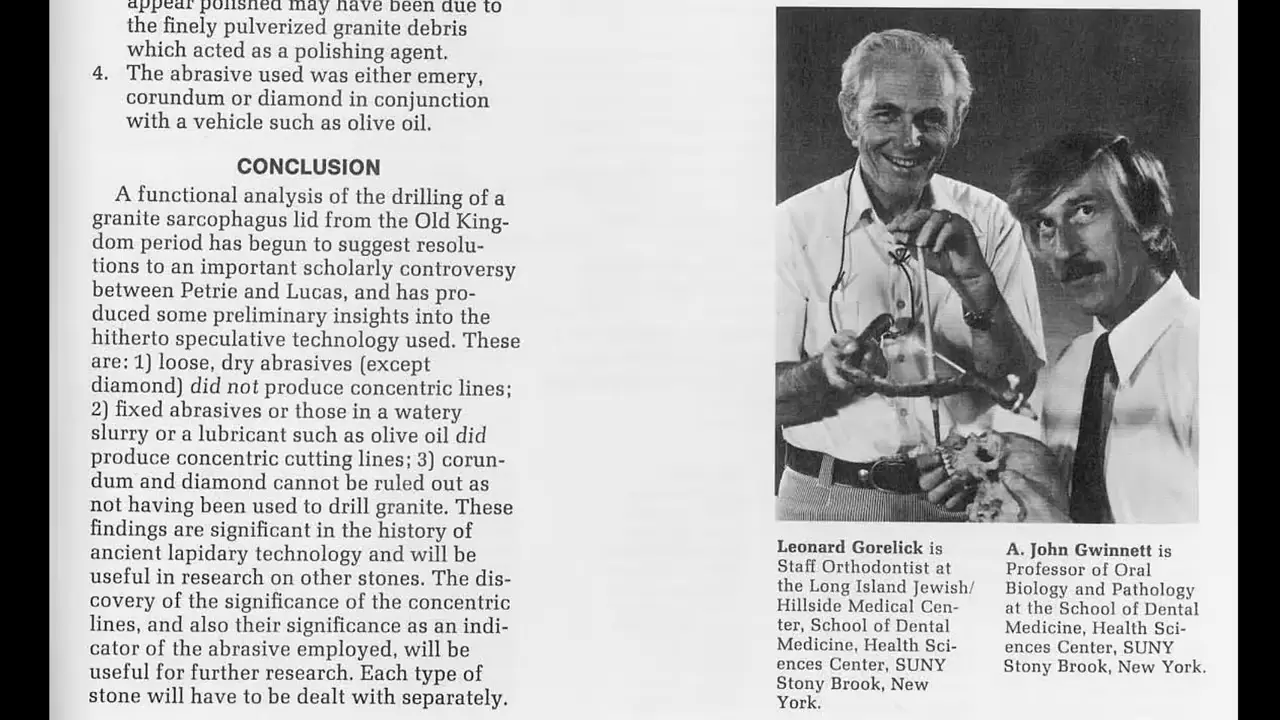
Expedition Magazine | Ancient Egyptian Stone-Drillingpenn.museum
“The cutting of granite was done by jewelled tubular drills . . . with cutting points . of emery . .. set in the sides of the tube both inside and out . ..
Ancient Egyptian Stone-Drillingpenn.museum
A slab of red granite similar to that of the sarcophagus was drilled with a copper rod and/or a copper tube in conjunction with the following abra- sives: ( ...
Claim: Ancient Egyptians Could Not Work Granite Without ...metabunk.org
It can cut, abrade and polish the hardest stone, such as granite and quartzite, both of which are harder than iron and bronze. Its name does ...
A SMALL NAGADA HARD STONE VASEroyalprovenance.com
In ancient Egypt, hardstone vessels were considered luxury items of the highest order. The art of sculpting tableware in stone reached its apogee already at ...
Tag: stone vesselsveronicasart.com
The ancient Egyptian hard stone vases are considered highly significant due to their incredible precision, meticulous design, and immaculate execution in ...
Stone vessels in ancient Egypten.wikipedia.org
Such vessels were an important status indicator, and commonly used to hold liquids or cosmetics, for ritual and display purposes, and as canopic jars.
Egyptian Predynastic Stone Vesselsjstor.org
by A Lucas · 1930 · Cited by 19 — EGYPTIAN PREDYNASTIC STONE VESSELS in part at least, from the Fayyuim, and probably certain gypsum vases found were also obtained from the Fayyum. But, if ...
Was this story useful?
Keep exploring
Every site on this page sits on the globe, and the people who research them are on the Discord.
3D Globe · Sites by country · Story Archive · Research Library · Weekly Journal · Search
AI-generated text · images from the original sources · always verify with the sources.