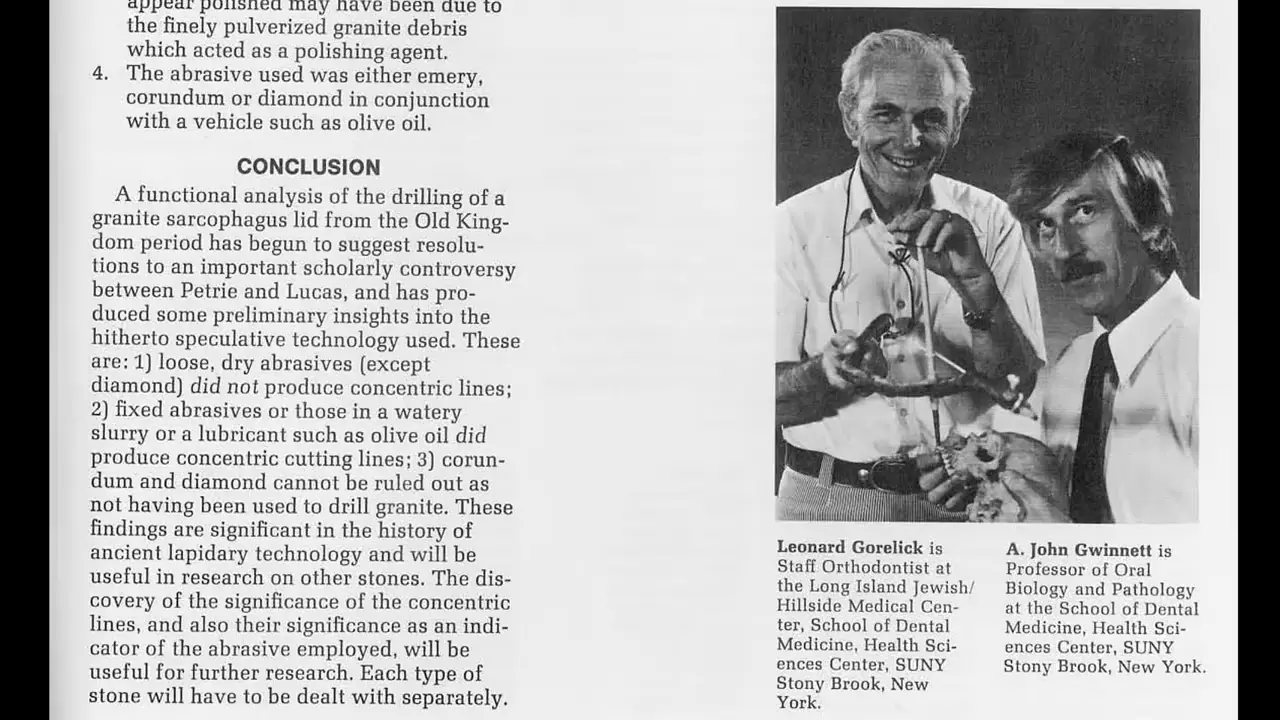
EGYPTians worked granite (6-7 Mohs) using abrasives, sand & water. An 1883 EGYPTological study by A. Lucas and Flinders Petrie proved copper tube drills could drill through red granite using abrasives. Old Kingdom reliefs show weighted hand drills.
Key facts:
- Predynastic EGYPTian stone vessels dating to 4000-3100 BC show clear rotary drill marks and lathe marks
- Hard stones like granite (6-7 Mohs hardness) were worked using abrasives with quartz, sand and water
- EGYPTians used lapis lazuli, carnelian (hardness 6.5-7), and garnet (6.5-7.5) in jewelry by 4000 BC
- Penn Museum records indicate granite was drilled using jewelled tubular drills with emery cutting points set in the tube
- Pre-dynastic Nakada culture created stone mace heads, cosmetic palettes, and ivory carvings
Sources
How did the ancient Egyptians drill holes into hard granite?gigazine.netIn 1883, Egyptologists A. Lucas and Flinders Petrie discussed the method by which tubular granite cores excavated from ancient Egyptian ruins were made.
Expedition Magazine | Ancient Egyptian Stone-Drillingpenn.museum“The cutting of granite was done by jewelled tubular drills . . . with cutting points . of emery . .. set in the sides of the tube both inside and out . ..
Ancient Egyptian Stone-Drillingpenn.museumA slab of red granite similar to that of the sarcophagus was drilled with a copper rod and/or a copper tube in conjunction with the following abra- sives: ( ...
Claim: Ancient Egyptians Could Not Work Granite Without ...metabunk.orgIt can cut, abrade and polish the hardest stone, such as granite and quartzite, both of which are harder than iron and bronze. Its name does ...
AI-generated text · images from the original sources · always verify with the sources.