

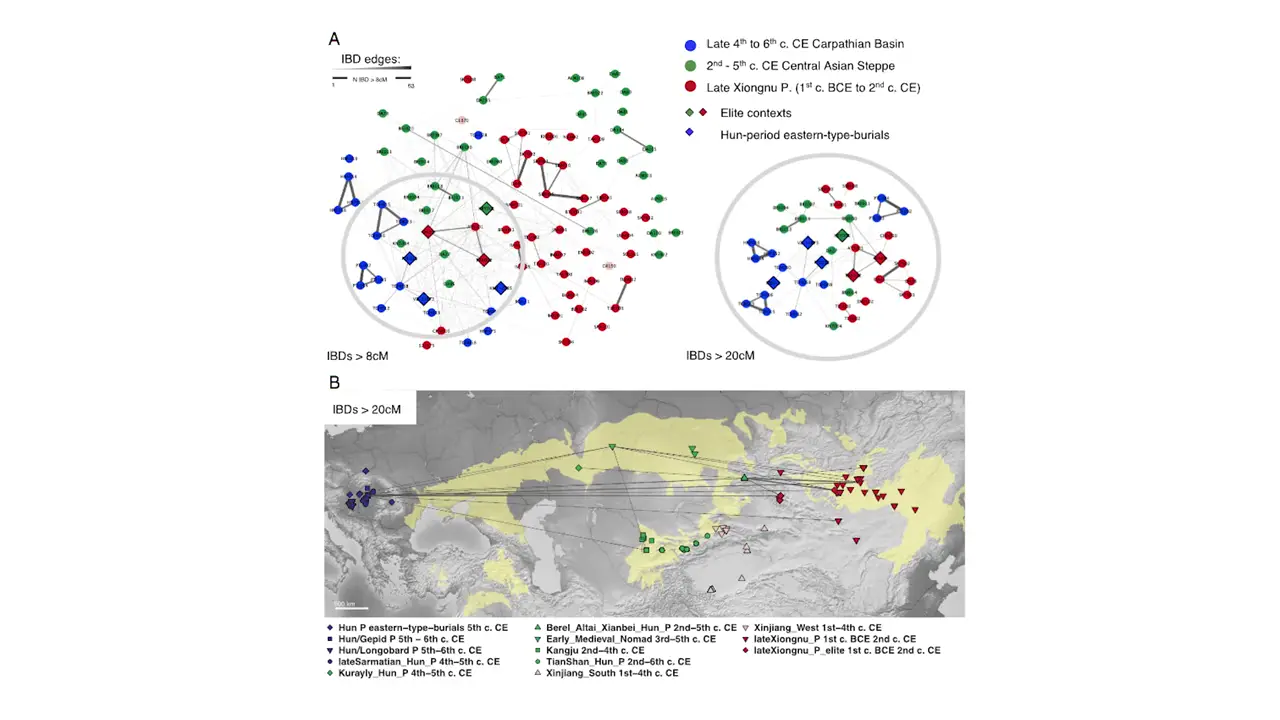
Ancient DNA is reshaping this picture beautifully. A 2018 Nature paper, a 2020 Cell study of 214 individuals, and a 2022 Current Biology analysis all show mobility and admixture across the step. A 2025 PNAS study found long shared DNA segments linking a small elite-marked group to late Xiongnu — while most Hun-period people were genetically local. 🧬
Ancient DNA studies reveal heterogeneous Xiongnu and mixed Hun genetic ancestry
Key facts
- A 2018 Nature paper analyzed ancient genomes across Mongolia, Central Asia, and Eastern Europe, showing mobility and admixture were the norm across the Eurasian step
- Xiongnu populations showed both East Asian and Western Eurasian genetic components
- A 2020 Cell paper analyzed genome-wide data from 214 ancient individuals from Mongolia and the Baikal region spanning about 6,000 years, arguing the Xiongnu empire formed through mixing of previously distinct populations
- A 2022 Current Biology paper studied three groups entering the Carpathian basin at different times (Huns 5th century, Avars, early Hungarians 9th century), finding a small minority core group with eastern step ancestry while most people were genetically local
- A 2025 PNAS study compared late Xiongnu genomes from Mongolia with Hun-period individuals in the Carpathian basin, identifying long identical-by-descent DNA segments linking a small number of elite-marked individuals to late Xiongnu contexts
- Most people buried in Hun-period Europe show genetic continuity with earlier Western Eurasian populations including Sarmatian and Roman period groups
Sources
pubmed.ncbi.nlm.nih.gov
Linked in video description
link.springer.com
Linked in video description
pubmed.ncbi.nlm.nih.gov
Linked in video description
pmc.ncbi.nlm.nih.gov
Linked in video description
sciencedaily.com
Linked in video description
Was this story useful?
Keep exploring
Every site on this page sits on the globe, and the people who research them are on the Discord.
3D Globe · Sites by country · Story Archive · Research Library · Weekly Journal · Search
AI-generated text · images from the original sources · always verify with the sources.