

Researchers found a Graecopithecus jaw fragment near Athens and a second tooth in Bulgaria, both dated to roughly 7.2 million years ago. CT scans revealed fused tooth roots—a trait seen in early hominins, not modern great apes. Combined with controversial 6-million-year-old footprints from Crete, this raises the possibility that hominin evolution may not have been exclusively African. Most paleoanthropologists remain skeptical of these interpretations, but the debate is far from settled.
7.2-million-year-old Graecopithecus challenges Africa's human origin monopoly
 GreeceBioarchaeology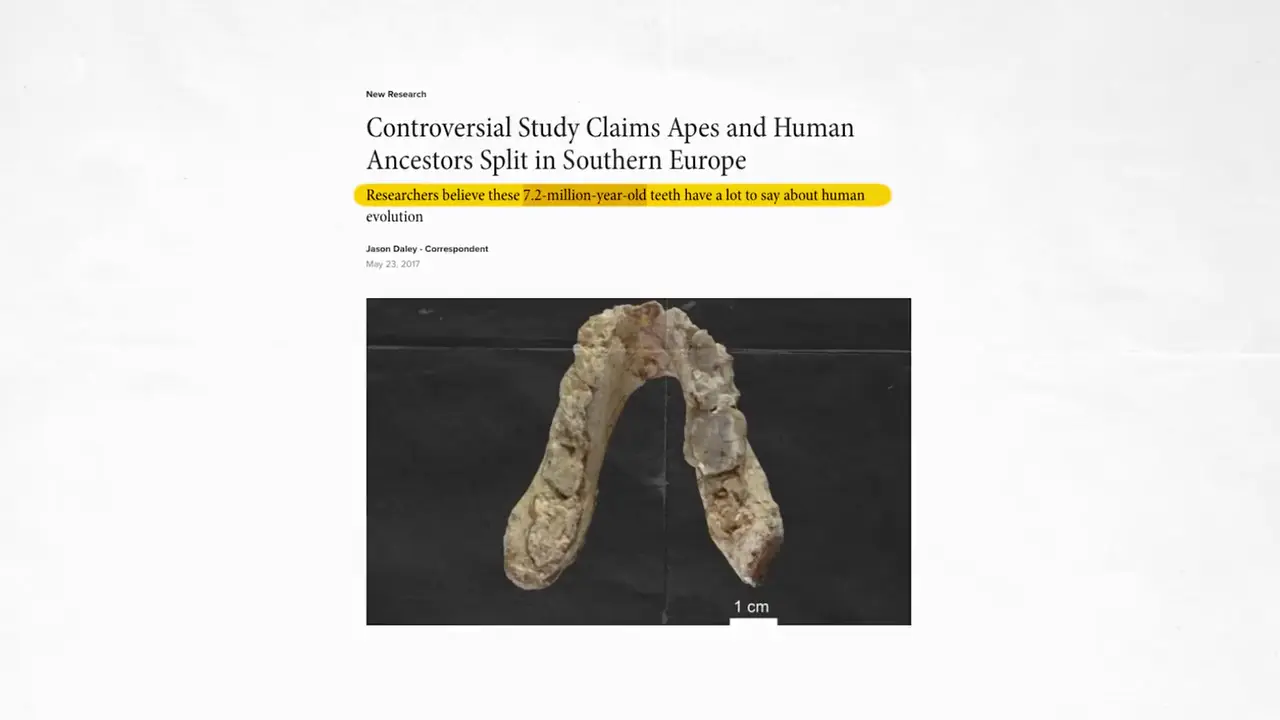
Key facts
- Graecopithecus jaw fragment found outside Athens (Attica), second fragment (upper premolar) found in Bulgaria
- Dated to approximately 7.2 million years ago using CT scans to examine internal tooth structure
- Tooth roots were fused, a trait seen in early hominins but not modern great apes
- Crete footprints dated to around 6 million years ago show possible hominin characteristics
- Both discoveries are controversial and disputed by most paleoanthropologists
- Raises possibility that earliest hominin evolution may not have been Africa-exclusive
Sources
7-million-year-old teeth add new layer to human origin storymashable.com
The fossils, which date back more than 7 million years, belonged to an ape-like creature named Graecopithecus freybergi, researchers hypothesized in two new ...
Graecopithecus, Potentially the Oldest Known pre-Humanen.uoa.gr
Geological investigations in Attica and particularly in Pikermi have revealed that this species lived about 7.2 million years ago together with ...
Potential hominin affinities of Graecopithecus from the Late Miocene ...pmc.ncbi.nlm.nih.gov
Graecopithecus is known from a single mandible from Pyrgos Vassilissis Amalia (Athens, Greece) ... Die Pikermi-fauna von tour la Reine (Attica).
Features of the Grecian ape raise questions about early homininsjohnhawks.net
A review of work published in 2017 describing fossil material of Graecopithecus freybergi from Greece and Bulgaria.
European fossils may belong to earliest known hominidsnexplores.org
They came from a chimpanzee-sized primate. It is being called Graecopithecus (Gray-ko-PITH-eh-kus), to honor Greece, one source of the fossils.
Was this story useful?
Keep exploring
Every site on this page sits on the globe, and the people who research them are on the Discord.
3D Globe · Sites by country · Story Archive · Research Library · Weekly Journal · Search
AI-generated text · images from the original sources · always verify with the sources.