

A Science Advances study published 7 October by IPHES and Universitat Rovira i Virgili documents 597 wood imprints and charred remains from 16 levels at Abric Romaní, about 30 miles west of Barcelona. The site's Neanderthal occupations date to roughly 62,000–40,000 years ago. The assemblage includes two spears, worked bark resembling shallow trays, a possible tripod and a 5.1 m pole. The authors say the evidence indicates woodworking was routine rather than occasional.
597 wood traces reveal repeated Neanderthal woodworking at Abric Romaní
 SpainArtifactNew Research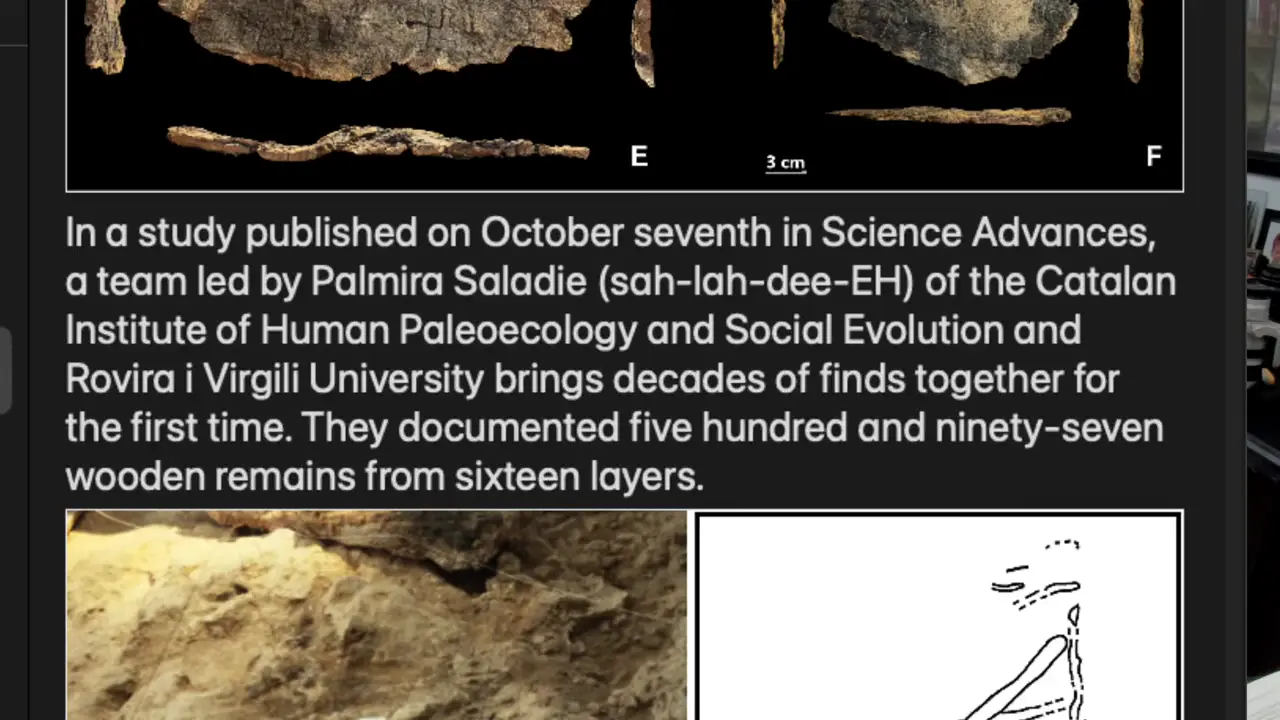
Site mentioned
Key facts
- Abric Romaní is a rock shelter about 30 miles (50 km) west of Barcelona, with Neanderthal occupations dated to roughly 62,000–40,000 years ago; excavations have been conducted there since 1983.
- A Science Advances study published on 7 October by the Catalan Institute of Human Paleoevolution and Social Evolution and Universitat Rovira i Virgili documents 597 wood imprints and charred remains from 16 archaeological levels.
- Mineral precipitation in the shelter's limestone sediments preserved impressions of decayed wood and, in some cases, microscopic wood anatomy.
- The authors identify 13 human-modified pieces, including two spears, four charred bark pieces resembling shallow trays, crossed poles interpreted as a possible tripod, and a straight 5.1 m pole that may have formed part of a windbreak.
- A level-P object has a 16 cm handle and a 14 cm head and has been compared with a knife or club; no wear traces establish its function.
- The authors interpret the repeated, cross-layered evidence as showing that woodworking was routine, involving wood selection and shaping, rather than an isolated activity.
- The comparison finds are roughly 300,000-year-old wooden spears from Schöningen, Germany, and roughly 171,000-year-old digging sticks from Gesher Benot Ya'aqov, Israel—not Italy.
Sources
A Wooden Club and Other Rare Finds Reveal 'Invisible ...gizmodo.com
What sets Abric Romaní apart, however, is that we “see wood again and again, in different archaeological levels, over thousands of years, and ...
Exploring the Wood Technology of the Neanderthals ...fundacionpalarq.com
The presentation of wood in the Abric Romani in the form of imprints, could contribute to deepen economic aspects in relation to the collection of firewood ...
hearth-related wood remains from abric - romani layer μ ( ...jstor.org
by A Solé · 2013 · Cited by 64 — In Abric Romani layer M, 93 (81.6%) of the 114 identified wood remains were uncharred (WN) and 21 (18.4%) were charred.
Archaeologists Uncover Unprecedented Evidence of ...sciencealert.com
Abric Romaní, archaeologists have unearthed a massive cache of wood imprints, several of which appear to be tools.
Neanderthal woodworking at Abric Romaní: Insights into ...science.org
We document 597 wooden imprints and charred wood remains recovered from 16 archaeological levels dated between ∼62,000 and 40,000 years ago.
Was this story useful?
Keep exploring
Every site on this page sits on the globe, and the people who research them are on the Discord.
3D Globe · Sites by country · Story Archive · Research Library · Weekly Journal · Search
AI-generated text · images from the original sources · always verify with the sources.