

Ancient DNA from upper Paleolithic Europeans reveals maternal haplogroups including N, R, and U8 — showing early Homo sapiens in Europe were genetically diverse with ties to Asian lineages. Some haplogroups later vanished from Europe while persisting elsewhere, hinting at later population replacements. Specifically, haplogroup M is nearly absent in modern Europe but widespread in East, South, Southeast Asia and Oceania; haplogroups N and R are basal branches of the non-African mitochondrial DNA tree; and U8 appears in upper Paleolithic European remains and is ancestral to haplogroups U5 and U4 — along with sharing a common origin with U5.
40,000-year-old Europeans carried haplogroups M, N, R, U8
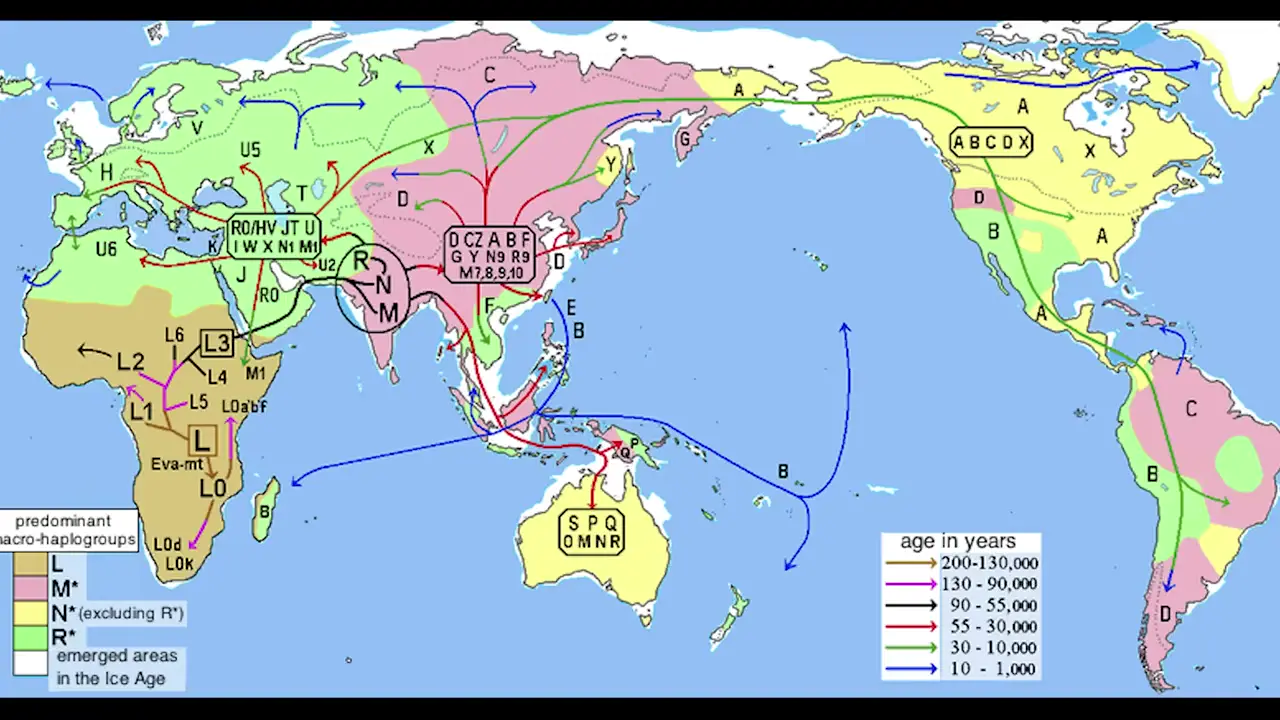
Key facts
- DNA from 40,000-year-old Homo sapiens in Europe shows maternal haplogroups M, N, R, and U8
- Haplogroup M is nearly absent in modern Europe but widespread in East, South, Southeast Asia and Oceania
- This suggests early Europeans shared close ancestry with populations that gave rise to Asians and Australo-Melanesians
- Haplogroups N and R are basal branches of the non-African mitochondrial DNA tree
- U8 appears in upper paleolithic European remains and is ancestral to haplogroups UF and U4
- These maternal lineages show the earliest waves of Homo sapiens into Europe were genetically diverse
- Haplogroup M vanished from Europe while persisting in Asia, indicating population replacement
Sources
nature.com
Linked in video description
journals.openedition.org
Linked in video description
pmc.ncbi.nlm.nih.gov
Linked in video description
dspace.library.uvic.ca
Linked in video description
link.springer.com
Linked in video description
nature.com
Linked in video description
pmc.ncbi.nlm.nih.gov
Linked in video description
Was this story useful?
Keep exploring
Every site on this page sits on the globe, and the people who research them are on the Discord.
3D Globe · Sites by country · Story Archive · Research Library · Weekly Journal · Search
AI-generated text · images from the original sources · always verify with the sources.