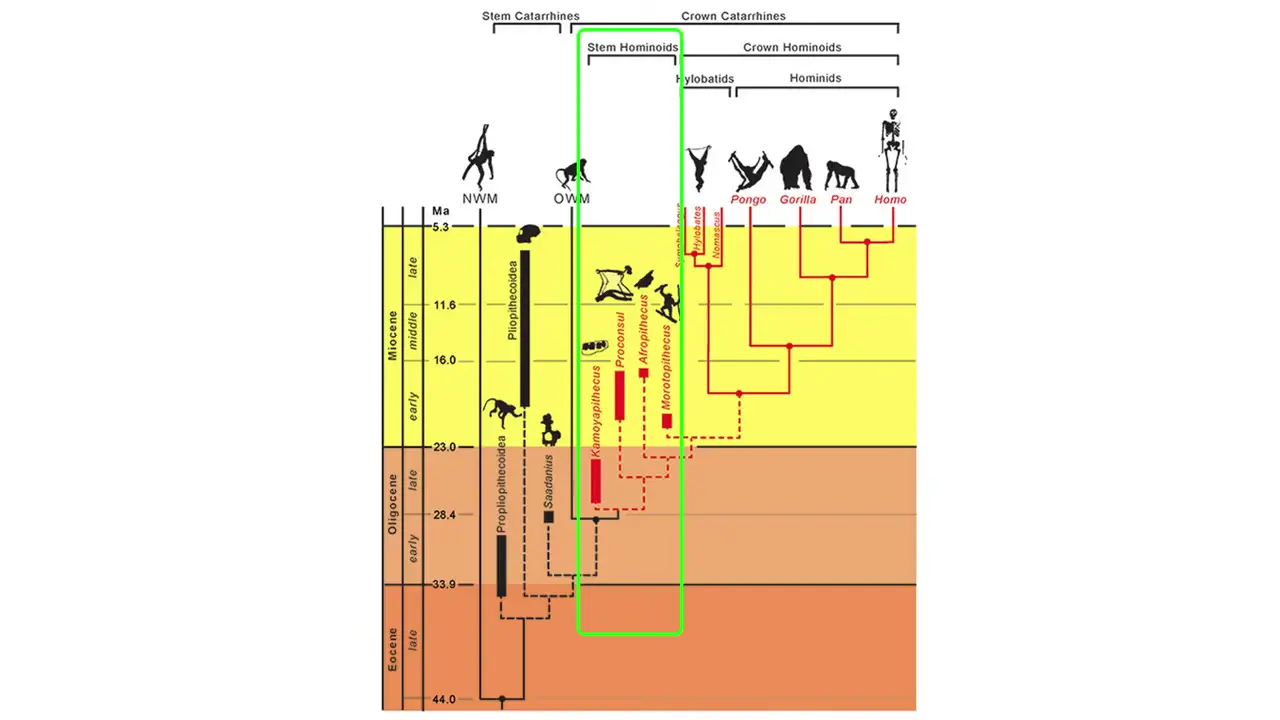
Researchers discovered a new Early Miocene ape from Egypt ~18 million years ago — sitting closer to the root of living ape radiation than any previously known fossil from this era, challenging the East Africa-centric view of early ape evolution.
Key facts claimed:
- Masripithecus is an 18 million year old Early Miocene ape fossil discovered in Egypt
- The fossil is a jaw with robust anatomy, large canines, and molars with rounded, heavily textured chewing surfaces suggesting a flexible fruit-based diet
- Phylogenetic analysis places this fossil closer to the root of living ape radiation than any previously known ape from this time period
- Researchers used tip dating methodology integrating fossil age directly into evolutionary tree analysis
- The study suggests a northern Afro-Arabian setting may better explain the divergence point of crown Hominoidea rather than East Africa
Sources
18 million-year-old fossils of ape found in Africa, but ... - Live Sciencelivescience.comThe ancestor of apes was long thought to come from East Africa, but newly discovered fossils in Egypt may prompt a rethink.
Masripithecus: A new Miocene ape from Egypt sheds light ... - Phys.orgphys.orgThe researchers' analysis found that Masripithecus is more closely related to the living apes than are any species known from the Early Miocene ...
Newly discovered primate species could redraw the ape family treenationalgeographic.comAn 18-million-year-old jawbone discovered in Egypt challenges the long-held view that East Africa was the cradle of our modern ape ancestors. A ...
These 17-Million-Year-Old Fossils Could Rewrite the Evolutionary ...smithsonianmag.comThe new discovery suggests that Masripithecus is distinct from creatures of the same age found in the more southern location, and that apes ...
18-Million-Year-Old Ape Fossil From Egypt Suggests Modern Apes ...discovermagazine.comTheir analysis found that Masripithecus is more closely related to living apes than any species currently known from the Early Miocene of East ...
AI-generated text · images from the original sources · always verify with the sources.