 ANCIENT NERDS
The Squatter Man Petroglyph and Auroral Sky Mythology
The paper concludes that Peratt's hypothesis that the "squatter man" petroglyph and similar Neolithic rock art depict high-current Z-pinch auroral plasma instabilities is morphologically plausible but not yet established, and that its load-bearing premises remain speculative. It finds the quantitative physics objection decisive—proposed Birkeland currents would need to be five to six orders of magnitude above current magnetospheric measurements, and a timescale gap of nine to twelve orders of magnitude separates laboratory Z-pinch disassembly from human carving behavior—and notes that the cross-cultural morphological matching lacks blind-testing, inter-rater reliability, or statistical controls against pareidolia. The paper places the plasma hypothesis alongside entoptic/neuropsychological and shamanic-projection explanations as comparably grounded but mutually unresolved.
On the night of 23 April 2023, instruments at the Hanle observatory in Ladakh, India — at 33°N geographic latitude — recorded red auroral emissions climbing to altitudes of 700 to 950 kilometers, far south of where the auroral oval normally hangs. Plasma physicist Anthony Peratt of Los Alamos National Laboratory built his case across two papers in IEEE Transactions on Plasma Science — “Characteristics for the Occurrence of a High-Current Z-Pinch Aurora as Recorded in Antiquity” (December 2003) and “Directionality and Source” (August 2007, with McGovern) — that many Neolithic and Early Bronze Age petroglyphs worldwide are direct depictions of high-current Z-pinch auroral plasma instabilities, sustained by Birkeland currents flowing into Earth’s atmosphere at magnitudes on the order of megaamperes. [1]
The Z-Pinch in the Laboratory
In September 2000, plasma physicist Anthony Peratt, then at Los Alamos National Laboratory and already an established authority on high-energy discharge instabilities, received a communication from comparative mythologist David Talbott pointing out apparent morphological similarities between laboratory plasma discharge patterns and ancient rock art. Peratt, an American physicist with credentials spanning plasma physics, nuclear fusion, and plasma petroglyph research, took the observation seriously and began a multi-decade investigation. That work culminated in December 2003 with a peer-reviewed paper in IEEE Transactions on Plasma Science (Vol. 31, No. 6, pp. 1192–1214) titled “Characteristics for the Occurrence of a High-Current Z-Pinch Aurora as Recorded in Antiquity,” proposing that many Neolithic and Early Bronze Age petroglyphs worldwide are direct depictions of intense auroral plasma phenomena—specifically high-current Z-pinch instabilities observed in the sky by ancient peoples. A Part II follow-up paper appeared in August 2007 (Vol. 35, No. 4), focused on the directionality and source of the proposed auroras. [2] [3] [4]
The Z-pinch itself is a well-established plasma confinement configuration: an axial electric current through the plasma generates an azimuthal magnetic field that compresses, or “pinches,” the column radially inward. During compression and stagnation, such systems reach typical core densities of 10^18 to 10^22 cm^-3 and temperatures of 0.1 to 1 keV before becoming highly unstable—disassembling through a characteristic sequence of magnetohydrodynamic instabilities including kink and sausage modes, loops, flares, and disruptions, as documented through high-resolution laser probing diagnostics at the 1-MA level. The unstable formations Peratt cataloged across his multi-decade laboratory work became known informally as “Peratt Instabilities” because he was the first to systematically document them. The instabilities evolve through identifiable phases: stacks of toroids, flattened toroids, helical instabilities, ladder configurations, separatrix patterns, eye/nose masks, pipette forms, and vortex configurations. [5]
Modern high-fidelity particle-in-cell (PIC) simulations have been used to replicate the carved petroglyph morphologies Peratt attributed to these phases, anchoring the comparison program to current computational plasma physics. The most-discussed correspondence—and the most frequently depicted petroglyph in his database—is what Peratt termed the “squatter man,” an hourglass-shaped anthropomorphic silhouette that appears globally in roughly identical form. Stacks of such toroids characteristically number nine—a numerical signature that Peratt noted matches recurring global petroglyph motifs of nine-dot or nine-element patterns. Peratt compiled more than 25,000 rock art images from 139 countries to support these correspondences, described as perhaps the largest rock art dataset ever assembled, with fieldwork concentrated in the American Southwest and Northwest combined with international data collection. [5]
The petroglyphs he studied date approximately to between 10,000 and 2,000 BCE, corresponding to the Neolithic through Early Bronze Age transition. The methodological pillar holding the comparison together is scale invariance: plasma behavior can be scaled across many orders of magnitude, so centimeter- and meter-scale laboratory Z-pinches can replicate Earth-scale auroral configurations. Real laboratory Z-pinch instabilities have been documented producing magnetic fields on the order of 1,000 Tesla—roughly 100,000 times Earth’s field—demonstrating the magnitude of electromagnetic energies available to a Z-pinch instability of the type Peratt uses as a morphological template. [1]
Because petroglyphs are fixed rock carvings that have not changed since creation, Peratt argued, they preserve their accuracy as depictions in a way no oral tradition or painted image can. Through computer processing of petroglyph images from different world regions, the data were arranged into animation cells, allowing a 3D reconstruction of the proposed auroral form—essentially running the laboratory instability sequence in reverse from carved images alone. The hypothesis implies an ancient aurora requiring the solar wind to have been between one and two orders of magnitude greater than present values, to produce visible high-current Z-pinch auroras at the lower latitudes where petroglyphs are abundant. But the most important finding—and the unresolved question—is whether the morphological match between 84 documented petroglyph types and Z-pinch discharge phases reflects a shared external phenomenon witnessed and recorded globally, or whether the correspondence is something the human visual system produces readily from many sources. The image data Peratt assembled, the 84-morphology catalog, and the supercomputer simulations built on the Chandrasekhar–Fermi equations—the same equations used to reproduce galactic-scale plasma structures—constitute the formal case. Whether that case closes remains contested, but the underlying physics is not in dispute: a Z-pinch column driven by intense current does produce precisely the stacked toroids, ladder patterns, pipette forms, and vortex squatter-man configurations carved into stone across continents during the Neolithic, and the laboratory-to-aurora scaling argument is genuinely grounded in the way plasmas behave. [6]
Squatter Men Across Continents
On 21 December 2003, plasma physicist Anthony Peratt published a paper in the IEEE Transactions on Plasma Science claiming that recurring worldwide petroglyph patterns are “reproductions of plasma phenomena in space” rather than products of shamanistic vision or symbolic tradition. The comparison rested on a database he and comparative linguist Marinus Anthony Van Der Sluijs had assembled since 2000, eventually encompassing more than 25,000 GPS-referenced rock-art images gathered by a team of about 30 volunteers from 139 countries — described by Penn Museum as “perhaps the largest rock art dataset ever collected”. The key quantitative finding: correspondences between 84 specific petroglyph morphologies and high-current Z-pinch auroras, including stacked toroids (often numbering nine), ladder patterns, separatrix patterns, eye-and-nose masks, pipette forms, vortex formations, and the anthropomorphic “squatter man”. The August 2007 Part II paper extended this analysis with directional data drawn from the 139-country corpus, presenting a planetary-scale argument that the same morphologies recur because the same plasma source was being observed. [5]
EARLY MEDIEVAL HELMET. Photo: Europeana. Another of the eight specific morphologies; showing the actual rock-art form is necessary for the…. Source
The squatter man configuration, under Peratt’s hypothesis, is interpreted as arising when a disk or torus around a linear discharge column is bent by magnetic fields induced by intense current flow, producing an apparent hourglass form in which upper torus edges point up (forming “arms”) and lower torus edges point down (forming “legs”). Peratt documented this configuration across the Americas, Scandinavia, Siberia, the Middle East, and elsewhere. He extended the correspondences beyond portable rock art into monumental land-art features, claiming exact structural parallels between plasma discharge formations and stone circles including Stonehenge and the Majorville Medicine Wheel in southern Alberta — a site with a 9-meter central cairn, 28 radiating spokes, and a 27-meter outer cobble circle that has seen continuous ritual use for approximately 4,500 years. Gordon Freeman, professor emeritus at the University of Alberta, had already been arguing in “Canada’s Stonehenge” (2009) that Majorville (Iniskim Umaapi) functioned as an astronomical calendar with solstice/equinox alignments, drawing explicit analogies with Stonehenge. Peratt’s claim sits on top of that astronomical reading but adds a plasma-physics source for both. [5]
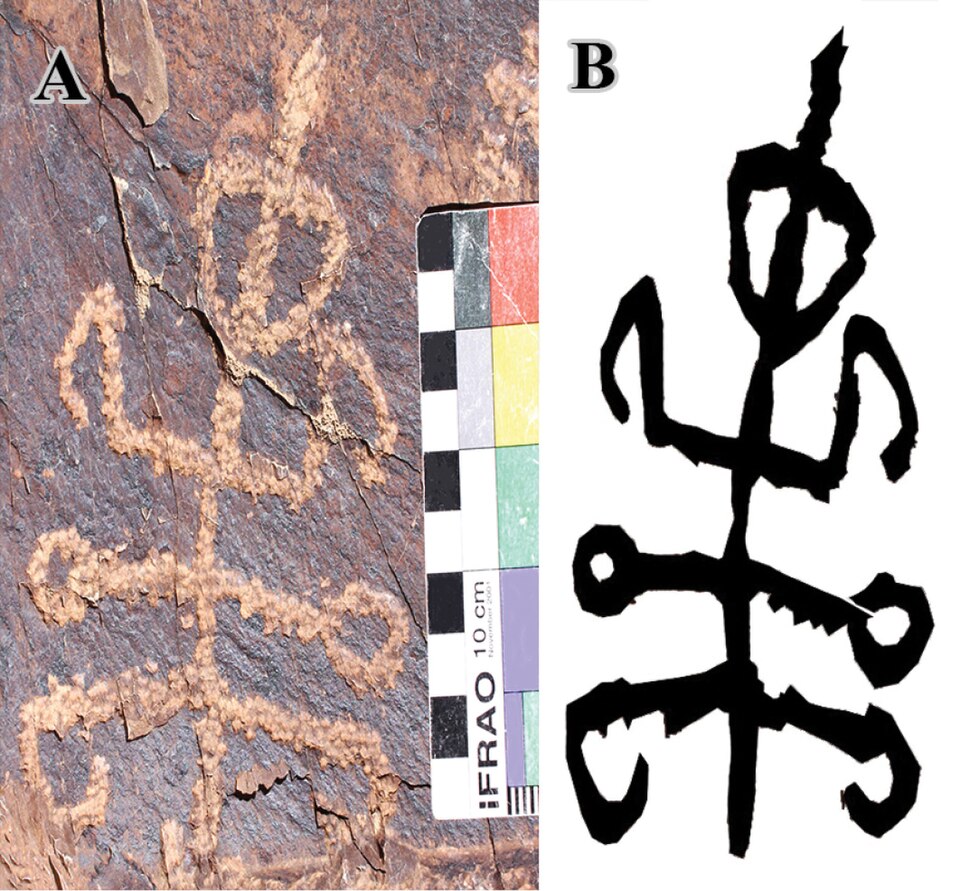
But here’s where the evidence gets uncomfortable for a clean plasma interpretation. On a 30-degree sloped boulder near Sarkubeh village in Khomein County, Markazi Province, central Iran, a 14-cm motif was documented during 2017–2018 surveys at the Teymareh rock art site — which contains over 21,000 petroglyphs spread across 31 archaeological sites covering approximately 150 square kilometers. The carving depicts a six-legged creature with a triangular head, large eyes, and raptorial forearms whose middle limbs end in loops or circles. In March 2020, entomologists and archaeologists Kolnegari, Naserifard, Hazrati, and Shelomi published a peer-reviewed identification of this motif in the Journal of Orthoptera Research as a prehistoric praying mantis — narrowed by a distinctive head extension to the local genus Empusa. Crucially, the Kolnegari et al. paper itself explicitly notes an alternative hypothesis for the loops flanking the figure: that they “represent auroras caused by atmospheric plasma discharges”. This makes the 2020 paper simultaneously the strongest peer-reviewed entomological challenge to Peratt’s reading of the squatter man motif AND an acknowledgment within that very challenge that the plasma-discharge interpretation of the flanking circles is a legitimate contender. Age estimates for the Teymareh motif range from 40,000 to 4,000 years ago based on stylistic examination by rock-art experts Jan Brouwer and Gus van Veen — radiocarbon dating is currently impossible because international sanctions on Iran prohibit the import of radioactive materials. That dating uncertainty — a 10x range — sits at the center of any plasma-event claim. [7] [8] [9]

Mantis petroglyph, Iran, Khomein County, Markazi Province. Photo: Kolnegari M, Naserifard M, Hazrati M, Shelomi M / Wikimedia Commons. Establishes the physical and archaeological context of why a six-legged motif on a single 30-degree…. Source
Across continents, other rock-art traditions explicitly invoke sky beings in ways Peratt’s framework reads as supportive. The Wandjina figures of Australia’s north-west Kimberley, dated to roughly 3,800–4,000 years ago, are described in Worrorra, Ngarinyin, and Wunambal oral tradition as “powerful sky beings” who descended from the Milky Way (specifically the first Wandjina, Idjair) to create the land and its inhabitants, with painted body dots representing rainfall and headdresses symbolically tied to lightning. They are characterized iconographically by round heads, large circular staring eyes, the absence of mouths (sealed, by tradition, upon the first lightning strike), and halo-like head decorations — features some commentators have likened to figures wearing “helmets”. The Nebra Sky Disc, dated to c. 1600 BC and inscribed on the UNESCO Memory of the World Register, features a gold arc at the bottom variously interpreted as a solar boat with oars, a rainbow, a comet, a sickle, or the Aurora Borealis. And in cross-cultural auroral folklore, the Northern Lights recur as fire, weapons, or heavenly armies — Julius Obsequens describing them as “military spears,” Hudson Bay Inuit seeing them as torches carried by the dead, the Norse associating them with the burning Bifröst bridge or reflections off Valkyrie armor. These traditions show that indigenous and ancient sources themselves explicitly attribute certain rock art and sky phenomena to celestial-sky origins — but they do not adjudicate whether the sky events were auroral, plasma-discharge, or simply the standard Northern Lights visible at high latitude. [10]
The Lights as Living Beings
Aurora borealis is widely associated in Norse tradition with the Bifröst bridge, sometimes identified with the Valkyries’ shining armor, and the connection between Bifröst and the Northern Lights is recognized in both popular and academic literature. These two interpretations — sky-bridge and celestial escort — anchor a wider pattern in which the aurora was treated not as weather but as inhabited space, populated by named beings whose behavior mattered to those below. [11] [12] [13] [14]
Sámi and Norse peoples interpreted the aurora as the spirits or breath of the dead, with strong cautionary taboos (no whistling, singing, or teasing) that could provoke the spirits. Finnish and Sámi legend attributes the aurora to a ‘fire fox’ (revontulet) whose tail brushes the mountains and sparks the sky, paralleling how the Sámi viewed the aurora as ancestors and other Arctic peoples viewed it as animal or human spirits. The prohibitions reflected a recognition that the lights were responsive presences, not passive display. [13] [15] [16] [14]
Multiple Inuit and Eskimo traditions interpret the aurora as spirits of the dead playing a ball game with a walrus skull, with an inverted variant among some Greenlanders, and a regime of taboos governs human response. The phenomenon was simultaneously afterlife, recreation, and threat, and the rule across variants was the same: the lights were responsive presences, not passive display. [17]
Wandjina rock art of the Kimberley in Western Australia depicts anthropomorphic sky-beings whose features are interpreted within Aboriginal tradition as cloud, lightning, and rain imagery, with the paintings coexisting alongside much older Gwion Gwion figures. Popular and comparative sources compare Wandjina figures and other ‘humanoid with large head’ petroglyphs to ‘space helmets’ or otherworldly beings, while Aboriginal oral tradition grounds them as sky/cloud/lightning spirits who ‘descended from the heavens’. [18][19][20][21]
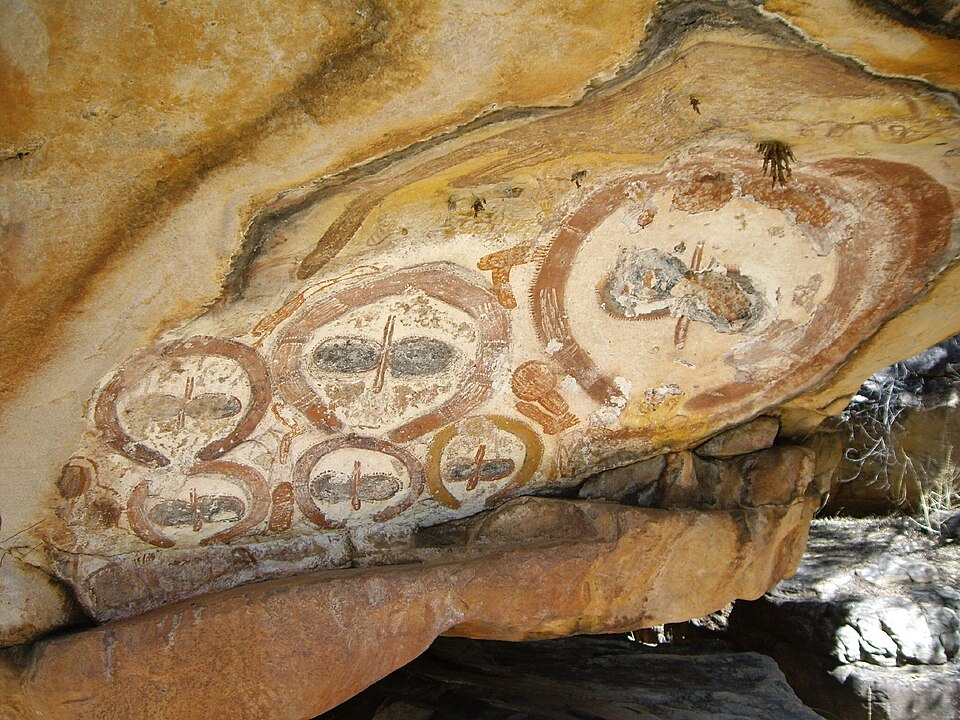
Wandjina rock art. Photo: Claire Taylor from Everywhere, Australia / Wikimedia Commons. The geological context of the rock overhangs is essential to understanding why the Kimberley preserves…. Source
Auroral-style ‘luminous sky’ phenomena are embedded in stratified European folk traditions ranging from the Sámi and Norse in the north, to the Scottish ‘Merry Dancers’ — interpreted as a celestial battle with blood-red lights as omens of bloodshed — and southward to Estonian legends of celestial sleighs. Classical Greco-Roman writers documented aurora-like atmospheric phenomena they could rarely observe from Mediterranean latitudes, with Aristotle and Seneca providing extended early descriptions. The Roman Aurora herself descends from a reconstructed Proto-Indo-European dawn goddess *H₂éwsōs, reflected in cognates across Indo-European traditions: Roman Aurora, Greek Ēōs/Eos, Vedic Uṣas, Lithuanian Aušrinė. Across these geographically distant cultures the auroral phenomena inspired a rich, convergent set of myths — the Norse identification with the Valkyries’ armor or the Bifröst bridge, the Sámi fire-fox legend, the Inuit view of the aurora as spirits playing a ball game with a walrus skull — in which the aurora was alive and one was expected to respond accordingly. [13] [22]
When the Sky Came Alive
In 774 CE, tree rings across Japan, Germany, Russia, the United States, Finland, and New Zealand recorded a simultaneous 1.2 percent spike in atmospheric carbon-14 — roughly twenty times normal year-to-year variation. This is the 774–775 Miyake event, and it is not the only one. Tree-ring radiocarbon and ice-core beryllium-10 records now confirm at least six such “Miyake” extreme solar proton events at 774–775 CE, 993–994 CE, 664–663 BCE, 5259 BCE, 7176 BCE, and approximately 12,350 BCE. The 664–663 BCE event, constrained by larch tree-ring measurements from Yamal and Altai, shows a 12‰ rise in Δ14C over just two years, with a 14C production rate 3.2 to 4.8 times average solar modulation. The 12,350 BCE event is the strongest yet identified — its 14C rise runs nearly double that of the 774 CE spike. These events were real, global, and produced atmospheric disturbances on a scale that could translate, in the right magnetospheric conditions, into low-latitude auroras visible from regions where such displays do not occur today. [23]
But the geophysical condition Peratt’s hypothesis most heavily leans on is the Laschamps excursion of 41,000 to 42,000 years ago. Multiple reconstructions agree the geomagnetic field collapsed to roughly 5 to 10 percent of present strength, with the most acute phase pulling it transiently as low as 4–5 percent. During this collapse, the magnetosphere compressed to approximately 2 to 5.3 Earth radii on the dayside, and magnetospheric modeling by Mukhopadhyay et al. shows the auroral oval detached from the poles and drifted toward near-equatorial latitudes — what they term an “omni-aurora” or “global aurora” — visible at low latitudes for roughly 300 years during peak field weakening. Cosmogenic isotope reconstructions put average beryllium-10 production at twice the present rate, confirming elevated radiation during the event. The dating aligns with the emergence of figurative cave art, and Cooper, Turney and colleagues proposed in 2021 that this excursion drove the rise of ochre use, cave occupation, and possibly Neanderthal extinction. Within nine months, two Technical Comments in Science challenged the chronology — Picin et al. noted that the Blake geomagnetic excursion around 114,000 years ago occurred without comparable cultural or extinction signals, weakening the causal link. The geophysics of the Laschamps excursion is well-documented; its cultural consequences remain contested. [24]
The evidence doesn’t require Laschamps-scale catastrophe for low-latitude aurora, though. The youngest documented Holocene excursion occurred roughly 2,500 years ago, recorded in Russian peat deposits from the Khabarovsk Territory. This event coincides with ancient Assyrian clay-tablet records of northern lights observed at latitudes of 30–40°N — well south of where auroras occur under current geomagnetic conditions. In modern corroboration, an all-sky camera at Hanle, Ladakh, India (33°N geographic) captured red auroral emissions at 700–950 km altitude during the moderate 23–24 April 2023 geomagnetic storm, with low-energy electron precipitation at ~54°N producing emissions visible from equatorial latitudes. So even under present (non-excursion) conditions, auroras at the latitudes Peratt’s hypothesis requires are not physically implausible; they’re documented today. [25]
What this means for testing the Peratt hypothesis is concrete. Plasma-oxidation AMS radiocarbon dating of calcium oxalate accretions on pictographs is now methodologically established; Shumla’s work on Pecos River Style anthropomorphs in Eagle Cave, Texas yielded three statistically overlapping paint dates clustering around 3280 BP. With calibration curves (IntCal13, IntCal20) now accounting for solar and geomagnetic modulation of atmospheric 14C over the Holocene, the geological and chronological tools to test whether specific auroras coincide with specific petroglyphs exist. The smoking gun of an omni-aurora-era petroglyph layer dated to between 41,000 and 42,000 years BP would be the strongest available evidence; the strongest available counter-evidence would be a petroglyph cluster dated firmly to a geomagnetically quiet millennium with no corresponding plasma-aurora signature. The geophysical conditions Peratt’s hypothesis requires are demonstrably real across the Pleistocene–Holocene transition. The unresolved question is not whether the sky ever came alive — but whether the record survives well enough, on enough dated rock, to prove that someone was watching. [26]
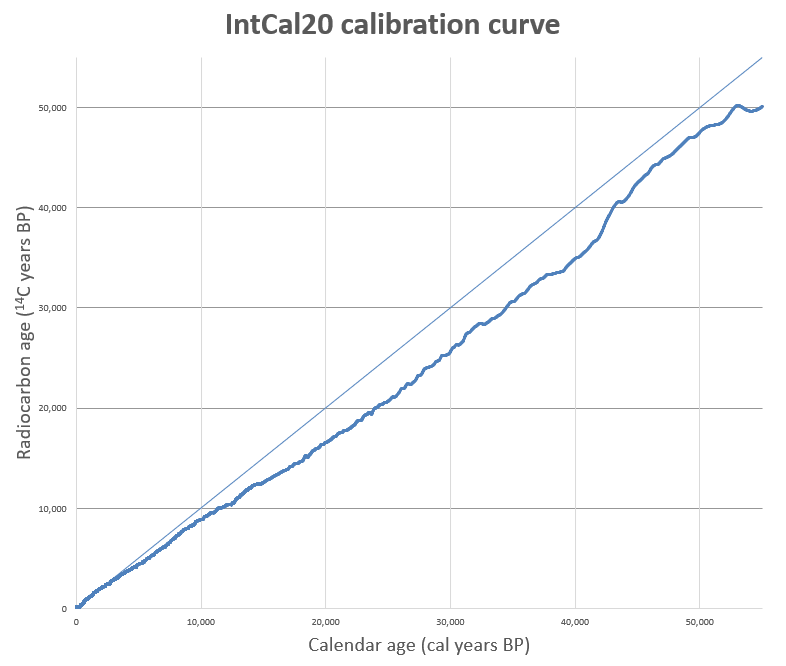
Intcal 20 calibration curve. Photo: Mike Christie / Wikimedia Commons. Displaying the actual calibration graph — with its known wiggles tied to solar/geomagnetic modulation —…. Source
Connecting the Dots
Across cultures separated by oceans and millennia, aurora is personified with a consistency that resists coincidence. Norse traditions identify the lights with Bifröst, the shimmering bridge linking realms of the living and the dead. Sámi interpreters perceived the aurora as the breath and spirits of ancestors, with strict prohibitions against whistling, singing, or teasing the lights, lest the spirits respond. Inuit and Eskimo communities described the aurora as dead spirits playing ball with a walrus skull, with a regime of taboos governing human response. The Finnish and Sámi “fire fox” legend attributes the aurora to a creature whose tail brushes mountains and sparks the sky, paralleling how Arctic peoples broadly viewed auroral displays as animal or human agents. This pattern of personification, where distant cultures independently encode the same phenomenon as a responsive, volitional being, connects directly to Peratt’s plasma-instability hypothesis: because high-current Z-pinch plasma behavior produces configurations that form and reform dynamically — the squatter man’s disk is bent by magnetic fields induced by intense current flow, creating shapes that shift and reconfigure — observers would have experienced auroral displays as encounters with a sentient entity rather than passive celestial light. Under a mundane reading, the cross-cultural consistency of these myths reflects convergent human cognitive tendencies toward anthropomorphizing powerful natural phenomena, but the recurrence of strong cautionary taboos — no whistling, no teasing — across unrelated Arctic cultures points to a shared experiential trigger that pure shamanic projection does not adequately explain. [13] [15] [16] [14]
Two competing interpretive frameworks now dominate academic debate, and they reach opposite conclusions from similar datasets. Lewis-Williams and Dowson’s 1988 neuropsychological model proposed that universal entoptic imagery experienced during altered states of consciousness produces the geometric and anthropomorphic petroglyphs found globally. Peratt and colleagues documented approximately 84 petroglyph morphologies corresponding to high-current Z-pinch discharge phases, with a database compiled from 139 countries suggesting that plasma instabilities, not entoptic hallucinations, generated the recurring forms. A 2020 peer-reviewed reinterpretation of the 14-cm motif at Teymareh (Iran) argued that Peratt’s “squatter man” actually depicts a six-legged creature with raptorial forearms, a prehistoric praying mantis, not an anthropomorphized plasma instability[27]. Direct archaeological confirmation of hallucinogen use at rock art sites, including Datura quids at Pinwheel Cave, supports the neuropsychological framework empirically. Peratt’s plasma hypothesis nonetheless has its own physical scaffolding: laboratory Z-pinch experiments at 1.3 MA and 5–16 MA have replicated the morphologies observed in petroglyphs, demonstrating that the correspondence is physically grounded. The interpretive stalemate persists because neither framework has been definitively falsified, and the same image can be read as either entoptic projection or plasma record depending on the assumptions one starts with.
A precise chronological scaffolding for testing these hypotheses now exists, but it does not yet resolve the dispute. Tree-ring radiocarbon records have documented Miyake events with extreme precision: the ca. 660 BCE event is now constrained to 664–663 BCE based on larch tree-ring analysis from Yamal and Altai, showing a ~12‰ rise in Δ14C over two years and a 14C production rate 3.2–4.8 times higher than average solar modulation. The 774–775 CE event alone produced an ~1.2% increase in atmospheric 14C, roughly 20 times normal year-to-year variation, and is recorded globally in tree rings from Japan, Germany, Russia, the United States, Finland, and New Zealand. Geomagnetic excursions, including one ~2,500 years ago documented in Russian peat deposits, have been correlated with Assyrian clay-tablet records of auroral sightings at 30–40°N where auroras are not seen today. Peratt places his proposed plasma events at approximately 10,000 years ago, during the Neolithic or Early Bronze Age, but this chronology remains asserted rather than directly dated. Shumla’s work on Pecos River Style anthropomorphs in Eagle Cave (Texas) demonstrated that direct AMS radiocarbon dating of paint layers is feasible by isolating carbon from calcium oxalate accretions using plasma oxidation, yielding three statistically overlapping dates clustering around 3280 BP. The technique name — plasma oxidation — is identical to the language of Peratt’s plasma research program, yet the dates it produces (a few thousand years ago) do not align with the ~10,000-year window Peratt proposes for the bulk of his petroglyph corpus. This temporal mismatch does not disprove either framework, but it exposes a critical gap: the most rigorous direct dating methods currently anchor specific motifs to periods far younger than the hypothesized plasma event window, leaving the question of when, and whether, ancient peoples actually witnessed the instabilities Peratt describes, empirically open. [28]
The Other Side
The dominant alternative in rock-art studies is the neuropsychological model developed by David Lewis-Williams and Thomas Dowson in 1988, which explains the worldwide recurrence of geometric motifs through six universal “form constants” — grids, parallel lines, dots, zigzags, catenary curves, and filigrees — that arise as entoptic phenomena during altered states of consciousness. This framework, published in Current Anthropology and refined over decades, was never displaced by Peratt’s revision: mainstream authorities hold that only depictions of the sun, moon, and stars reliably record external celestial phenomena, and that the global geometric corpus is best understood as projections of shamanic-trance content rather than as observational records of atmospheric events. The model has received independent archaeological support, including the unambiguous recovery of roughly 400-year-old Datura wrightii quids co-occurring with rock art on the same ceiling at Pinwheel Cave, California, demonstrating entheogen-assisted image-making at a documented rock-art site [29]. A growing experimental and ethnographic literature has continued to bolster this neurovisual reading.
The methodological scaffolding of Peratt’s comparative work has drawn pointed criticism. Pareidolia — the cognitive tendency to perceive meaningful patterns in ambiguous stimuli — combined with confirmation bias undermines any protocol in which researchers visually match plasma-discharge photographs against a curated bank of 25,000 petroglyphs without documented blind-testing, inter-rater reliability, pre-registered matching criteria, or statistical control against selection effects. The clearest illustration of why identical morphologies support competing readings is the 14-cm Teymareh motif, one of Peratt’s signature comparison cases: Kolnegari and colleagues, writing in the Journal of Orthoptera Research in 2020, identified the figure as a six-legged prehistoric praying mantis of the genus Empusa, narrowed by head-extension morphology, and explicitly offered the plasma/auroral reading only as a co-existing alternative for the flanking circles rather than as the primary identification. A second structural problem is chronological: a published critique notes that many of the myths Peratt and Van Der Sluijs invoke appear to be related to dates around 680 BCE, which postdate the proposed ~10,000-year BP plasma event by millennia and complicate any single-event plasma-correlated reading of the worldwide corpus. [27] [30]
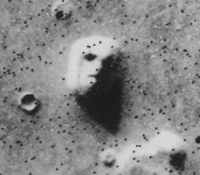
Martian face viking cropped. Photo: Viking 1, NASA / Wikimedia Commons. The canonical pareidolia image anchors the paragraph’s methodological point about ambiguous-stimulus pattern-recognition bias attacking Peratt’s…. Source
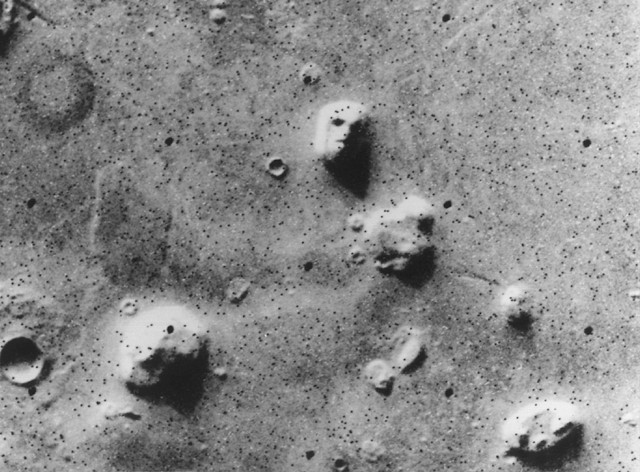
Martian face viking. Photo: Viking 1, NASA / Wikimedia Commons. The canonical pareidolia image anchors the paragraph’s methodological point about ambiguous-stimulus pattern-recognition bias attacking Peratt’s…. Source
The most exposed quantitative objections come from plasma physics itself. Birkeland currents linking the magnetosphere to the ionosphere are measured in megaamperes, while a Z-pinch producing the proposed petroglyph morphologies would require currents of 10¹¹–10¹² amperes — five to six orders of magnitude above present magnetospheric measurements, leaving a substantial energy-budget gap that the hypothesis has not closed. A second engineering-level mismatch concerns timescales: laboratory Z-pinch plasmas disassemble in 100 nanoseconds to 1 microsecond, while the hypothesis requires coherent plasma structures to remain stable and visible long enough to be perceived, remembered, and carved as petroglyphs — a gap of nine to twelve orders of magnitude between laboratory plasma lifetime and human-perception/carving timescales. The scaling premise that laboratory Z-pinch experiments can replicate Earth-sized plasma configurations is asserted only in a non-peer-reviewed compilation and has not been independently derived in primary plasma-physics literature. A further natural-experiment control weakens the assumed causal link between geomagnetic weakening and bursts of cultural activity: the Blake geomagnetic excursion around 125,000 years ago was comparable in duration and field-weakening magnitude to the Laschamps event, yet left no detectable cultural transition or extinction pulse in the archaeological record. Granito and colleagues, writing in 2022, offered a complementary sociological alternative — finding that motifs from contact Aboriginal groups were significantly more likely to be judged as intersubjectively recognizable than motifs from isolated groups, suggesting that demography and intergroup contact, rather than atmospheric events, shape pictorial figurativeness. [31]
What We Actually Know
The international recurrence of similar humanoid and geometric rock-art motifs across continents is a genuine, non-trivial empirical pattern that every reviewing angle in this investigation acknowledges, even as they disagree entirely about its cause. At the foundation of the hypothesis sits Anthony Peratt’s body of work at Los Alamos, published across two principal papers in IEEE Transactions on Plasma Science (December 2003, with a co-authored McGovern Part II in August 2007), proposing that many Neolithic and Early Bronze Age petroglyphs are direct depictions of high-current Z-pinch auroral plasma instabilities[2]. The supporting physical backdrop is well established: Birkeland currents flow into and out of Earth’s atmosphere at high latitudes with total magnitudes on the order of millions of amperes as routinely measured by today’s satellites, and cross-cultural auroral traditions independently treat these lights as spirits, death, and celestial battle across Norse, Sámi, Inuit, and Scottish ‘Merry Dancers’, with Aboriginal Australian traditions associating Aurora Australis’s generally red color with fire, death, and blood [32]. Aristotle and Seneca described aurora-like ‘Chasmata’ from Mediterranean latitudes, providing direct primary-text evidence for low-latitude atmospheric phenomena, and the April 2023 observation from Hanle, Ladakh at 33°N demonstrated that low-latitude auroral sightings can occur via red-light emissions at anomalously high altitudes produced by low-energy electron precipitation. Five precisely dated Miyake extreme solar proton events (7176 BCE, 5259 BCE, 664–663 BCE, 774–775 CE, 993–994 CE) plus the ~12,350 BCE candidate provide directly datable, global physical records of extreme space-weather episodes against which any petroglyph chronology could be checked.
The morphologically specific claims for the hypothesis are plausible but not yet established. Peratt’s mechanism identifies the ‘squatter man’ as a disk or donut-like torus around a linear discharge column bent by magnetic fields induced by intense current flow, producing the hourglass-like anthropomorphic silhouette, with ~84 distinct categories mapped to specific stages in Z-pinch time-evolution drawn from a database of several tens of thousands of digital petroglyph photographs from 139 countries roughly dated 10,000–2,000 BCE. A 14-cm motif at Teymareh, Iran has been independently identified in the Journal of Orthoptera Research as a six-legged creature with raptorial forearms from the genus Empusa based on a narrowing head extension, with the authors explicitly offering ‘auroras caused by atmospheric plasma discharges’ as a co-existing alternative for the flanking circles rather than a wholesale replacement for the mantis reading of the figure itself. Three principal competing explanations now stand on comparable evidentiary footing: direct depictions of intense auroral/plasma phenomena invoking the scaling principle that ‘plasma behaviour can be scaled across many orders of magnitude, so laboratory-scale Z-pinch experiments can replicate earth- and sky-sized plasma configurations’; entoptic/neuropsychological phenomena during altered states of consciousness, with archaeologically confirmed entheogen use at rock-art sites including Pinwheel Cave; and independent cultural convergence with shamanic projection as the mainstream position[33][29]. A 2024–2025 preprint by Ghander extends the morphological hypothesis with a ‘behavioral dimension,’ arguing that plasma’s quasi-agentive physical behavior would have produced in any observer a cognitive experience of encountering a responsive, volitional entity rather than a passive visual event, and direct AMS radiocarbon dating of rock-art paint layers has been demonstrated feasible via plasma oxidation at Eagle Cave, Texas, yielding paint dates clustering around 3280 BP. T-shaped pillars and anthropomorphic carvings from Göbekli Tepe and Tepecik Tarlas have been described as resembling a posture and iconography ‘reflected in iconography all around the world’.
The load-bearing premises of the hypothesis remain speculative. The quantitative physics objection is decisive: Birkeland currents are measured at megaampere scale today, while a Z-pinch producing the proposed petroglyph morphologies would require currents 5–6 orders of magnitude above current magnetospheric measurements. A fundamental timescale mismatch exists between laboratory Z-pinch plasmas, which disassemble on 100-nanosecond to 1-microsecond scales, and human-perception-and-carving timescales of minutes to hours, leaving a gap of 9–12 orders of magnitude unresolved in available sources. The scaling premise that licenses direct visual comparison between laboratory shadowgrams and petroglyphs is sourced only to a single non-peer-reviewed compilation and is not independently demonstrated in primary plasma-physics literature. The ‘cookie-cutter’ morphological correspondence across 139 countries rests on subjective visual matching without documented blind-testing, inter-rater reliability assessment, pre-registered matching protocol, or statistical control against pareidolia and selection bias, and the matching was ‘adjusted for line of sight’ by Peratt himself, introducing investigator degrees of freedom. The extension from petroglyphs to worldwide creation myths, claiming structural elements such as first light/sound, separation of sky and earth, and the sacred mountain/tree preserve ancient recollections of intense plasma phenomena, competes with Proto-Indo-European linguistic reconstruction and the entoptic three-stage progression and is sourced only to proponent material. The Cooper et al. (2021) causal cascade linking the Laschamps excursion to Neanderthal extinction and the eruption of figurative cave art is contested by a Technical Comment in Science, and Peratt’s extension to megalithic monuments including Stonehenge and the Majorville Medicine Wheel is not independently substantiated in any peer-reviewed source. [1]
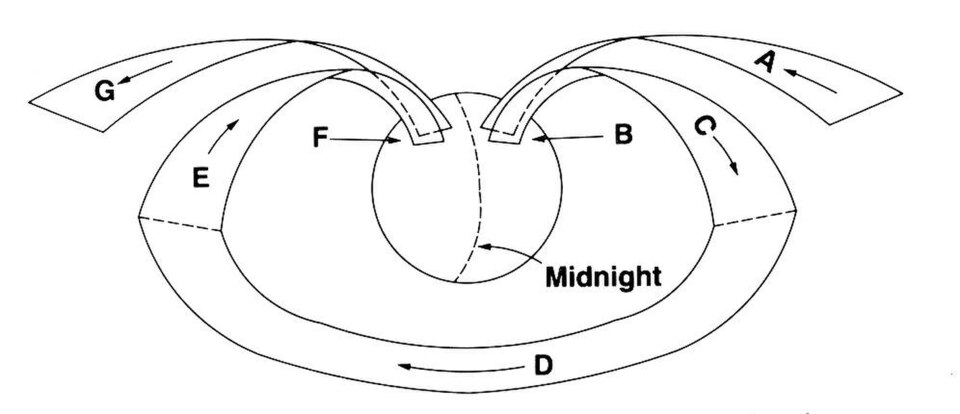
Birkeland current schematic. Photo: David Stern / Wikimedia Commons. Schematic of en:Birkeland currents. Source
References
[1] Peratt Instabilities, Plasma Columns, Z-Pinch. The Axis Mundi. — https://www.eixdelmon.com/peratt-instabilities-plasma-columns-z-pinch/ (accessed 2026-07-06)
[2] Characteristics for the occurrence of a high-current, Z-pinch aurora … — https://ieeexplore.ieee.org/document/1265340/1000 (accessed 2026-07-06)
[3] Anthony Lee Peratt - Los Alamos National Laboratory - Output — https://laro.lanl.gov/esploro/profile/anthony_peratt/output/all?institution=01LANL_INST (accessed 2026-07-06) [Academic]
[4] Characteristics for the Occurrence of a High-Current Z … — https://www.academia.edu/9156694/Characteristics_for_the_Occurrence_of_a_High_Current_Z_Pinch_Aurora_as_Recorded_in_Antiquity_Part_II_Directionality_and_Source (accessed 2026-07-06) [Academic]
[5] Plasma Scientists Find Ancient Petroglyphs Record Earth’s … — https://greenworldview.wordpress.com/2012/02/19/plasma-scientists-find-ancient-petroglyphs-record-earths-turbulent-past/ (accessed 2026-07-06)
[6] (PDF) Neolithic rock art associated with intense auroral currents — https://www.academia.edu/9156605/Neolithic_rock_art_associated_with_intense_auroral_currents (accessed 2026-07-06) [Academic]
[7] Teymareh petroglyphs edge closer to World Heritage Recognition — https://www.tehrantimes.com/news/499299/Teymareh-petroglyphs-edge-closer-to-World-Heritage-Recognition (accessed 2026-07-06)
[8] Teymareh Petroglyphs, One of the World’s Largest Rock Art … — https://arkeonews.net/teymareh-petroglyphs-one-of-the-worlds-largest-rock-art-collections-at-risk-of-disappearing-due-to-mining-activities/ (accessed 2026-07-06)
[9] Rock art in Iran - Wikipedia — https://en.wikipedia.org/wiki/Rock_art_in_Iran (accessed 2026-07-06) [Reputable]
[10] Ancient Civilizations Tried To Tell Us Something We Ignored [2:00-4:00] — Universe Inside You (YouTube) — https://youtu.be/mNM0cFWzVhs?t=120 (accessed 2026-07-06)
[11] Bifröst - Wikipedia — https://en.wikipedia.org/wiki/Bifr%C3%B6st (accessed 2026-07-06) [Reputable]
[12] Bifrost: The Rainbow Bridge in Norse Mythology — https://reykjaviknorthernlights.is/blog/bifrost (accessed 2026-07-06)
[13] History of the Northern Lights: myths and legends — https://www.hurtigruten.com/en-us/explore-norway/northern-lights/myths-legends (accessed 2026-07-06)
[14] 7 Mystical Tales Behind the Northern Lights — https://www.icelandia.com/inspiration/7-mystical-tales-behind-the-northern-lights (accessed 2026-07-06)
[15] Northern Lights Myths and Legends - Runaway Juno — https://runawayjuno.com/runaway-tales/northern-lights-myths-and-legends/ (accessed 2026-07-06)
[16] Legends of the Aurora Borealis | Frontiers North Adventures — https://frontiersnorth.com/inspiration/blog/legends-of-the-aurora/ (accessed 2026-07-06)
[17] Aurora in Eskimo Legend | Geophysical Institute — https://www.gi.alaska.edu/alaska-science-forum/aurora-eskimo-legend (accessed 2026-07-06) [Academic]
[18] Wandjina | Encyclopedia.com — https://www.encyclopedia.com/environment/encyclopedias-almanacs-transcripts-and-maps/wandjina (accessed 2026-07-06)
[19] Wandjina Art & Paintings - Kimberley WA - Japingka Gallery — https://japingkaaboriginalart.com/articles/wandjina/ (accessed 2026-07-06)
[20] Wandjina - Wikipedia — https://en.wikipedia.org/wiki/Wandjina (accessed 2026-07-06) [Reputable]
[21] Wandjina - Myth and Folklore Wiki - Fandom — https://mythus.fandom.com/wiki/Wandjina (accessed 2026-07-06)
[22] 15 Traditional Tales About the Northern Lights | Folklore — https://www.nathab.com/blog/fifteen-native-tales-about-the-northern-lights (accessed 2026-07-06)
[23] 774–775 carbon-14 spike — https://en.wikipedia.org/wiki/774–775_carbon-14_spike (accessed 2026-07-06) [Reputable]
[24] Wandering of the auroral oval 41,000 years ago - PMC — https://pmc.ncbi.nlm.nih.gov/articles/PMC12002135/ (accessed 2026-07-06) [Academic]
[25] Geomagnetic Storms | NOAA / NWS … — http://www.spaceweather.gov/phenomena/geomagnetic-storms (accessed 2026-07-06) [Academic]
[26] Shumla’s Chemistry Lab Part II: Radiocarbon Dating Eagle Cave … — https://shumla.org/shumla-chem-lab-part-2/ (accessed 2026-07-06)
[27] (PDF) Squatting (squatter) mantis man: A prehistoric … — https://www.researchgate.net/publication/339925389_Squatting_squatter_mantis_man_A_prehistoric_praying_mantis_petroglyph_in_Iran (accessed 2026-07-06)
[28] The timing of the ca-660 BCE Miyake solar-proton event constrained … — https://www.nature.com/articles/s43247-024-01618-x (accessed 2026-07-06) [Academic]
[29] Datura quids at Pinwheel Cave, California, provide … — https://www.pnas.org/doi/10.1073/pnas.2014529117 (accessed 2026-07-07) [Academic]
[30] Ancient mantis-man petroglyph discovered in Iran — https://www.sciencedaily.com/releases/2020/03/200316090338.htm (accessed 2026-07-06)
[31] Laschamps Excursion: When Earth’s Field Collapsed - Geoscopy — https://geoscopy.com/laschamps-excursion-when-earths-field-collapsed/ (accessed 2026-07-06)
[32] Duane W. Hamacher (2013). AURORAE IN AUSTRALIAN ABORIGINAL TRADITIONS. Journal of Astronomical History and Heritage. DOI: 10.3724/sp.j.1440-2807.2013.02.05 (accessed 2026-07-06)
[33] Archaeologists uncover evidence of psychedelics use at … — https://news.uoregon.edu/content/archaeologists-uncover-evidence-psychedelics-use-cave-site (accessed 2026-07-07) [Academic]
Keep exploring
Every site on this page sits on the globe, and the people who research them are on the Discord.
3D Globe · Sites by country · Story Archive · Research Library · Weekly Journal · Search