 ANCIENT NERDS
The Enuma Elish, Tiamat, and the Sitchin Nibiru Controversy
This paper concludes that the cuneiform evidence does not support Zacharia Sitchin's interpretation of the Enuma Elish as describing a destroyed planet (Tiamat) shattered by a twelfth planet (Nibiru/Marduk) inhabited by extraterrestrial Anunnaki. Across all surviving recensions, Tiamat is consistently a primordial goddess of salt water and chaos whose dismemberment forms the cosmos through standard Mesopotamian cosmological template, while Nibiru is a flexible astronomical term applied variously to Jupiter, Mercury, the pole star, or the autumnal equinox—none of Sitchin's specific claims. The argument against Sitchin is that his reading, while structurally suggestive, simply does not match what the texts actually say.
On clay tablets compiled around 1000 BCE and known as MUL.APIN, Babylonian astronomers listed a celestial body they called Nibiru—and most often identified it with Jupiter , the slowest of the visible planets to cross the night sky. In the Enuma Elish, the same civilization staged a stranger drama: Tiamat, the primordial goddess of salt water ; her consort Apsu, who first plotted against the younger gods because their noise disturbed his rest ; and Marduk, who volunteered to dispatch her with arrows, winds, and a net , then split her body in two to make the sky, the earth, and the rivers . [1]
What the Enuma Elish and Tiamat Actually Describe
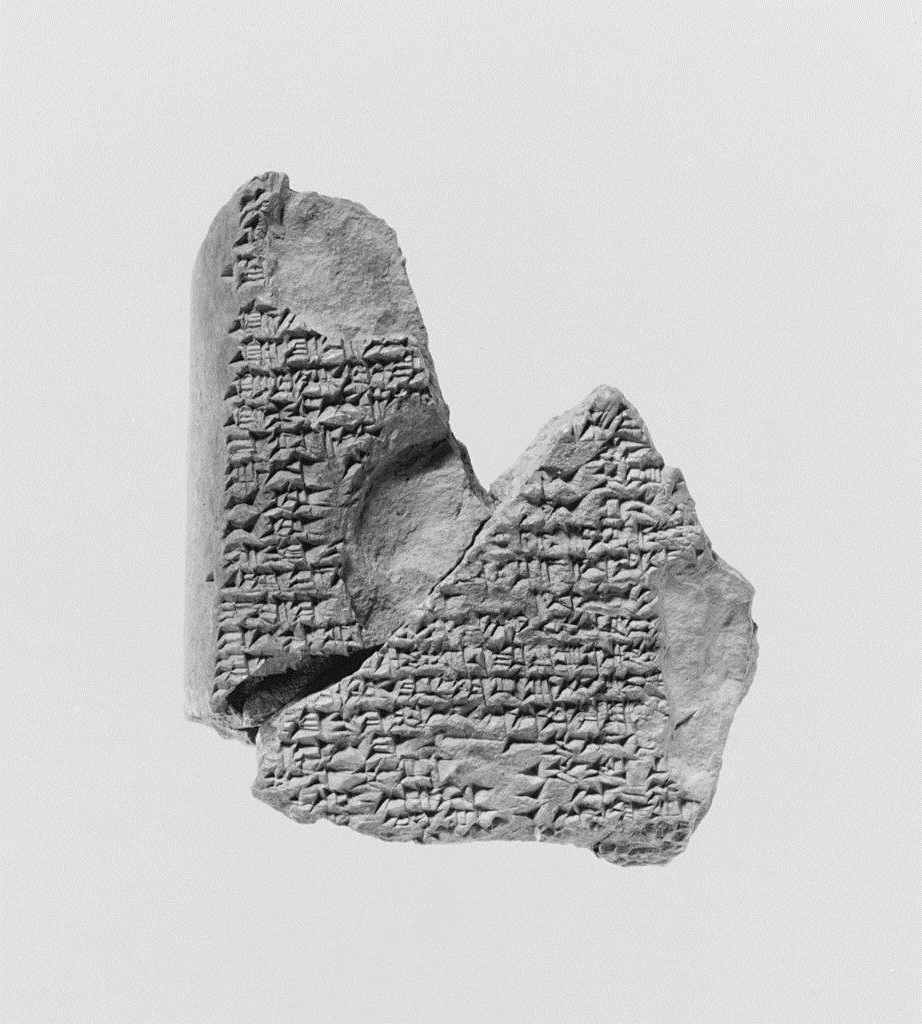
The Enuma Elish opens not with a planet but with water — specifically, two primordial waters named Apsu and Tiamat, whose commingling produced the first generation of younger gods. Tiamat is the goddess of salt water, paired with the freshwater god Apsu; her name derives from the Akkadian tiamtum, simply meaning “sea”. She is described consistently across translations as a primordial mother figure of chaos, not as a destroyed planet or any celestial body. The surviving seven clay tablets, totaling roughly 1,000 lines in Akkadian, were recovered in fragmentary form by Austen Henry Layard in 1849 from the Library of Ashurbanipal at Nineveh and first published by George Smith in 1876. The earliest attestation of Tiamat as a divine entity actually predates the Enuma Elish — she appears in an Old Akkadian incantation from the Sargonic period (ca. 2334–2154 BCE), invoked alongside the warrior god Tišpak as the “steward of Tiamat”. 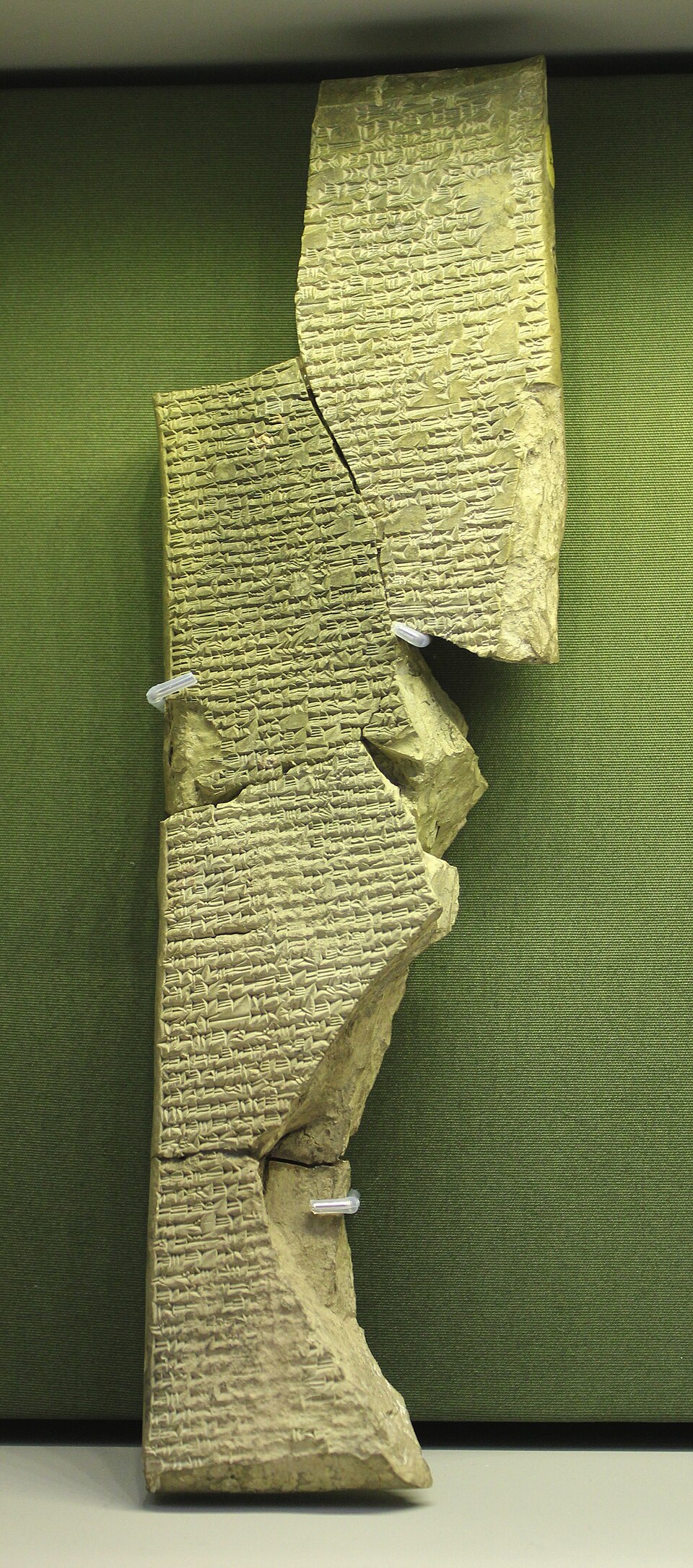 [1] [2]
Enuma Elish K.3473. Photo: Zunkir / Wikimedia Commons. Image placed by the paper writer as visual evidence for this passage. Source
In Tablet I, after Ea kills Apsu, Tiamat creates exactly eleven composite monsters — named in the surviving cuneiform as Bašmu, Ušumgallu, Mušmaḫḫū, Mušḫuššu, Laḫmu, Ugallu, Uridimmu, Girtablullû, Umū dabrūtu, Kulullû, and Kusarikku, creatures with poison for blood instead of blood — and installs her new consort Kingu as their commander, giving him the Tablet of Destinies. Marduk volunteers to fight Tiamat only on the condition the gods proclaim him supreme ruler; after trapping her with a net and the four winds and shooting an arrow that pierces her heart, he splits her body in two “like a dried fish”. The upper half becomes the heavens; the lower half becomes the earth. The Tigris and Euphrates flow from her eyes, mountains form from her udder, her ribs become gates — a cosmogonic dissection of a slain goddess, not a planetary collision. From the blood of Kingu, mixed with clay, Marduk then creates humanity explicitly to relieve the gods of labor. The poem ends with a litany of fifty names bestowed upon Marduk by the assembled gods, sealing his elevation. 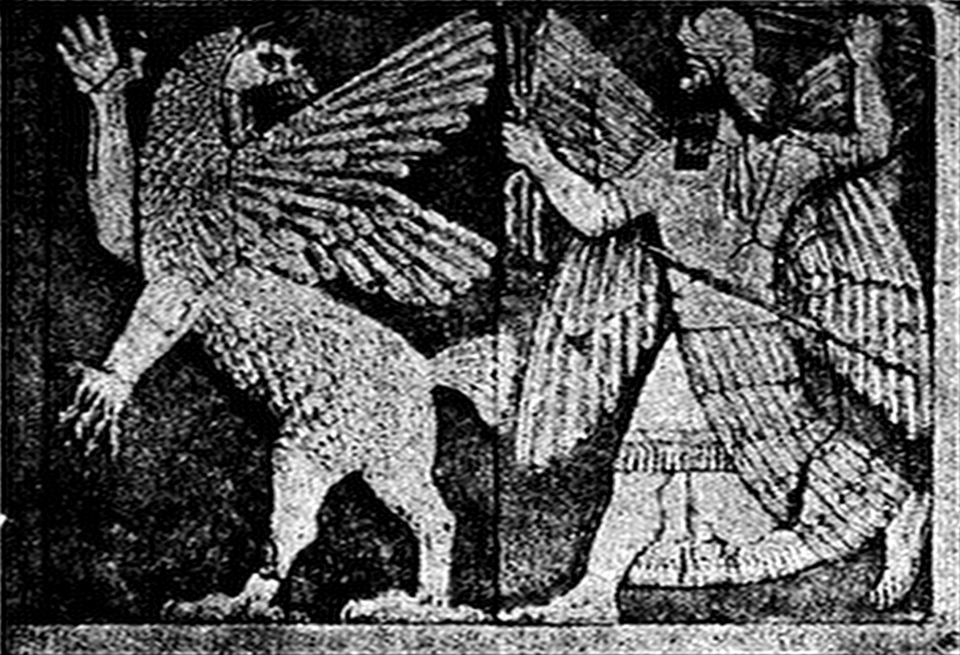 [3] [4]
Bildhuggarkonst, Marduks strid med draken, Nordisk familjebok. Photo: Wikimedia Commons. Image placed by the paper writer as visual evidence for this passage. Source
The “Anunnaki” of the Enuma Elish are not visitors from another world. They are a class of great gods within the Mesopotamian pantheon — the Sumerian Anuna, meaning “princely seed” or “royal offspring” of the sky god Anu. In Tablet I, when Tiamat elevates Kingu, she declares his word “shall prevail over all of them the Anunnaki” — referring to the great gods of the assembly, not alien astronauts. The text’s primary function is theogonic: it legitimizes Marduk’s rise to kingship over the Babylonian pantheon, positioning him as son of Ea/Enki of Eridu and transferring Eridu’s “first city” prestige to Babylon. This political-theological purpose is confirmed by the late Assyrian recensions, which simply substitute the national god Ashur for Marduk as the champion. The poem was recited annually at the Akitu (Babylonian New Year) festival, where the high priest of Bel-Marduk’s Esagil temple read the entire epic from beginning to end before Marduk’s statue. Mainstream Assyriology reads the Enuma Elish within the standard Chaoskampf combat-myth pattern attested across Sumerian, Babylonian, Ugaritic, Hurro-Hittite, Egyptian, and Israelite literature — a young storm/cosmic-order god defeating a primordial sea monster to establish ordered creation, not as encoded astronomy or an ancient-astronaut narrative. [5]
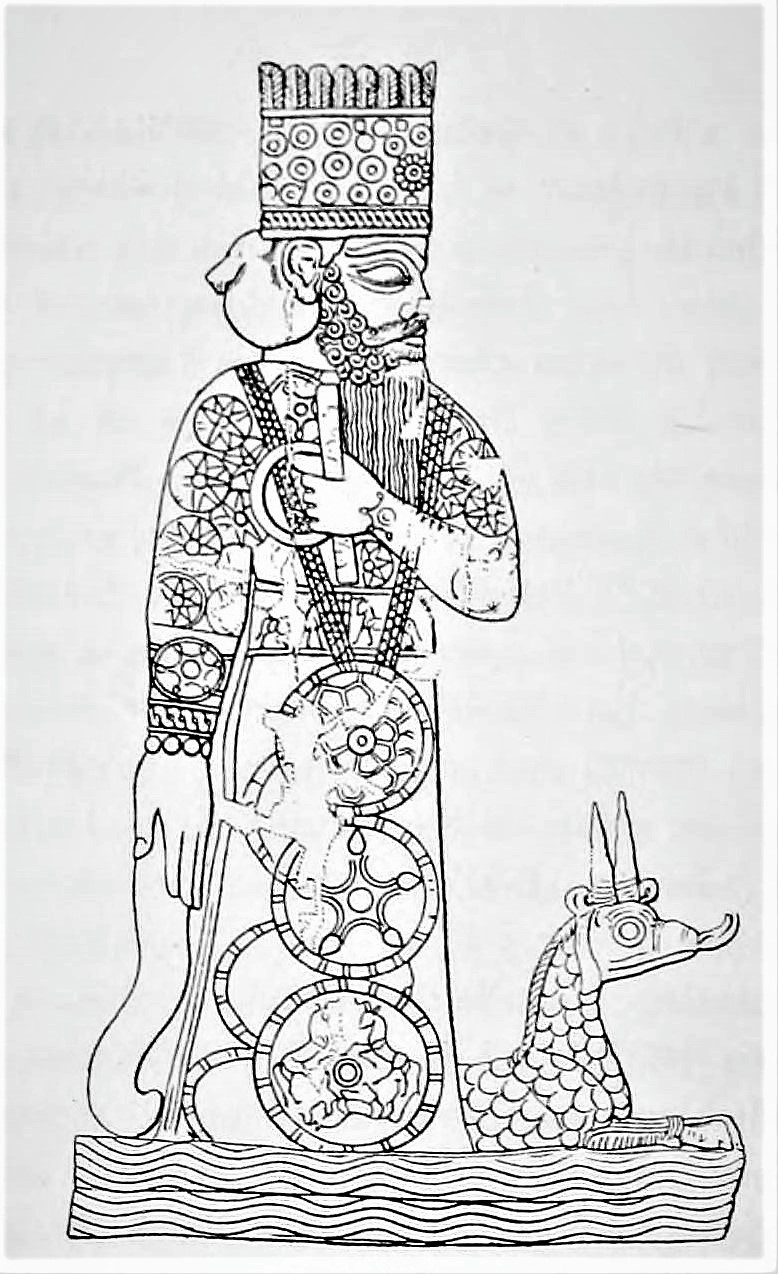
Marduk and pet. Photo: Franz Heinrich Weißbach / Wikimedia Commons. Concrete visual evidence of the festival context demonstrates that the Enuma Elish was a state…. Source
The Enuma Elish contains no reference to a destroyed planet, a 12th planet, or any extraterrestrial body. Tiamat is consistently a primordial salt-water goddess throughout. The term “Nibiru” appears in the text only in Tablet VII (lines 124–131), and there it designates Marduk’s star tasked with fixing celestial stations and shepherding the planetary paths — not a destroyed world, not a 12th member of the solar system, and not an extraterrestrial homeworld. In Babylonian astronomical compendia like MUL.APIN (ca. 1000 BCE), Nibiru is identified primarily with the planet Jupiter (Marduk’s star) and occasionally Mercury; the Akkadian term derives from ebēru, “to cross over,” referring to a celestial crossing-point. The alternative reading — Zecharia Sitchin’s claim, articulated in The 12th Planet (1976), that Tiamat was a planet between Mars and Jupiter destroyed by a collision with Nibiru, and that the Anunnaki were alien genetic engineers who crossed their DNA with Homo erectus to create humans — is explicitly characterized in mainstream scholarship as pseudoscience and pseudohistory, with documented errors in his translations of terms like “Anunnaki” (mainstream: “princely seed”; Sitchin: “those who from heaven to earth came”) and “shem” (mainstream: “name”; Sitchin: “rocket”). The only direct critique of Sitchin’s philological competence cited in the provided sources is a popular YouTube lecture by Matthew LaCroix, who states that Sitchin “didn’t know how to read Sumerian, Akkadian, Babylonian” — a charge from within the alternative-history milieu itself, not from peer-reviewed Assyriology, but echoed by biblical scholar Michael S. Heiser’s dedicated SitchinIsWrong.com critique. The most striking finding is therefore the gap between what the cuneiform actually contains — a 1,000-line political hymn to Marduk composed in the second millennium BCE, recovered in 1849, and read consistently as theogonic literature for over 150 years — and the planetary-collision framework that has been projected onto it since 1976. [6] [7]

Cuneiform tablet- Atrahasis, Babylonian flood myth MET 266811. Photo: Wikimedia Commons. Babylonian or Achaemenid; Cuneiform tablet; Clay-Tablets-Inscribed. Source
Sitchin’s Planetary Reading of the Creation Epic
The Enuma Elish opens Tablet I with a genealogical scene that has generated two fundamentally incompatible readings. In the standard Akkadian, Apsu and Tiamat are primordial cosmic waters — Apsu the freshwater father, Tiamat the saltwater mother — whose commingled waters produce Lahmu, Lahamu, Anshar, Kishar, Anu, and Nudimmud (Ea) in sequence. Tiamat, after her consort Apsu is killed by Ea, creates eleven kinds of monsters and elevates her son Kingu as champion; Marduk then defeats her in combat and splits her body to form the sky and earth, with the Tigris and Euphrates flowing from her eyes. The narrative is a theogonic battle culminating in cosmogonic construction — not an astronomical event. [8]
Zecharia Sitchin, publishing The 12th Planet, recast every figure in this drama as a physical body in a planetary collision. Apsu became the Sun; Mummu became Mercury; Tiamat became a primordial planet located between Mars and Jupiter; Lahmu and Lahamu became Mars and Venus; Anshar and Kishar became Saturn and Jupiter; Anu became Uranus; Nudimmud (Ea) became Neptune; and Marduk became a trans-Plutonian “twelfth planet” called Nibiru. In this reading, Nibiru’s satellites strike Tiamat, splitting her body so that one half becomes Earth (the “seventh planet” counted outward from Nibiru), the other half becomes the asteroid belt, and Tiamat’s chief satellite Kingu becomes the Moon. Sitchin assigned Nibiru a highly elliptical 3,600-year orbit. [9]
In the prologue to The 12th Planet, Sitchin writes that he takes the Enuma Elish “at face value” as a “statement of cosmologic facts as known to the Sumerians, as told them by the Nefilim” — a hermeneutic stance that places his work outside the conventional Assyriological framing of the text as Babylonian theological-political literature glorifying Marduk’s supremacy. Sitchin’s academic credentials for the work he claimed to do are disputed or absent — his university training was in economic history (London School of Economics) and he worked as a journalist and editor in Israel, not as a trained Assyriologist; no verified degree-level credential in Sumerian or Akkadian has been produced. The critics who have documented the philological problems include Michael S. Heiser, who holds a Ph.D. in Hebrew Bible and Ancient Semitic Languages. [10]
Nibiru, in actual Babylonian astronomical texts — most prominently the MUL.APIN compendium — refers to a celestial body associated with the god Marduk, most commonly identified with Jupiter, occasionally with Mercury, or to a “crossing point” / “ferry point” of celestial orbits. The term is connected to the concept of crossing or ferrying, and in scholarly readings it denotes a celestial ‘crossing point’ / ‘ferry point’ of orbits. No cuneiform attestation places Nibiru as a trans-Plutonian 12th planet on a 3,600-year orbit. The Anunnaki, in the same textual record, are a group of deities descended from An (sky) and Ki (earth), functioning as judges of the dead or members of the great divine assembly; nothing in the cuneiform corpus suggests an extraterrestrial origin, habitation of a planet called Nibiru, or involvement in human genetic engineering. [11]
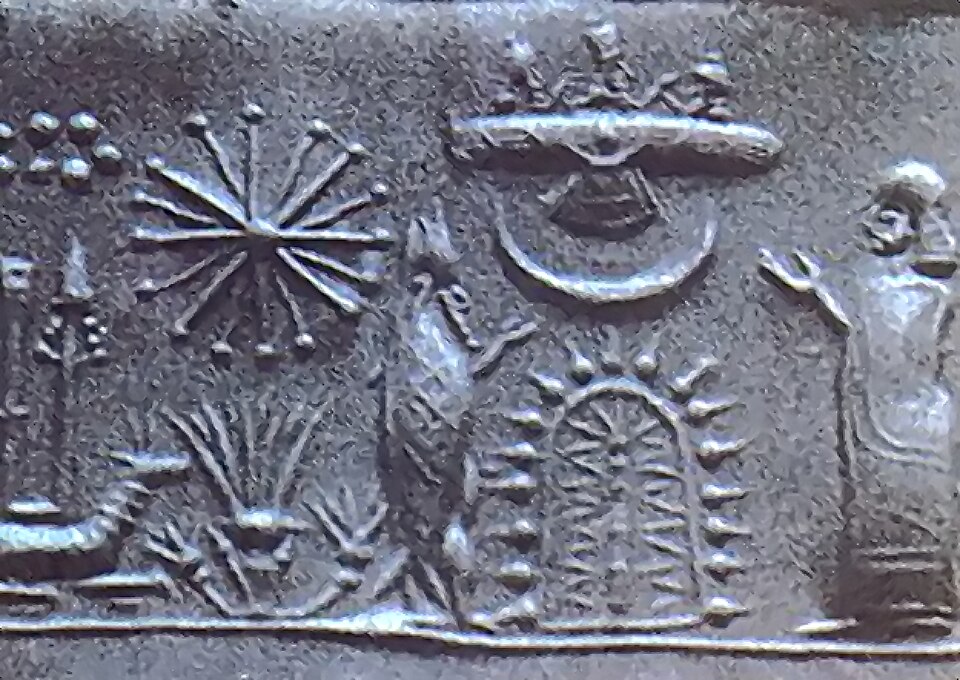
Mesopotamian cylinder seal impression. Photo: The original uploader was IronyWrit at English Wikipedia. / Wikimedia Commons. Image placed by the paper writer as visual evidence for this passage. Source Sitchin’s principal inscriptional evidence is cylinder seal VA 243, which he reads as a depiction of the solar system’s twelve bodies. This interpretation is described as incorrect by mainstream Assyriologists and ancient-language specialists.
Nibiru in Babylonian Astronomical Texts
The word “Nibiru” entered cuneiform studies carrying baggage it never earned. The term is Akkadian, derived from the verb ebēru meaning “to cross over” or “to ferry,” and translates literally as “crossing,” “ford,” “ferry,” or “point of transition”. The Chicago Assyrian Dictionary documents attestations of neberu in mundane contexts, including geographical river crossings, ferry fees, and place names. In Babylonian usage, Nibiru could simply mean a river crossing or a ferryman, not a planetary body. [6] [7] [12] [13]
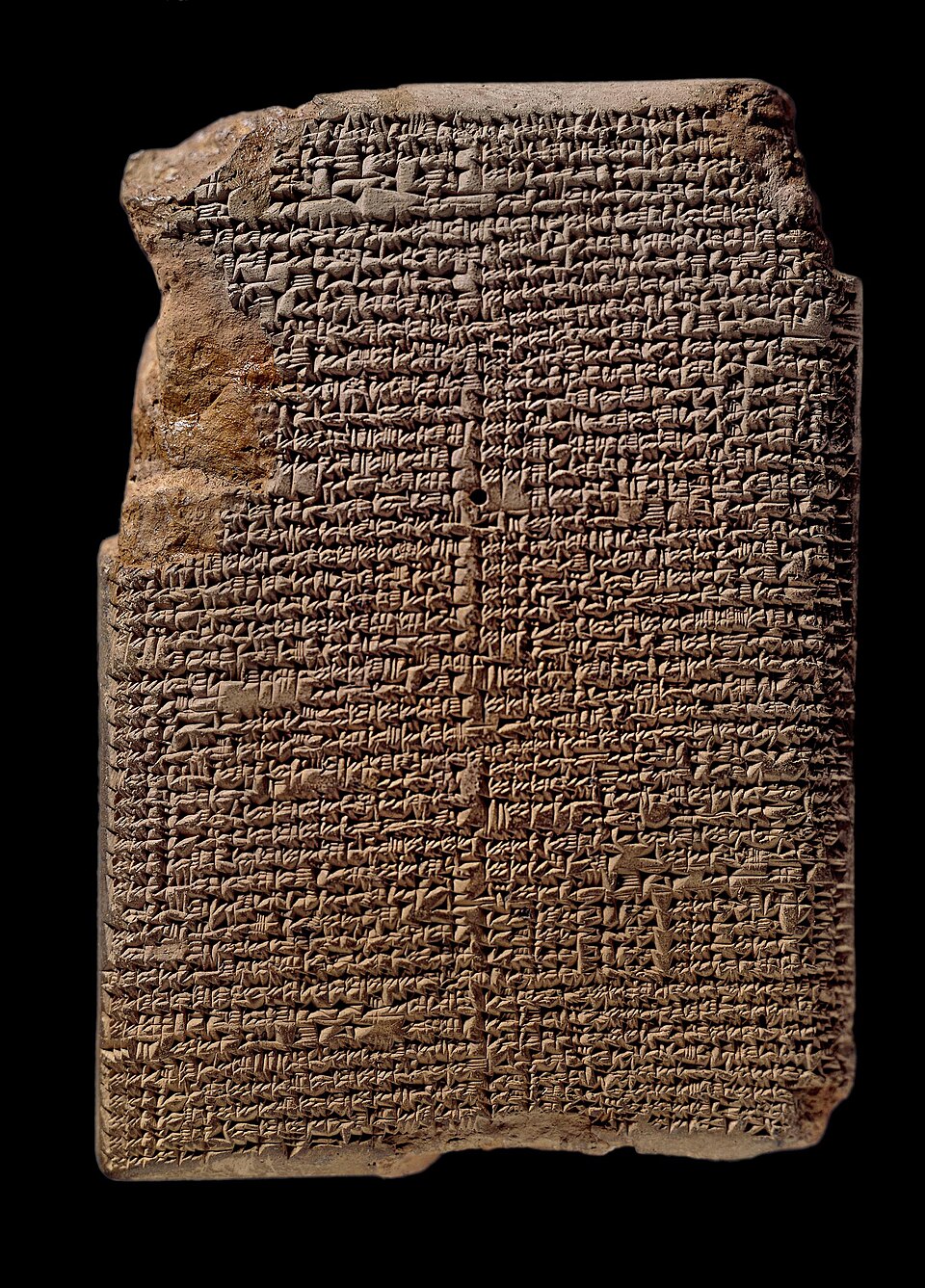
MulApin-BritishMuseum. Photo: British Museum / Wikimedia Commons. Image placed by the paper writer as visual evidence for this passage. Source
The MUL.APIN compendium, compiled around 1000 BCE but incorporating observations dated to roughly 1370 ± 100 BCE at latitude 35.1° N, makes the term’s astronomical application explicit. At lines I.i 36–38, the text identifies Nibiru directly with Jupiter (SAG.ME.GAR), describing it as a star that “divides the sky in half and stands there” at the boundary between the paths of Enlil and Anu, and labels it the star of Marduk. Mainstream Assyriology, including Francesca Rochberg’s work, treats this Jupiter-Marduk identification as the dominant referent because of the consistent pairing in the omen literature. The compendium’s empirical observations, not mythic narrative, anchor the term in the regular motion of the brightest visible “King Star” of the Babylonian sky. [6] [7] [14]
The Enuma Elish reinforces rather than contradicts that identification. Tablet VII, line 124 declares Nibiru as one of Marduk’s fifty names, glossed in Akkadian as “let (the star) Neberu be in control of the crossing places of the sky and of the earth”. The function described is station-keeping at a celestial juncture — a fixed reference point where other bodies pause — not a destructive planet on a 3,630-year orbit. The Epic’s other central figure, Tiamat, fares no better as a planet candidate: she is the primordial goddess of salt-water chaos whose body Marduk splits to form the heavens and earth, with the Tigris and Euphrates flowing from her eyes and her tail arched overhead as the Milky Way. W. G. Lambert, the leading 20th-century scholar of the text, characterized it bluntly as “a theological document designed to establish Marduk’s supremacy over the other gods of the Mesopotamian pantheon,” not a scientific cosmogony. The humans the text describes Marduk creating come from the blood of Kingu, Tiamat’s general, mixed with clay to serve as laborers for the gods. [6] [15] [16]
Zecharia Sitchin built his framework on a different reading. In The 12th Planet (1976), Sitchin interpreted the Anunnaki as having “hailed from a world apart, a wandering planet the Sumerians called Nibiru”. Sitchin proposed that Nibiru had a highly elliptical 3,630-year orbit as the twelfth member of the solar system, and that its collision with a planet called Tiamat (placed by Sitchin between Mars and Jupiter) destroyed Tiamat and formed Earth, the asteroid belt, and the Moon; Sitchin attributed his orbital figures to Maya astronomers. He further claimed the Anunnaki genetically engineered Homo sapiens by crossing Anunnaki and Homo erectus DNA to produce slave workers for gold mining, motivated by the need for gold particles to repair Nibiru’s atmosphere. In Sitchin’s reading, the slain Tiamat becomes a watery planet between Mars and Jupiter whose destruction by Nibiru formed Earth, the asteroid belt, and the Moon. Mainstream scholarship has rejected this on every front. [9]
Michael S. Heiser’s systematic review found no cuneiform text in the entire corpus that identifies Nibiru as a planet beyond Pluto, connects it with the Anunnaki, or describes a 3,630-year orbital cycle. The roughly 15,000 cuneiform lexical lists compiled by Mesopotamian scribes themselves preserve the conventional meanings of these terms and would have refuted Sitchin’s translations had he consulted them. Dynamical astronomy adds a simpler test: a body on the orbit Sitchin described would destabilize the inner solar system within a few revolutions and should have been naked-eye visible to any observer on Earth by 2012 — and no such object has been reported. [17] [18]
The cuneiform record also exposes the elasticity of the Anunnaki claim. A late Babylonian fragment, K.6174 line 9’, reads: “If Mercury divides the sky and remains there, its name is Nibiru” — demonstrating that the term was applied to whichever visible planet happened to occupy a particular celestial crossing. The Anunnaki themselves, in actual Sumerian and Akkadian sources, are a major group of deities — “the princely or royal offspring of Anu” — not extraterrestrials; in the Atrahasis myth cycle they appear alongside the Igigi as junior and senior divine cohorts. The most comprehensive review of the cuneiform evidence concludes that Nibiru is called a star in the texts, identified “nearly always” with Jupiter-Marduk, only once with Mercury, and “never anything beyond Pluto or the known planets”. Sitchin’s planet is a modern construction, projected onto texts that record empirical Babylonian astronomy and Marduk-centered theology. [19]
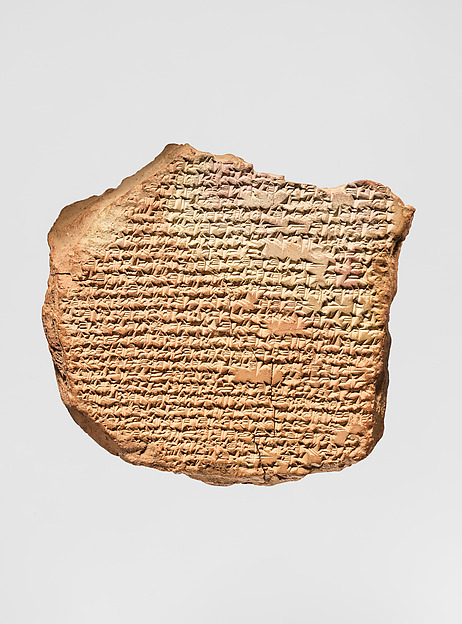
Cuneiform tablet: hymn to Marduk. Photo: The Met / Open Access. concrete textual evidence of the Marduk-centered theological tradition in Babylonian cuneiform, supporting the claim that…. Source
Mainstream Assyriology’s Rejection of Sitchin
Zecharia Sitchin (1920–2010) published The 12th Planet in 1976, launching the Earth Chronicles series with a sweeping claim: the Anunnaki were extraterrestrials from a twelfth planet called Nibiru, traveling on a 3,600-year elliptical orbit to mine gold on Earth, and their leader Enki genetically engineered modern humans by combining Anunnaki DNA with Homo erectus. The books sold millions of copies, but the professional response was immediate and uniform. Mainstream Assyriologists, Sumerologists, Orientalists, and anthropologists resoundingly rejected the work as pseudoscience and pseudohistory, citing flawed methodology, mistranslations of cuneiform, the ignoring of archaeological and historical evidence, and incorrect astronomical claims. Sitchin’s training was as a journalist and economic historian, not a credentialed specialist in the ancient Near East. That distinction matters, because the debates over his work turn on philology, astronomy, and tradition-history — fields in which his formal credentials were absent. [20] [21] [22] [23]
The first collision point is the Anunnaki themselves. In actual cuneiform sources, the Anunnaki (Sumerian Anuna; Akkadian Anunnaki) are a category of deities understood as the “princely offspring” or “offspring of An,” the sky god — anthropomorphic members of the Mesopotamian pantheon, not extraterrestrials. Their primary function in Sumerian literature was to decree the fates of humanity and serve as divine judges; in Inanna’s Descent into the Netherworld they appear as seven judges of the underworld. The group is inconsistent across texts — one composition names as many as fifty Anunnaki associated with Eridu, while another names only seven — and no complete roster has survived. No archaeological evidence of a collective Anunnaki cult or group iconography has been unearthed; each Anunnaki deity had an individual cult and city patron. The popular translation of the name as “those who from heaven to Earth came” — a Sitchin-style folk etymology — contradicts the mainstream derivation meaning “offspring of An”. That translation, not the cuneiform evidence, is what drives the modern association with Planet X and ancient astronauts. [24] [25]
The second collision point is the astronomical term Sitchin built his hypothesis on. Biblical scholar Michael S. Heiser, who maintained the “Sitchin Is Wrong” site, systematically examined every cuneiform occurrence of the word Nibiru and reached a categorical conclusion: in actual Mesopotamian texts, the term refers to the planet Jupiter, occasionally Mercury, the god Marduk, or a generic star — never to a hidden planet beyond Pluto. Jupiter was the largest visible planet to Mesopotamian observers, called the “King Star” and associated with the god Marduk, its movements tracked in the comprehensive omen series Enūma Anu Enlil, which contains over 7,000 omens. The Sumerian cosmological scheme mapped specific celestial bodies to specific deities — Inanna to Venus, Utu to the Sun, Nanna to the Moon, Marduk to Jupiter, An to equatorial stars, Enlil to northern stars, and Enki to southern stars — with no slot for a “twelfth planet” or trans-Plutonian body. The MUL.APIN compendium, composed between 1200 and 1000 BCE, divides the heavens into three structured paths (Enlil, Anu, Ea) and catalogs approximately 71 stars and constellations; it contains no reference to Nibiru as a hidden body. A planet with a 3,600-year elliptical orbit, as Sitchin described, would gravitationally destabilize the inner solar system on geological timescales, and if it were currently near perihelion would already be visible to the global amateur astronomical community — yet no such object has ever been observed. The 1984 Astrophysical Journal Letters infrared survey paper repeatedly cited by Nibiru proponents as evidence of an unknown planet was followed up, and the “no counterpart” sources were resolved as distant galaxies, not planets. [18] [26]
But the deepest collision is over Sitchin’s signature reading of the Enuma Elish, the Babylonian creation epic on seven tablets composed no later than the reign of Hammurabi (1792–1750 BCE) and discovered in 1876 among the tablets of Ashurbanipal’s library at Nineveh. In the actual cuneiform text, Tiamat is a primordial goddess of the salt waters — paired with Apsu, the freshwater god — whose mingled waters give birth to the younger gods. Marduk does defeat Tiamat in combat, but he splits her body into two halves to form the heavens and the earth, with the Tigris and Euphrates flowing from her eyes — a cosmogonic act, not a description of a destroyed planet. Humanity in the epic is created not by genetic engineering but from the blood of Kingu, Tiamat’s defeated commander, in order to relieve the gods of their labor burden. The Atrahasis epic gives a parallel etiology: the Igigi, a junior generation of gods, rebel against the Anunnaki’s labor demands, and the god Enki creates humans from clay mixed with a slain god’s blood to replace them. W. G. Lambert, one of the foremost Assyriologists of the twentieth century and editor of the standard critical edition of the Enuma Elish, demonstrated that the composer adapted older Sumerian traditions about the god Ninurta slaying a monster and recast them around Marduk — a literary-religious composition legitimizing Marduk’s kingship over the older Sumerian/Akkadian gods and Babylon’s political-cultural hegemony, not an account of planetary destruction. The Chaoskampf motif — a god-versus-chaos combat resulting in creation — recurs across the ancient Near East (Babylon, Ugarit, Hebrew Bible, Hurro-Hittite), and subsequent scholarship (Gunkel, Watson, Rackley) reads it as functioning primarily to legitimate kingship rather than to record astronomical events. Sitchin’s parallel reading — that the Enuma Elish encodes a planetary collision in which Nibiru shattered Tiamat into Earth and the asteroid belt — is an interpretation overlaid on the cuneiform text by Sitchin in 1976, not a reading derived from the texts themselves. [3] [4]
Sitchin’s broader method depended on mistranslating key Sumerian and Akkadian terms, taking mythological figures as literal extraterrestrials, and misreading the lexical and astronomical record. His rendering of the Hebrew nephilim as “those who came down” or “people of the fiery rockets” has been characterized as linguistically impossible given the Hebrew philology. His pairing of Gilgamesh’s description as “two-thirds divine and one-third human” with the 1987 mitochondrial-DNA “Mitochondrial Eve” research, arguing Gilgamesh would have inherited his goddess-mother Ninsun’s distinct mitochondrial DNA, treats a poetic convention as a literal genetic signature. The competence question is direct: speakers at ancient-civilization lectures and mainstream critics state that Sitchin did not in fact know how to read Sumerian or Akkadian, contrary to his publishers’ marketing. Heiser’s critique of Sitchin’s call for DNA testing of ancient Mesopotamian remains characterized the proposal as scientifically untestable. The evidence resolves the core questions cleanly: Nibiru in cuneiform sources refers to Jupiter or Marduk, not a trans-Plutonian planet; the Anunnaki are a divine category descended from An, not an alien species; the Enuma Elish is a theogony/cosmogony legitimizing Marduk’s kingship, not an astronomical record. What remains unresolved is why, in the face of that evidence, the Sitchin synthesis continues to attract adherents in popular media — a question that belongs less to cuneiform scholarship than to the sociology of alternative history. [21] [27] [28]
Connecting the Dots
In the Enuma Elish, fresh water (Apsu) and salt water (Tiamat) open the cosmos as primordial waters whose commingling produces the younger gods. Tiamat’s name derives from the Akkadian word tiamtum, “sea” — she personifies the primordial salt sea and is associated with chaos, not any planetary body. After Marduk defeats her, her body becomes raw material for constructing sky, earth, rivers, and mountains: a cosmogonic dissection following a theogonic battle, with no reference to a destroyed planet in the surviving text. The Anunnaki appear in the Enuma Elish as a category of deities — 600 of the underworld and 300 of heaven in a late recension — assigned positions by Marduk, anthropomorphic gods of the Mesopotamian pantheon rather than extraterrestrials. The text was composed in Akkadian on seven tablets in the late 2nd millennium BCE, recovered primarily from Ashurbanipal’s library at Nineveh and first published by George Smith in 1876, and served the primary purpose of elevating Marduk as patron of Babylon above other Mesopotamian gods. [16] [29] [30]
Sitchin’s re-reading maps these same divine figures onto a planetary system: Apsu becomes the Sun, Tiamat a primordial planet shattered by an invading “twelfth planet” called Nibiru, with Marduk’s satellites smashing Tiamat so that one half becomes Earth, the other the asteroid belt, and Tiamat’s satellite Kingu becomes the Moon. This translation does not survive contact with the cuneiform record. The attested Mesopotamian astronomical texts pair Jupiter with Marduk as the “King Star” and Venus with Ishtar, but the specific god-to-planet equations Sitchin proposes — Apsu=Sun, Anshar=Saturn, Kishar=Jupiter, Anu=Uranus, Tiamat=primordial planet — do not match the attested Mesopotamian god=planet lists. In MUL.APIN (ca. 1000 BCE), Nibiru is explicitly equated with Jupiter (SAG.ME.GAR), the “star of Marduk, the Ford”. Outside astronomy the Akkadian word denoted geographical river crossings, ferry fees, ferry-boats, and place names — never a trans-Plutonian planet. Sitchin was an economics journalist and shipping industry executive who taught himself to read cuneiform; no verified degree-level credential in Sumerian or Akkadian is attested. [17]
Where the Enuma Elish does invoke celestial phenomena, it describes order, not catastrophe. The text presents Marduk as establishing structured celestial ordering, including constructing stations for the great gods, setting the constellations as their likeness, determining the year and its seasons, and making the crescent moon appear. In Tablet VII, Nibiru is presented as Marduk’s star within this framework of celestial ordering. These passages map directly onto the actual practice of Babylonian celestial observation recorded in MUL.APIN and the more than 7,000 omens of Enūma Anu Enlil, where Nibiru functions as a celestial designation tied to Jupiter within the observed heavens. The cylinder seal Sitchin relied upon (VA 243), which he interpreted as showing 12 solar-system bodies, is read by ancient-language specialists as depicting a standard mythological scene, not a planetary alignment. L.W. King’s early commentary on the text further notes that it was Apsu, not Tiamat, who initiated the conflict — Tiamat prepared for battle only to avenge Apsu’s downfall — a narrative sequence Sitchin collapsed into a single Marduk-versus-Tiamat planetary collision. The mythological texts, the astronomical compendia, the lexical dictionaries, the iconography of VA 243, and the lack of professional Sumerological credentials all point in the same direction: the Enuma Elish describes a theogonic battle of deities establishing cosmic and celestial order, and the Anunnaki/Nibiru/Tiamat planet-collision narrative is a twentieth-century construction that the cuneiform sources do not support. [1]
The Other Side
The cuneiform record offers no support for Sitchin’s identification of Nibiru as a trans-Plutonian planet. In MUL.APIN, the standard Babylonian astronomical compendium whose underlying observations have been independently dated to roughly 1370 ± 100 BCE at latitude 35.1 ± 1.2°, Nibiru appears as a synonym for Jupiter under the logogram SAG.ME.GAR. Late Babylonian ritual tablets K.6174:9’ and K.12769:6’ instead identify the term with Mercury, and the Landsberger–Kinnier Wilson reconstruction of Enuma Elish Tablet V renders ni-bi-ri as “pole star” — pointing, at the relevant epoch, to Thuban or Kochab in Ursa Minor. Across more than a millennium of Babylonian astronomical writing, no text uses Nibiru to denote a planet beyond Pluto, and no Enuma Elish passage describes a planetary collision producing Earth and the asteroid belt. The mainstream reading treats the term as a flexible technical label variously applied to Jupiter, Mercury, a stationary point on the celestial equator, or the autumnal equinox marker — interpretations grounded in Babylonian observational astronomy but consistent with none of Sitchin’s specific claims. [31]
What We Actually Know
The strongest evidence in Sitchin’s favor is structural rather than textual. The Enuma Elish does describe a cosmic battle in which a goddess’s body is split to form the raw material of the world — Tiamat’s eyes become the sources of the Tigris and Euphrates, her breasts become mountains, and her two halves are spread as sky and earth. That image is genuinely striking, and it has sustained an interpretive tradition that reads the text as cosmological allegory. Nibiru is also a real Babylonian astronomical term attested in MUL.APIN and other texts. And there does exist at least one academic paper that frames Sitchin’s reading as an “astronomical interpretation” worth testing against the evidence [32]. These are not nothing. They explain why the hypothesis has persisted for nearly fifty years.
The textual record, however, points in a different direction. Tiamat is consistently described across all recensions as a primordial goddess of salt water and chaos — consort of Apsu, mother of the younger gods whose waters commingle — never as a destroyed planet or celestial body. The Enuma Elish contains no reference to a destroyed planet, a twelfth planet, or any extraterrestrial body. The cosmic battle is initiated by Apsu, not Tiamat, and Marduk’s combat with her follows the cross-cultural “Chaoskampf” pattern attested from Babylon to Ugarit to the Hebrew Bible — a shared structural template used primarily for kingship legitimation rather than astronomy. The Anunnaki are high gods of the pantheon — “great offspring of An” or “descendants of An and Ki,” whose primary function was to decree fates — not extraterrestrials or visitors from another planet. The text was identified, published, and translated by mainstream Assyriology beginning with George Smith in 1876, a full century before Sitchin’s The 12th Planet. [5] [24] [30]
Plausible but uncertain threads remain. The Enuma Elish does perform a “silent displacement” of the goddess Ishtar, splitting her qualities and reassigning them to Marduk — circumstantial traces of her presence appear in three sections even though she is never named [33]. The text is both theogonic (Apsu/Tiamat → Lahmu/Lahamu → Anshar/Kishar → Anu → Ea) and cosmogonic (Tablet V’s creation of sky, earth, stars, moon, rivers from Tiamat’s dissected body), though the primary compositional function remains political-theological legitimation of Marduk’s supremacy as Babylon’s patron, embedded in the Akitu festival recitation context. A Landsberger–Kinnier Wilson reconstruction translates “ni-bi-ri” in Tablet V as “pole star” — Thuban or Kochab in Ursa Minor — rather than as a planet name, though in late-period usage neberu is unambiguously a planet. Astronomical dating of MUL.APIN places its underlying observations at 1370 ± 100 BC or 1300 ± 150 BC, providing firmer context for the celestial terminology. And Nibiru served as a celestial marker for the autumnal equinox in Babylonian texts, associated with the heliacal rising of stars in Libra and intersecting the ecliptic with the celestial equator circa 1251 BCE.
References
[1] Enuma Elish–The Babylonian Creation Story — https://faculty.gvsu.edu/websterm/Enuma_Elish.html (accessed 2026-07-07) [Academic]
[2] Enuma Elish — https://www.pas.rochester.edu/~tim/introframe/EnumaElish.pdf (accessed 2026-07-07) [Academic]
[3] Babylonian Creation Epic Enuma Elish | KÜRE Encyclopedia — https://kureansiklopedi.com/en/detay/babylonian-creation-epic-enuma-elish-5ab70 (accessed 2026-07-07)
[4] I.2 Poem of Creation (Enūma eliš) - electronic Babylonian Library — https://www.ebl.lmu.de/corpus/L/1/2 (accessed 2026-07-07)
[5] Enūma Eliš — https://en.wikipedia.org/wiki/Enūma_Eliš (accessed 2026-07-07) [Reputable]
[6] Nibiru (Babylonian astronomy) - Wikipedia — https://en.wikipedia.org/wiki/Nibiru_(Babylonian_astronomy) (accessed 2026-07-07) [Reputable]
[7] Nibiru (Babylonian astronomy) - Grokipedia — https://grokipedia.com/page/Nibiru_(Babylonian_astronomy) (accessed 2026-07-07)
[8] ‘Genesis Three’ (Enuma Elish), with commentary | Jacket2 — https://jacket2.org/commentary/technicians-sacred-expanded-genesis-three-enuma-elish-commentary (accessed 2026-07-07)
[9] Nibiru - Crystalinks — https://casa.colorado.edu/~dduncan/pseudoscience/Nibiru.html (accessed 2026-07-07) [Academic]
[10] Nibiru - Under the Microscope - Obsidian Publish — https://publish.obsidian.md/findingtruth/Math+%26+Science/Space/Nibiru (accessed 2026-07-07)
[11] Babylonian Astronomy. II. The Thirty-Six Stars — https://www.journals.uchicago.edu/doi/pdfplus/10.1086/370901 (accessed 2026-07-07) [Academic]
[12] Nibiru - Ultraverse Wiki - Fandom — https://ultraverse.fandom.com/wiki/Nibiru (accessed 2026-07-07)
[13] What Does “Nibiru” Actually Mean? - Bustle — https://www.bustle.com/articles/198021-what-does-nibiru-mean-the-history-behind-this-doomsday-theorys-name-is-actually-kind-of-cool (accessed 2026-07-07)
[14] Nibiru - A Story Upon Epics Wiki | Fandom — https://a-story-upon-epics.fandom.com/wiki/Nibiru (accessed 2026-07-07)
[15] Enuma Elish - The Babylonian Epic of Creation - Full Text — https://www.worldhistory.org/article/225/enuma-elish---the-babylonian-epic-of-creation---fu/ (accessed 2026-07-07)
[16] Tiamat: The Great Mesopotamian Goddess of Chaos — https://www.worldhistory.org/Tiamat/ (accessed 2026-07-07)
[17] Zecharia Sitchin — https://www.sitchiniswrong.com/sitchinerrors.htm (accessed 2026-07-07)
[18] Nibiru: The Nonexistent Planet - Space — https://www.space.com/15551-nibiru.html (accessed 2026-07-07)
[19] Nibiru: Myths vs. Cuneiform Evidence | PDF | Zecharia Sitchin | Planets — https://www.scribd.com/doc/103196367/nibiru (accessed 2026-07-07)
[20] Zecharia Sitchin — https://en.wikipedia.org/wiki/Zecharia_Sitchin (accessed 2026-07-07) [Reputable]
[21] Looking for alien DNA - NBC News — https://www.nbcnews.com/science/cosmic-log/looking-alien-dna-flna6c10403988 (accessed 2026-07-07)
[22] Who Were the Anunnaki? Sumerian Gods and the Ancient Astronaut … — https://bookofworldhistory.com/blog/who-were-the-anunnaki-sumerian-gods-ancient-astronaut-theory (accessed 2026-07-07)
[23] What we know about the Anunnaki - Universe Space Tech — https://universemagazine.com/en/who-are-the-anunnaki-and-where-did-they-come-from/?srsltid=AfmBOopjHL6hceoQlUzM1ZHS1-xQ4HbTkh8yJZlimnrXv3OCIWFL7aJw (accessed 2026-07-07)
[24] Anunnaki — https://en.wikipedia.org/wiki/Anunnaki (accessed 2026-07-07) [Reputable]
[25] Anunnaki [ANUNNAKI] - Organizations — https://robertsspaceindustries.com/en/orgs/ANUNNAKI (accessed 2026-07-07)
[26] Planet Nibiru — https://baike.baidu.com/en/item/Nibiru/1511004 (accessed 2026-07-07)
[27] Ancient Civilizations & Nature of Reality FULL Lecture | Matthew LaCroix, Paul Wallis [64:16-66:09] — Matthew LaCroix (YouTube) — https://youtu.be/N_6RHIOWKS8?t=3856 (accessed 2026-07-07)
[28] Ancient Civilizations & Nature of Reality FULL Lecture | Matthew LaCroix, Paul Wallis [65:44-67:24] — Matthew LaCroix (YouTube) — https://youtu.be/N_6RHIOWKS8?t=3944 (accessed 2026-07-07)
[29] Tiamat | Mythology, Demon, Goddess, Dragon, & Popular … — https://www.britannica.com/topic/Tiamat (accessed 2026-07-07) [Reputable]
[30] Tiamat — https://en.wikipedia.org/wiki/Tiamat (accessed 2026-07-07) [Reputable]
[31] What Advances Did The Sumerians Make In Mathematics And … — https://vaccination.gov.ng/Resources/gnp2M2/4S9082/what-advances-did-the-sumerians_make__in_mathematics_and_astronomy.pdf (accessed 2026-07-07) [Academic]
[32] (PDF) ASTRONOMIC ANALYSIS OF THE ENUMA ELISH — https://www.academia.edu/44642366/ASTRONOMIC_ANALYSIS_OF_THE_ENUMA_ELISH (accessed 2026-07-07) [Academic]
[33] Gabriel, Gösta (2025). Ištar in Enūma elîš: a Silent Displacement. Refubium (Universitätsbibliothek der Freien Universität Berlin). DOI: 10.17169/refubium-50362 (accessed 2026-07-07)
Keep exploring
Every site on this page sits on the globe, and the people who research them are on the Discord.
3D Globe · Sites by country · Story Archive · Research Library · Weekly Journal · Search