 ANCIENT NERDS

Geomagnetic Excursions and Pole Shift Catastrophism
This paper concludes that geomagnetic excursions, including the Laschamp event, are well-documented paleomagnetic phenomena that have no established link to mass extinctions, dramatic climate disruptions, or biospheric catastrophe, with Earth's atmosphere independently providing radiation shielding equivalent to roughly thirteen feet of concrete. It further concludes that Hapgood's Earth Crust Displacement hypothesis and related pole-shift catastrophism lack credible geophysical support, as Last Glacial Maximum ice-sheet modeling shows such shifts could displace the pole by less than 0.25°, while speculative links between excursions and events like megafaunal extinctions or the Younger Dryas impact remain unestablished or actively contested.
Around 41,000 years ago, instruments reading the magnetization of volcanic rocks beneath the French Massif Central detected something unsettling: Earth’s magnetic field had collapsed to roughly one-fifth of its present strength, its axial dipole nearly vanishing but stubbornly refusing to swap hemispheres. Geophysicists named the episode the Laschamps excursion, and within decades they had documented its atmospheric fingerprint — spikes in radiocarbon and beryllium-10 as weakened magnetic shielding let cosmic rays pour through. [1]
The event was real, measurable, and short-lived, lasting roughly a thousand to two thousand years. But in 1958, a former history teacher named Charles Hapgood published Earth’s Shifting Crust, arguing that imbalances under polar ice could cause the planet’s outer crust to slide catastrophically over the mantle — a thesis Albert Einstein agreed to preface with a foreword. Today the rock record shows at least eighteen such excursions puncturing the present geological epoch, and the fossil record shows no biospheric catastrophe trailing any of them, in part because the atmosphere alone offers radiation shielding equivalent to roughly thirteen feet of concrete. [2]
The Laschamps Event and What Excursions Actually Are
Bonhommet and Babkine first identified reversed paleomagnetic directions in the Laschamps and Olby lava flows of the Chaîne des Puys, Massif Central, France, in 1967. Subsequent K-Ar and 40Ar/39Ar incremental-heating experiments converged on an age of approximately 41,000 calendar years before present, with the main phase dated by U-Th methods on a North American speleothem to 41.10 ± 0.35 ka BP. The maximum excursion duration spans 42.25–39.70 ka BP, but the surface field expression lasted roughly 2,000 years between 42 and 40 ka. This makes the Laschamps the youngest and most extensively studied geomagnetic excursion in the geological record. [3]
At the field minimum, the dipole intensity dropped to roughly one-fifth to one-sixth of its present value — approximately 17–20%, not the 5–10% cited in some popular accounts. The virtual geomagnetic pole traced a clockwise loop around Earth as the field weakened. The excursion was governed primarily by axial dipole decay and recovery; the axial dipole component reduced to nearly zero but did not fully reverse, producing globally visible but spatially non-uniform surface-field behavior. Reduced magnetic shielding allowed greater galactic cosmic ray flux into the atmosphere, recorded as sharp spikes in atmospheric 14C and 10Be production. This makes the Laschamps simultaneously a real, geophysically documented event and a magnet for extrapolation far beyond what the data supports. [4]
The Matuyama–Brunhes transition — the most recent full reversal — occurred approximately 786,000 years ago and may have taken less than 100 years for the actual directional flip based on a high-resolution lake-sediment record in the Sulmona basin, Italy, though it was preceded by more than 6,000 years of unstable, low-intensity behavior. Excursions and full reversals are categorically distinct events: reversals swap magnetic north and south hemispheres globally and persist for tens of thousands of years, while excursions involve large directional deviations and intensity collapse before the field ultimately returns to its prior polarity without a true global flip. At least 18 to 23 excursions are reliably dated within the current Brunhes Normal Polarity Chron (the last 770,000 years), including Mono Lake (~33 ka), Laschamps (~41 ka), Blake (~115–122 ka), and Iceland Basin (~188 ka). Excursions recur far more frequently than full reversals — at least 183 reversals are recorded in the past 83 million years, an average of roughly one every 450,000 years. [5]
The question of whether geomagnetic field weakening directly drives climate change remains scientifically unresolved. A 2013 PNAS study reports mid-latitude cooling intervals coincident with the Matuyama–Brunhes and Lower Jaramillo reversals, proposing that when field intensity falls below ~40% of present, cosmic ray flux increases by more than 40% and modulates climate through cloud formation. A high-resolution study at the Chiba composite section in Japan, however, explicitly finds no support for direct coupling between geomagnetic field intensity and regional or global climate. The fossil record shows no correlation between reversals and mass extinctions or biospheric catastrophe, and the atmosphere itself provides substantial radiation shielding even with a weakened field. A systematic CO₂-null test across the five best-documented Brunhes Chron excursions found no detectable atmospheric CO₂ anomaly at any of them. But triple sulfur-isotope measurements in Antarctic ice cores provide direct evidence of a southern-hemisphere UV window between ~41.7 and 41.6 ka BP — coinciding precisely with the weakest magnetic-field phase of the Laschamps. The Laschamps weakened the field enough to measurably thin ozone; it did not measurably move CO₂. [6]
In 2021, Cooper et al. coined the term “Adams Event” — a tribute to Douglas Adams’s Hitchhiker’s Guide — and reported that during transition phases the field dropped to less than 6% of present strength. This 0–6% figure is more extreme than the published paleointensity evidence, which places the minimum closer to 17–20% (one-fifth to one-sixth). Independent experts challenged the most dramatic claims: ice cores do not show evidence of dramatic climate change at the Laschamps, and the proposed link to Neanderthal extinction remains speculative rather than demonstrable. A formal Comment by Stringer and Talamo in Science and a RealClimate critique by Gavin Schmidt both disputed the magnitude of the claimed effects. But here’s the part that doesn’t sit right: the strongest physical evidence from the Laschamps itself — the UV window, the 10Be spike, the directional record — is real, while the civilizational-collapse framework built on top of it goes substantially further than the geophysics supports. [7] [8]
Hapgood’s Crustal Displacement and the Physics It Requires
Charles Hapgood’s 1958 book “Earth’s Shifting Crust” proposed that the Earth’s rigid outer lithosphere could slip catastrophically over the mantle when centrifugal force from asymmetric polar ice exceeded a critical threshold, displacing the geographic poles toward the equator. The mechanism was published with a foreword by Albert Einstein, who called the displacement idea “original, of great simplicity, and — if it continues to prove itself — of great importance” while flagging as “the only doubtful assumption” whether the crust could actually be moved easily enough over the inner layers. The foreword was enthusiastically cited by catastrophists for decades, with some preserving the framing of “fascinating and important” while quietly dropping Einstein’s single flagged caveat. [9]
True polar wander, the phenomenon Hapgood’s mechanism was meant to explain, is in fact a real and documented process, but it bears no resemblance to what Hapgood proposed. A 2025 paleomagnetic reanalysis by Vaes and van Hinsbergen finds TPW over the past ~300 million years proceeded at a smooth average rate of ~3 cm/year, consistent with a gradual viscoelastic response of Earth’s moment of inertia to density anomalies in mantle convection. Over the last 200 million years, TPW has been episodic, alternating between quasi-standstills and faster tracks of 30–50 km/Myr, totalling only ~30° of rotation, with no convincing evidence for episodes of “superfast” TPW. The governing physics is mantle convection itself, which has remained stable for at least ~250 million years, with the Large Low Shear Velocity Provinces beneath Africa and the Pacific anchored in roughly their current locations throughout that interval. The contrast is stark: documented TPW operates at centimetres per year over tens of millions of years; Hapgood’s mechanism demands metres per year over hours. [10]
Einstein himself quietly undermined the physical basis of Hapgood’s original proposal. In later analysis cited within the catastrophist literature itself, Einstein concluded that the force exerted by polar ice mass imbalance was insufficient to trigger a crustal displacement. Mainstream geophysical modelling of Last Glacial Maximum ice loading confirms the criticism: even if the crust were free to move over the mantle, the ice mass alone would have shifted the pole by less than 0.25° relative to its present position. Hapgood’s own mechanism, the centrifugal momentum of accumulating polar ice, is thus quantitatively rejected by the very physics it invoked. Mainstream reference sources classify Hapgood’s Earth Crust Displacement hypothesis as pseudoarchaeological or pseudo-scientific rather than as a tested geophysical model. [11] [12]
Rather than abandoning the hypothesis, catastrophist authors have repeatedly re-engineered it. Rand and Rose Flem-Ath corresponded with Hapgood from 1977 until his death in 1982; in an August 3, 1977 letter, Hapgood wrote that their work was “the first truly scientific exploration of my work that has ever been done,” and that they “found evidence for crustal displacement that I did not find”. The Flem-Aths went on to propose in “When the Sky Fell” that Atlantis was a civilization on temperate Antarctica destroyed ~11,000–12,000 years ago by a rapid crustal displacement that relocated Antarctica to the South Pole, mapping worldwide flood myths onto the event. Reviewers noted that the Flem-Aths’ extrapolations “go well beyond their evidence” and that the work “isn’t science”. Most recently, Mark Carlotto published a revised mechanism in the Journal of Scientific Exploration (a venue explicitly outside the mainstream peer-reviewed geophysical literature) proposing that short-term geomagnetic reversals or excursions could “unlock” the crust from the mantle, allowing Earth-Moon-Sun tidal forces to displace it, framed explicitly as a rescue of Hapgood’s hypothesis after Einstein’s ice-mass critique. Carlotto himself acknowledges that “paleomagnetic evidence of a shift in the geographic pole over [the past 100,000 years] is inconclusive” and that Einstein “later determined that [the ice-mass] force was insufficient, leaving Hapgood’s hypothesis without a physical cause”. [13] [14] [15] [16]
The most striking admission comes from within the catastrophist literature itself. Randall Carlson, who has long promoted Hapgood’s framework, has publicly stated that he “began to move away from the pole shift concept” after working through the mathematics of what an impact would require to shift Earth’s rotational axis by any significant amount. Graham Hancock, the popularizer most associated with the framework in its modern form, made a similar acknowledgment: the physics simply does not support the mechanism. Meanwhile, the catastrophic-event correlation some catastrophists invoke, the temporal coincidence of Large Igneous Province eruptions with the four largest Phanerozoic mass extinctions over the past 260 million years, is real but operates on timescales ten million times longer than the millennial or centennial displacements Hapgood proposed. The quantitative evidence, from the ~3 cm/year measured TPW rate, to the <0.25° maximum ice-driven pole shift, to the absence of any credible physical driver short of a planet-scale collision, sits in flat contradiction to Hapgood’s mechanism. The most important unresolved question may not be whether rapid crustal displacement is geophysically possible, but whether catastrophist authors will continue to cite Einstein’s 1958 endorsement while quietly conceding his own subsequent critique. [17]
The Catastrophist Synthesis: From Velikovsky to Lost Civilizations
Immanuel Velikovsky published “Worlds in Collision” in 1950, arguing that Earth had suffered catastrophic close planetary contacts in historical times – with Venus and Mars as principal agents – and proposed that electromagnetic effects played important roles in celestial mechanics. He marshaled biblical texts and comparative mythology to construct a sequence of planetary encounters: a “cometary Venus” ejected by Jupiter causing the Exodus plagues around 1500 BCE and Joshua’s sun standing still, periodic close contacts with Mars wreaking havoc in the 8th–7th centuries BCE, and electromagnetic explanations of gravitational behavior. The 1955 New York Times review of his geological companion “Earth in Upheaval” was blunt: Velikovsky “offers little in the way of direct evidence” and provides “no real explanation of how his comets might have originated”. His revised chronology lowering ancient Egyptian dates by approximately 500 years was rejected by mainstream Egyptologists based on radiocarbon dating and Philistine pottery stratigraphy. Wikipedia now characterizes his work as “a canonical example of pseudoscience” frequently cited in discussions of the demarcation problem, ignored or vigorously rejected by the academic community. [18]
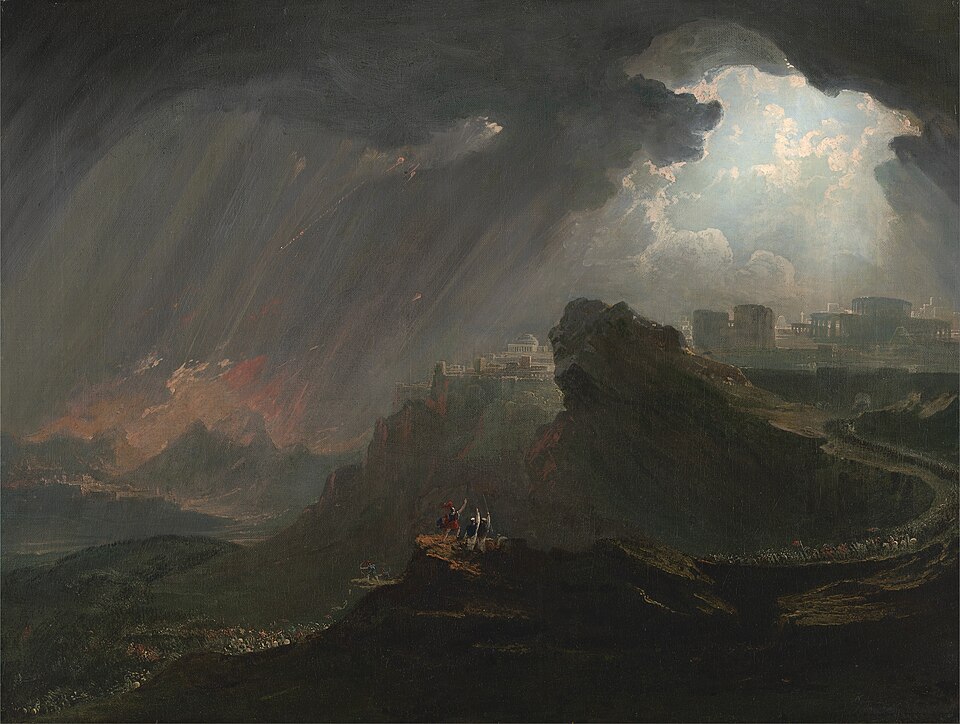
John Martin - Joshua Commanding the Sun to Stand Still - Google Art Project. Photo: John Martin / Wikimedia Commons. Source

Joshua Commanding the Sun to Stand Still upon Gibeon (1816) John Martin - NGA 2004.64.1. Photo: John Martin / Wikimedia Commons. Source
Charles Hapgood’s 1958 “Earth’s Shifting Crust” proposed that under certain conditions the Earth’s crust as a whole could shift atop the liquid magma beneath it, displacing the geographic location of the poles without disturbing the planet’s overall rotational axis. Albert Einstein wrote a foreword to the book endorsing the science. Graham Hancock seized upon this framework in “Fingerprints of the Gods” (1995), arguing that a planetary alignment in the 11th millennium BCE, acting with an excessively heavy ice-sheet mass at the pole, generated enough force to jerk the crust around upon its molten base, moving a temperate Antarctic civilization to the South Pole. Hancock later abandoned this mechanism in favor of a comet strike in polar regions melting enough ice to cause sea-level rise that flooded the lost civilization circa 10,500 BC, with the Younger Dryas cooling becoming his preferred catastrophic trigger. The crustal-displacement thesis was “widely ridiculed by just about everyone with any knowledge of astronomy and geology as hopelessly misunderstanding both subjects”, and Einstein himself later concluded polar ice mass was quantitatively insufficient, calculating that Last Glacial Maximum ice would have shifted the theoretical pole by less than 0.25° even if the crust were free to move. [19]
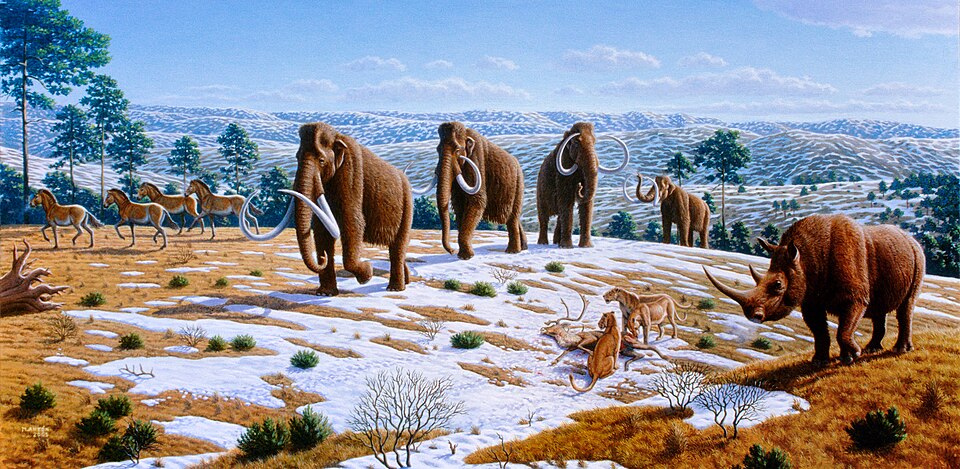
The Younger Dryas cooling event was extremely abrupt: Greenland ice core records show central Greenland temperatures fell by 9–14°C “within a single year or less” at the YD onset (12.85 ± 0.14 ka), and rose 5–10°C “in less than a few decades” at termination. At its onset, roughly three-quarters of megafaunal mammal genera in North and South America disappeared, the Western Hemisphere horse lineage that had existed approximately 56 million years was extinguished, and the Clovis fluted projectile point tradition vanished from the archaeological record. The Younger Dryas Impact Hypothesis, proposed by Firestone et al. in 2007, posits that an extraterrestrial airburst or impact ~12,850 years ago triggered the cooling, contributed to Pleistocene megafaunal extinctions, and ended the Clovis culture, citing a carbon-rich black layer at approximately 50 Clovis-age sites containing magnetic grains with iridium, magnetic microspherules, charcoal, carbon spherules, glass-like carbon with nanodiamonds, and fullerenes with extraterrestrial helium. The hypothesis has been “comprehensively refuted” by Holliday et al. in a 96,000-word Earth-Science Reviews critique arguing no YD-age craters have been identified and most purported indicators have identification or measurement problems, while Powell (2022) argues it was “prematurely rejected” and Sweatman concludes “with the YD impact event essentially confirmed, the YD impact hypothesis should now be called a theory”. The Hiawatha impact crater beneath Hiawatha Glacier in northwest Greenland — initially proposed in 2018 as a possible Younger Dryas-age impactor — has been redated via 40Ar/39Ar analysis of glaciofluvial sand and U-Pb dating of shocked zircon to 57.99 ± 0.54 Ma (Late Paleocene), ruling out any causal connection to the Younger Dryas. A 2025 PLOS One reanalysis (Green et al.) finds that the GISP2 platinum spike previously cited as impact evidence occurred ~45 years AFTER Younger Dryas onset, is geochemically deficient in iridium relative to meteorites, and matches volcanic gas condensates from submarine fissure eruptions rather than impact ejecta. [20]
Paul LaViolette proposed in “Earth Under Fire” (1997/2005) that “galactic superwaves” from periodic Galactic core explosions — expanding shells of cosmic rays and dust recurring roughly every 12,900 years — caused ice-age-ending catastrophes and ancient global destruction myths, claiming superwaves could trigger crustal displacement and magnetic pole shifts. Catastrophist researchers at events such as Cosmic Summit 2024 — including Randall Carlson, Graham Hancock, and Martin Sweatman — explicitly connect the Younger Dryas impact to a comet storm ~12,860 years ago that destroyed an “advanced ice age civilization,” correlating it with Plato’s Atlantis date of ~9,600 BCE and global flood myths as evidence of a single coherent ancient cataclysm. Carlson has publicly stated he “began to move away from the pole shift concept” when working through the math of what a bolide impact would require to shift the planetary rotational axis, and acknowledges that Hapgood himself “abandoned his original version of accelerated crustal pole shift” toward the end of his career. Sweatman and Tsikritsis proposed that Göbekli Tepe’s Pillar 43 encodes an astronomical date of ~10,950 BC ±250 years corresponding to the proposed Younger Dryas comet impact, but the official excavators (Notroff, Dietrich, Clare et al.) systematically rejected this interpretation as “extremely far-fetched,” noting the proposed date is 700–1,000 years older than the oldest radiocarbon date for Enclosure D and that pillars were often recycled. Modern scientific consensus holds that catastrophic events have shaped Earth’s history but rejects universal catastrophism, integrating extreme events with uniformitarian principles rather than invoking planetary encounters, crustal displacement, or recurrent galactic explosions. [17]
Galactic Center Of Milky Way. Photo: NASA/JPL-Caltech / Wikimedia Commons. Source
Connecting the Dots
The Laschamps excursion is empirically secure at ~41 ka through U-Th speleothem dating, with the main phase at 41.10 ± 0.35 ka BP and a surface-field expression lasting ~2 kyr between roughly 42 and 40 ka. Where the picture fractures is in the consequences: paleomagnetic field models place the minimum dipole intensity at roughly one-fifth to one-sixth of present-day strength, yet Cooper et al.’s 2021 Science paper reported the field had collapsed to about 6% of present strength during the “Adams Transitional Geomagnetic Event”, and catastrophist commentators routinely cite a 5–10% figure as evidence of civilizational reset. That 3x discrepancy between published peer-reviewed estimates is not cosmetic — at ~17–20% the field still provides substantial shielding, and the documented cosmogenic signatures, elevated 14C and 10Be from enhanced galactic cosmic ray flux, reflect a moderate weakening, not the catastrophic collapse the popularizers describe. [21] [22]
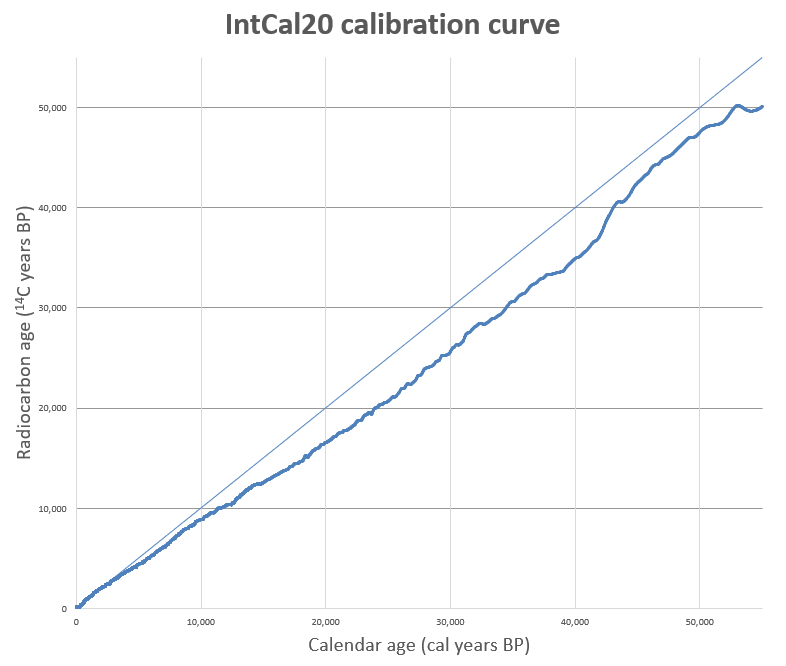
Intcal 20 calibration curve. Photo: Mike Christie / Wikimedia Commons. The paragraph explicitly invokes elevated 14C as the empirical signature that constrains how weak the…. Source
The Blake excursion at ~114 ka is the natural control experiment that catastrophist frameworks cannot survive: it produced comparable or longer dipole weakening of roughly 6,500 years yet left no detectable extinction pulse, no documented cultural transition, and no preserved spike in cave use. If geomagnetic excursions were capable of driving mass die-offs and civilizational collapse, Blake should have done so. Mainstream reviews confirm that correlations between Earth’s magnetic field and climate at multiple timescales are weak and mechanisms unproven, and even the canonical solar–climate coupling — the Maunder Minimum coinciding with the coldest portion of the Little Ice Age — is now attributed primarily to explosive volcanism rather than reduced solar irradiance, with ice-core evidence showing the Little Ice Age began abruptly between 1275 and 1300 AD driven by volcanic forcing. The USGS finds no correlation between mass extinctions and magnetic pole reversals, and Raup’s 1985 analysis identified a 30 Myr periodicity in geomagnetic reversal activity but found a nontrivial discrepancy between that magnetic periodicity and biological extinction periodicity. [23]
The Younger Dryas is where every thread in the catastrophist literature converges: it was a real, well-documented abrupt cooling event from 12,900 to 11,700 years BP with temperature decreases of 3°C over North America, 2–6°C in Europe, and up to 10°C in Greenland over just 3 years or less, and Graham Hancock’s Fingerprints of the Gods placed a “crust shift” in the 11th millennium BC — squarely within this window. The conventional scientific explanation involves AMOC disruption and meltwater release, not cosmic impact, and critical reviews of the Younger Dryas Impact Hypothesis identify an age discrepancy of up to two centuries between claimed impact sites, undermining the synchronous-event requirement. The Greenland platinum spike has been reinterpreted as volcanic rather than impact-related, and the Hiawatha crater that once anchored the hypothesis to ~12.8 ka has been redated to 57.99 ± 0.54 Ma (Late Paleocene) [24], removing it from the Younger Dryas entirely. Claims of continent-wide biomass burning, megafaunal extinctions, and platinum-group element anomalies remain contested and subject to alternative non-impact interpretations.
Ice age fauna of northern Spain - Mauricio Antón. Photo: Mauricio Antón / Wikimedia Commons. Source
Hapgood’s crustal displacement mechanism fails quantitatively before it fails politically: modeling of Last Glacial Maximum ice-sheet mass distributions suggests the ice could have shifted the pole by less than 0.25° relative to its present position — orders of magnitude less than the tens of degrees his mechanism requires. The crust’s “theoretical axis of rotation,” computed at 1.21°N, 18.52°W, lies near the equator in the tropics — not at the geographic poles. True polar wander IS real and measurable, with rates of approximately 3 cm/year over the past 300 million years and fast-track wander rates of 30–50 km/Myr over the last 200 Myr, but these operate on geological timescales utterly incompatible with the thousands-of-years pace the catastrophist literature demands. The Earth’s magnetic field IS generated by the geodynamo in the convecting outer core and reverses at irregular intervals averaging several hundred thousand years, leaving 183 reversals recorded over the last 83 million years — events whose timeline bears no systematic relationship to the catastrophe narratives that depend on them. [25]
The Other Side
The USGS states plainly that no mass extinction in the fossil record correlates with a magnetic polarity reversal, despite “much searching in the geologic and biologic record”; reversals occur on roughly million-year timescales while mass extinctions cluster on hundred-million-year cycles, and the biosphere has walked through past reversals without documented catastrophe. The 2021 Cooper-Turney “Adams Transitional Geomagnetic Event” paper, which tied the Laschamps excursion to Neanderthal extinction, megafaunal collapse, ozone depletion, and human behavioral change, was formally critiqued within nine months in two Technical Comments in Science. Picin and colleagues showed that Neanderthal disappearance was distributed across multiple glacial stadials over thousands of years rather than a 42-thousand-year pulse, that Australian megafauna survived past 40.1 ka, and that the cited behavioral markers (cave use, ochre, tailored clothing) all pre-date the Laschamps minimum by tens of millennia; John Hawks documented that several source dates had been misread from the primary literature. The high-resolution Chiba composite section paleomagnetic study of the Matuyama-Brunhes transition independently concludes there is “no support for a recently hypothesized direct coupling between variations in the geomagnetic field intensity and global/regional climate change”. [26]
The Younger Dryas Impact Hypothesis has suffered a series of specific empirical blows. The Hiawatha crater beneath the Greenland Ice Sheet, initially proposed as a candidate YD impactor, has been redated via 40Ar/39Ar and U-Pb analysis to 57.99 ± 0.54 Ma — Late Paleocene, predating the Greenland Ice Sheet itself by roughly 58 million years and removing it from any causal connection to events 12,800 years ago [27][28]. The Greenland ice-core platinum spike, a flagship YDIH proxy, post-dates the onset of YD cooling by approximately 45 years and has now been geochemically reinterpreted as volcanic in origin, most likely an Icelandic submarine fissure eruption rather than a cosmic airburst. Meanwhile, the conventional Younger Dryas mechanism — AMOC shutdown triggered by the catastrophic drainage of glacial Lake Agassiz (roughly 9,500 km³ through the St. Lawrence) — is independently supported by geochemical proxies at the St. Lawrence estuary, freshwater-discharge climate model simulations that reproduce the YD pattern, and the absence of confirmed craters or unambiguous shock indicators at YD sites. No cosmic impact or pole shift is required to explain the cooling, and a comprehensive 2023 review in Earth-Science Reviews concluded the impact hypothesis fails on its own evidentiary terms [29][30].
The older catastrophist physics fares no better. Carl Sagan’s 1974 AAAS critique of Velikovsky concluded that “where Velikovsky is original he is very likely wrong; and where he is right the idea has been preempted by earlier workers”. Slabinski demonstrated that Peter Warlow’s tippe-top Earth-inversion mechanism would require an intruding body at least 31% more massive than Jupiter, while Warwick showed gravity overwhelms electromagnetic forces in planetary encounters by a factor exceeding a billion, eliminating the electromagnetic “comet near-miss” mechanism that powered Velikovskian catastrophism. Charles Hapgood’s ice-mass crustal-displacement hypothesis, endorsed by Einstein in a brief foreword, has been quantitatively refuted: modeling shows that even if the lithosphere were completely free to move, Last Glacial Maximum ice would shift the rotation pole by less than 0.25°, far short of the thousands of kilometers of displacement required to relocate Antarctica to the equator. The modified “magnetic unlock” version proposed by Carlotto is explicitly described by its own author as untestable, and the mantle convection patterns on which any genuine true polar wander would depend have remained stable for at least 250 million years with no documented episode of superfast polar shift. The mainstream framework is not a refusal to take catastrophism seriously — it is the conclusion that, every time the underlying physics and chronology are checked, the catastrophist extrapolations do not survive the contact. [31] [32]
What We Actually Know
The Laschamps excursion stands on firm ground. It is dated to approximately 41,000 years ago, with a main phase at 41.10 ± 0.35 ka BP and a surface-field expression lasting roughly 1,000–2,000 years. During this interval the geomagnetic field intensity collapsed to roughly one-fifth to one-sixth of its present value, with the axial dipole reducing to nearly zero without fully reversing. This collapse left a clear cosmogenic fingerprint: atmospheric Δ14C and 10Be/9Be production spiked because reduced geomagnetic shielding allowed greater galactic cosmic ray flux. Crucially, excursions are not reversals — they are short-lived deviations into intermediate polarity states from which the field returns to its prior configuration. The Laschamps is not an isolated event; at least 18 excursions are considered reliably dated throughout the Brunhes Chron, including Mono Lake (~33 ka), Blake (~115–122 ka), and Iceland Basin (~188 ka). [21] [22]
What the geophysics does not support is equally well-documented. There is no convincing paleontological or stratigraphic evidence that geomagnetic reversals cause mass extinctions or dramatic climate disruptions; the USGS states no correlation exists, and the fossil record shows no correlated biospheric catastrophe. Earth’s atmosphere independently provides radiation shielding equivalent to a concrete layer roughly 13 feet thick, so even a greatly weakened field would not strip the protection necessary for mass biological damage. Charles Hapgood’s Earth Crust Displacement hypothesis — that mass imbalances from polar ice could abruptly shift Earth’s outer crust over the mantle — is classified as pseudoarchaeological by mainstream reference sources, not as a tested geophysical model. Albert Einstein did write a foreword describing Hapgood’s displacement material as deserving “serious attention,” but he later argued that polar ice mass imbalance alone was insufficient, and modeling of Last Glacial Maximum ice-sheet distributions indicates the ice could have shifted the pole by less than 0.25° relative to its present position. [33] [34]
The plausible-but-uncertain tier holds the most interesting bridges. A modified Earth Crustal Displacement theory published in the Journal of Scientific Exploration proposes that short-term geomagnetic excursions “unlock” the crust from the mantle and allow tidal forces to displace it. That same source correlates three named excursions with subsequent VEI-7+ eruptions: Norwegian-Greenland Sea preceding Toba (73–75 ka), Lake Mungo preceding Oruanui/Taupo (28–30 ka), and Laschamps preceding the Phlegraean Fields eruption (40–42 ka). Wei et al. (2014) proposed that reversals could enhance oxygen escape from Earth’s atmosphere by 3–4 orders of magnitude under conditions of extremely weak field, potentially accounting for roughly half of the observed 9% oxygen drop at the Triassic–Jurassic boundary. Meert and colleagues linked rapid polarity reversals during the Late Ediacaran (~542 Ma) with the Cambrian Evolutionary Radiation through increased UV-B radiation reaching Earth’s surface during periods of weak magnetic shielding [35]. Korte et al. (2019) tentatively suggest that, under assumptions resembling the Laschamps, a reversal or excursion should not be expected before 500 to 1000 years, with the language explicitly hedged. Geological evidence from Jordan’s Jebel Waqf as Suwwan crater indicates high-probability impact events at ~9600 and ~6000 yr B.P., with shatter cones and pseudo-wollastonite at ~1120°C cited and links drawn to Gilgamesh and John’s Apocalypse. Catastrophist commentators explicitly connect the Laschamps to civilizational catastrophe, claiming dramatic collapse of the magnetic shield and prolonged instability of the poles — claims that exceed what the peer-reviewed paleomagnetic record documents.
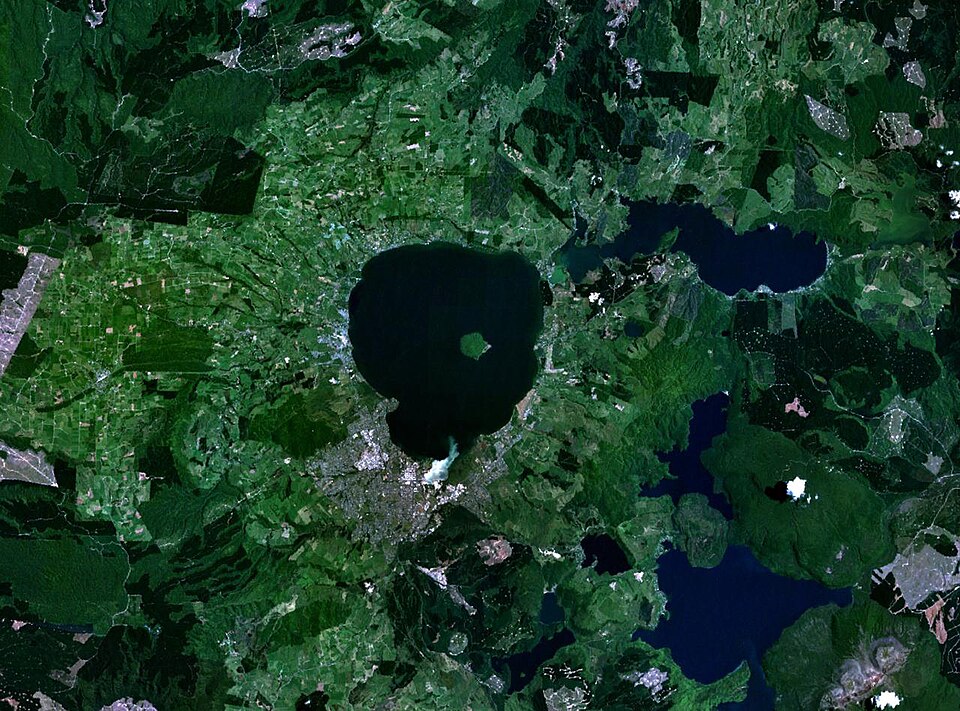
Lake rotorua. Photo: en:NASA World Wind / Wikimedia Commons. The Oruanui/Taupo eruption is the third VEI-7+ eruption the paragraph ties to a preceding excursion;…. Source
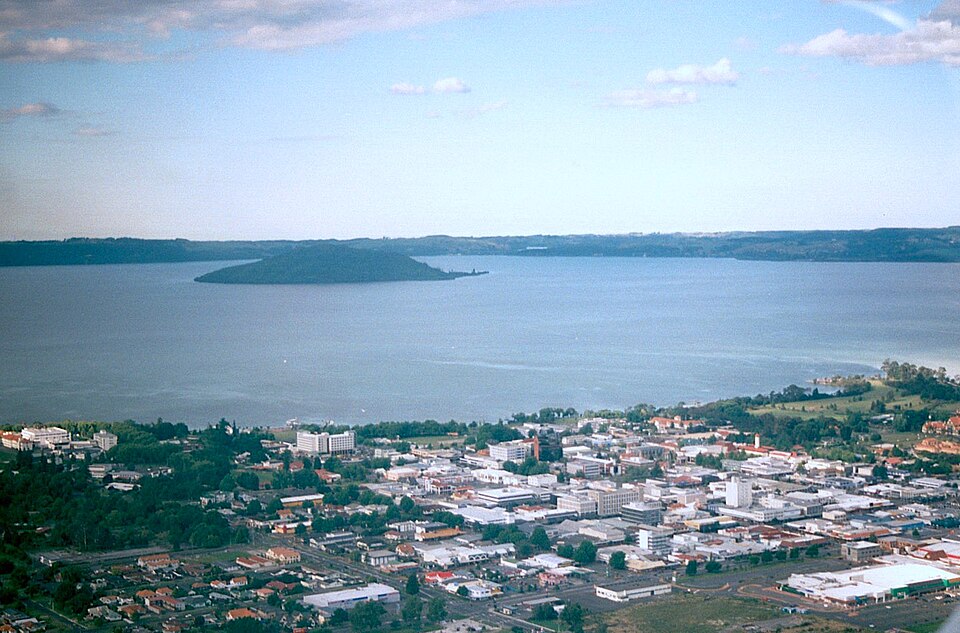
RotoruaAerial. Photo: Carl Lindberg / Wikimedia Commons. The Oruanui/Taupo eruption is the third VEI-7+ eruption the paragraph ties to a preceding excursion;…. Source
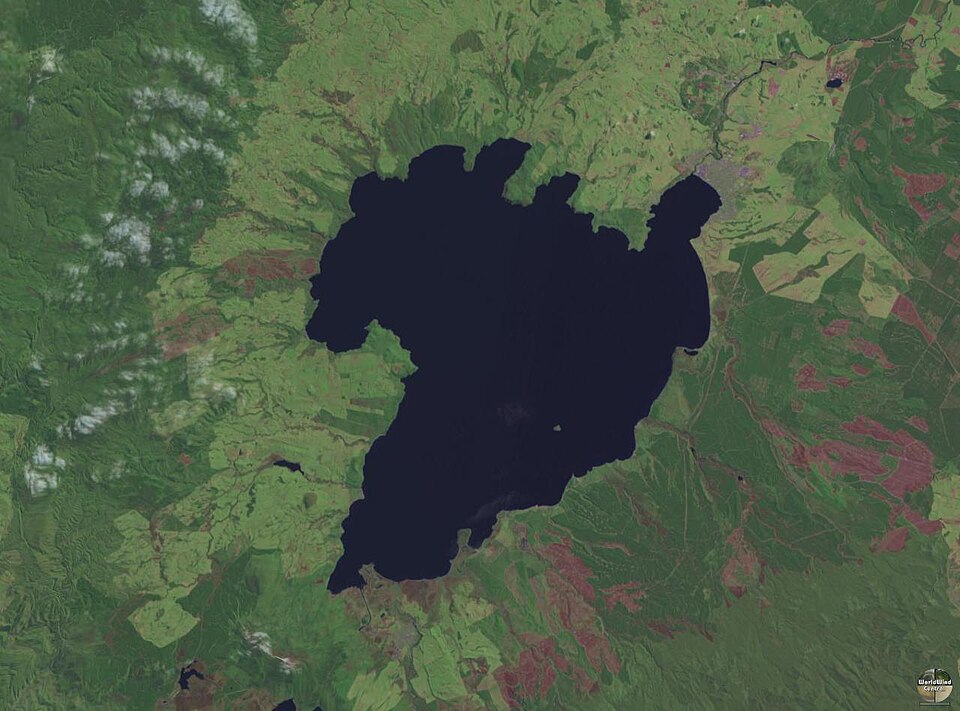
Lake taupo landsat. Photo: NASA / Wikimedia Commons. Lake Taupo in New Zealand’s North Island. Source
The speculative tier is where the case grows thinest. Whether geomagnetic field weakening directly drives climate change remains unestablished — Svensmark’s cosmic ray–cloud hypothesis is itself contested, with Courtillot and others calling for more data while CLOUD/Pierce & Adams/Laken et al. argue the effect is negligible[36]. Whether the Laschamps caused megafaunal extinctions, ozone depletion, and human behavioral changes — the “Adams Transitional Geomagnetic Event” hypothesis — is unconfirmed. The Younger Dryas Impact Hypothesis (~12,850 years ago, ~1,200-year cooling, ending Clovis culture) remains actively contested with no resolution; Powell (2022) argues for premature rejection while van Hoesel et al. (2018) identify age discrepancies up to 200 years and absence of diagnostic shock indicators, and the 2025 Baffin Bay paper was retracted. Whether Hapgood’s crustal displacement mechanism — or the Carlotto “geomagnetic unlock” revision — has any physical merit is unestablished. Whether oral traditions preserve genuine geological memories of catastrophic events remains open[37]. Paul LaViolette’s “galactic superwaves” framework, with a claimed ~12,900-year periodicity, rests on an interstellar dust claim reportedly confirmed by Ulysses in 1993; whether that confirmation supports or undermines his broader catastrophic architecture is unaddressed. Sea level did rise approximately 120 meters during the last deglaciation, submerging ~25 million km², with three reported episodes of global super-flooding at ~15,000–14,000, ~12,000–11,000, and ~8,000–7,000 years ago — real phenomena, but their encoding in myth remains interpretive.
References
[1] Antje H L Voelker, Pieter Meiert Grootes, Marie‐Josée Nadeau, and Michael Sarnthein (2000). Radiocarbon Levels in the Iceland Sea from 25–53 kyr and their Link to the Earth’s Magnetic Field Intensity. Radiocarbon. DOI: 10.1017/s0033822200030368 (accessed 2026-08-30) [Academic]
[2] Charles Hapgood “Earth’s Shifting Crust”, Museum Press, 1959, 1st … — https://www.traffordbooks.co.uk/lot/charles-hapgood-earths-shifting-crust-museum-press-1959-1st-edn-in-vg-djkt-foreword-by-albert-einstein-and-other-geological-works/17350 (accessed 2026-08-30)
[3] [PDF] Origin and age of the directions recorded during the Laschamp … — https://repository.geologyscience.ru/bitstreams/a19563ff-9d48-46df-bf08-00cb26f7c2ac/download (accessed 2026-08-30)
[4] Deep‐sea sediment records of the Laschamp geomagnetic … — https://agupubs.onlinelibrary.wiley.com/doi/full/10.1029/2003JB002943 (accessed 2026-08-30) [Academic]
[5] Reversals: Magnetic Flip - BGS Geomagnetism — https://geomag.bgs.ac.uk/education/reversals.html (accessed 2026-08-30) [Academic]
[6] Polar ice-cores unravel the formation of a UV window during magnetic field collapse ~ 42 ka BP — https://eartharxiv.org/repository/object/12935/download/22935/ (accessed 2026-08-30)
[7] Changing Name for Earth’s Changing Poles - Eos.org — https://eos.org/opinions/changing-name-for-earths-changing-poles (accessed 2026-08-30)
[8] A Civilization May Have Been Destroyed Before Us [4:42-6:20] — Michael Button (YouTube) — https://youtu.be/FuzCf2tUVCU?t=282 (accessed 2026-08-30)
[9] Full text of “Earth’s Shifting Crust” - Internet Archive — http://www.archive.org/stream/eathsshiftingcru033562mbp/eathsshiftingcru033562mbp_djvu.txt (accessed 2026-08-30) [Reputable]
[10] Jean Besse and Vincent Courtillot (2002). Apparent and true polar wander and the geometry of the geomagnetic field over the last 200 Myr. Journal of Geophysical Research Atmospheres. DOI: 10.1029/2000jb000050 (accessed 2026-08-30) [Academic]
[11] Charles Hapgood — https://en.wikipedia.org/wiki/Charles_Hapgood (accessed 2026-08-30) [Reputable]
[12] WHEN THE SKY FELL — https://www.kirkusreviews.com/book-reviews/rand-flem-ath/when-the-sky-fell/ (accessed 2026-08-30)
[13] When the Sky Fell. — https://www.f-b-a.com/product/when-the-sky-fell/ (accessed 2026-08-30)
[14] When The Sky Fell: In Search of Atlantis [2  — https://dokumen.pub/when-the-sky-fell-in-search-of-atlantis-2nbsped-9781591431374-9781591438953-2011040156.html (accessed 2026-08-30)
[15] Rand Flem-Ath — https://en.wikipedia.org/wiki/Rand_Flem-Ath (accessed 2026-08-30) [Reputable]
[16] Flem-Ath Rand — https://abcbookworld.com/writer/flem-ath-rand/ (accessed 2026-08-30)
[17] Atlantis Location: New Evidence | Graham Hancock & Randall Carlson [74:51-76:51] — The Randall Carlson (YouTube) — https://youtu.be/RTd7HS0IRfo?t=4491 (accessed 2026-08-30)
[18] Martin B. Sweatman (2017). Catastrophism through the Ages, and a Cosmic Catastrophe at the Origin of Civilization. Archaeology & Anthropology Open Access. DOI: 10.31031/aaoa.2017.01.000506 (accessed 2026-08-30)
[19] The Fingerprints of Graham Hancock - The Hall of Maat — https://www.hallofmaat.com/lostciv/the-fingerprints-of-graham-hancock/ (accessed 2026-08-30)
[20] The case of the Younger Dryas Impact Hypothesis - PMC — https://pmc.ncbi.nlm.nih.gov/articles/PMC10450282/ (accessed 2026-08-30) [Academic]
[21] Age of the Laschamp excursion determined by U-Th dating … — https://experts.umn.edu/en/publications/age-of-the-laschamp-excursion-determined-by-u-th-dating-of-a-spel/ (accessed 2026-08-30) [Academic]
[22] Robust Characteristics of the Laschamp and Mono Lake … — https://www.frontiersin.org/journals/earth-science/articles/10.3389/feart.2019.00086/full (accessed 2026-08-30) [Academic]
[23] Do any mass extinctions correlate with magnetic reversals? — https://www.usgs.gov/faqs/do-any-mass-extinctions-correlate-magnetic-reversals (accessed 2026-08-30) [Academic]
[24] A Late Paleocene age for Greenland’s Hiawatha impact structure - Science — https://www.science.org/doi/10.1126/sciadv.abm2434 (accessed 2026-08-30) [Academic]
[25] Earth’s magnetic field — https://en.wikipedia.org/wiki/Earth's_magnetic_field (accessed 2026-08-30) [Reputable]
[26] Antje H. L. Voelker, Michael Sarnthein, Pieter M. Grootes, Helmut Erlenkeuser, Carlo Laj, Alain Mazaud, Marie-Josée Nadeau, and Markus Schleicher (1997). Correlation of Marine 14C Ages from the Nordic Seas with the GISP2 Isotope Record: Implications for 14C Calibration Beyond 25 ka BP. Radiocarbon. DOI: 10.1017/s0033822200018397 (accessed 2026-08-30) [Academic]
[27] A Late Paleocene age for Greenland’s Hiawatha impact structure — https://core.ac.uk/download/492753390.pdf (accessed 2026-08-30) [Academic]
[28] A Late Paleocene age for Greenland’s Hiawatha impact … — https://pubmed.ncbi.nlm.nih.gov/35263140/ (accessed 2026-08-30) [Academic]
[29] Vance T. Holliday, T. L. Daulton, Patrick J. Bartlein, M. B. Boslough, Ryan P. Breslawski, Abigail E. Fisher, Ian Jorgeson, Andrew C. Scott, Christian Koeberl, Jennifer R. Marlon, Jeffrey P. Severinghaus, M. I. Petaev, and Philippe Claeys (2023). Comprehensive refutation of the Younger Dryas Impact Hypothesis (YDIH). Earth-Science Reviews. DOI: 10.1016/j.earscirev.2023.104502 (accessed 2026-08-30) [Academic]
[30] Comprehensive refutation of the Younger Dryas Impact … — http://ui.adsabs.harvard.edu/abs/2023ESRv..24704502H/abstract (accessed 2026-08-30) [Academic]
[31] A New Theory of Earth Crustal Displacement — https://beforeatlantis.com/2022/05/24/a-new-theory-of-earth-crustal-displacement/ (accessed 2026-08-30)
[32] Toward a New Theory of Earth Crustal Displacement — https://journalofscientificexploration.org/index.php/jse/article/view/1621 (accessed 2026-08-30)
[33] Is it true that Earth’s magnetic field occasionally reverses its polarity? — https://www.usgs.gov/faqs/it-true-earths-magnetic-field-occasionally-reverses-its-polarity (accessed 2026-08-30) [Academic]
[34] Earth’s magnetic field could flip within a human lifetime - Berkeley News — https://news.berkeley.edu/2014/10/14/earths-magnetic-field-could-flip-within-a-human-lifetime/ (accessed 2026-08-30) [Academic]
[35] Can Rapid Magnetic Reversals Cause a Mass Extinction? — https://geology.ufl.edu/news/2018/can-rapid-magnetic-reversals-cause-a-mass-extinction/ (accessed 2026-08-30) [Academic]
[36] What’s the link between cosmic rays and climate change? — https://skepticalscience.com/print.php?r=277 (accessed 2026-08-30)
[37] Massimo Rapisarda (2015). A scientific approach to Plato’s Atlantis. University of Messina University Library System (University of Messina). DOI: 10.1478/aapp.932c1 (accessed 2026-08-30)
Keep exploring
Every site on this page sits on the globe, and the people who research them are on the Discord.
3D Globe · Sites by country · Story Archive · Research Library · Weekly Journal · Search