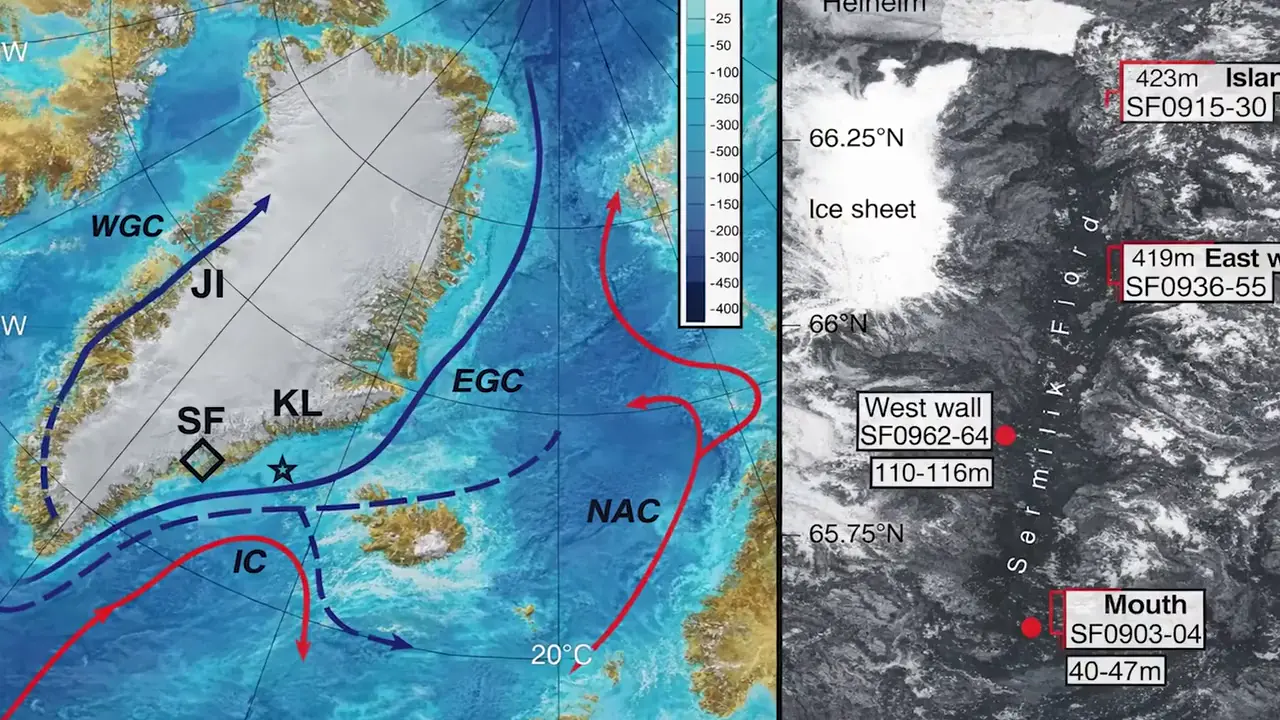
About 12,900 years ago, the Younger Dryas began, bringing rapid cooling to much of the Northern Hemisphere. Greenland ice cores show that its sharpest onset may have taken less than a decade, and the cold phase lasted until roughly 11,700 years ago. Cooling estimates vary by region and proxy; a recent Greenland reconstruction reports a local fall exceeding 15°C, making a uniform 10°C hemispheric drop misleading.
North America's commonly cited loss of about 35 large-mammal genera occurred across the broader end of the Pleistocene, not all within the Younger Dryas, and some—including the saber-toothed cat Smilodon—survived beyond it. Clovis fluted-point technology ended around 12,800 years ago, but the timing does not prove that climate change caused a population collapse. Human occupation continued through the Younger Dryas; the video's claimed 600-800-year North American hiatus is not supported. The video argues for a stronger causal link among the cooling, extinctions and end of Clovis, but current evidence establishes close timing rather than that complete causal chain.
Sources
Did a comet burst crash Earth's climate 12,800 years ago? - EarthSkyearthsky.orgThe icy conditions of the Younger Dryas cooling period lasted more than 1,200 years. But it shouldn't have happened. Earth was warming when the ...
The Big Freeze: Rapid Cooling During the Younger Dryasscied.ucar.eduMany scientists hypothesize that a partial or total shutdown of the ocean's thermohaline circulation led to the cooling.
[PDF] The Younger Dryasncei.noaa.govThe end of the Younger Dryas, about 11,500 years ago, was par- ticularly abrupt. In Greenland, temperatures rose 10°C. (18°F) in a decade (Alley 2000). Other ...
The Evidence for the Younger Dryas Impact Hypothesishumanoriginproject.comThe theory suggests a comet impact 12800 years ago destroyed the North American Ice sheet and set off global wildfires. As a result, periods of extreme ...
Scientists solve 12,800-year-old climate mystery hidden in ...sciencedaily.comIt appears close to the start of the Younger Dryas Event, a dramatic cold period that lasted from roughly 12,870 to 11,700 years ago. During ...
Younger Dryas and early Holocene climate in south ...sciencedirect.comby PJK Puleo · 2022 · Cited by 12 — Ice core records have long indicated that the Younger Dryas began and ended with large, abrupt climate shifts over Greenland. Key climatic features remain ...
Younger Dryasen.wikipedia.orgThe Younger Dryas (YD, Greenland Stadial GS-1) was the final climatic phase of the Last Glacial Period that occurred from around 12,900 to 11,700 years ...
Younger Dryas cooling and the Greenland climate response ...pmc.ncbi.nlm.nih.govby Z Liu · 2012 · Cited by 117 — Greenland ice-core δ18O-temperature reconstructions suggest a dramatic cooling during the Younger Dryas (YD; 12.9–11.7 ka), with temperatures being as cold ...
AI-generated text · images from the original sources · always verify with the sources.