

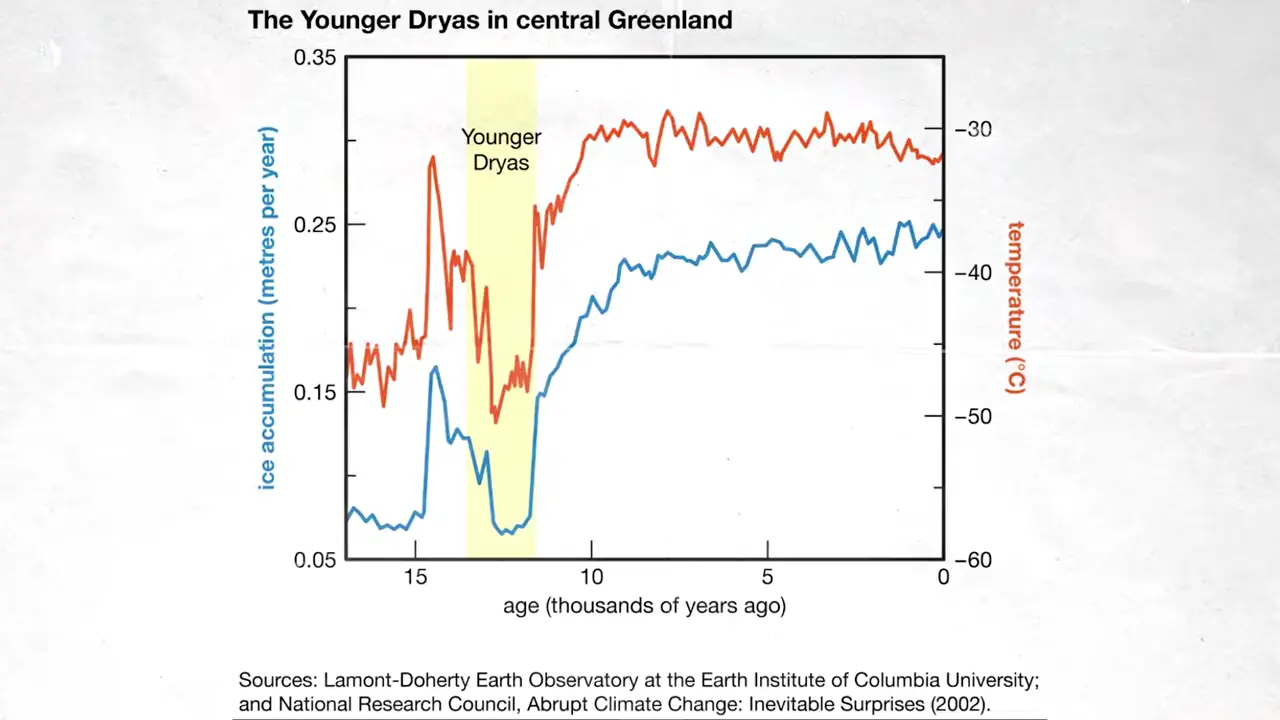
Around 12,900 years ago, temperatures plunged back toward near-glacial conditions in what we call the Younger Dryas. Some regions experienced shifts in decades - a single human lifetime. Ecosystems rearranged completely: grasslands contracted, forest belts shifted hundreds of kilometers. Habitats fragmented, which is lethal for megafauna. The majority of large mammals over 44 kg disappeared between roughly 13,000 and 10,000 years ago. Human populations were also hit by the same climate shock. Researchers argue this climate event aligns with the scale of extinction rather than small human bands with stone points.
Younger Dryas climate crisis likely drove megafauna extinction
Key facts
- Around 12,900 years ago, temperatures plunged back toward near-glacial conditions in the Younger Dryas
- Some regions experienced shifts in decades, a human lifetime
- Ecosystems rearranged: grasslands contracted, forest belts shifted hundreds of kilometers
- Habitats fragmented, which is lethal for megafauna
- Majority of large mammals over 44 kg disappeared between roughly 13,000 and 10,000 years ago
- The Clover culture in North America disappears from archaeological record as megafauna vanish
- Human populations were also hit by the same climate shock
- The climate shock that reshaped continents aligns with the scale of extinction rather than small human bands with stone points
Sources
Younger Dryas - Wikipediaen.wikipedia.org
It is primarily known for the sudden or "abrupt" cooling in the Northern Hemisphere, when the North Atlantic Ocean cooled and annual air temperatures decreased.
[PDF] The Younger Dryasncei.noaa.gov
This near-glacial period is called the Younger Dryas, named after a flower (Dryas octopetala) that grows in cold conditions and that became common in Europe ...
Younger Dryas | Definition, Causes, & Termination - Britannicabritannica.com
Younger Dryas, cool period between roughly 12900 and 11600 years ago that disrupted the prevailing warming trend in the Northern Hemisphere ...
Past Global Warming More Rapid than Today's: The Younger Dryasscienceunderattack.com
One of the best documented is a period of climate upheaval known as the Younger Dryas, which occurred approximately 12,900 to 11,700 years ago ...
The Big Freeze: Rapid Cooling During the Younger Dryasscied.ucar.edu
It's also called the Big Freeze for obvious reasons. Why did climate cool during the Younger Dryas? Scientists are not entirely certain about the cause or ...
Was this story useful?
Keep exploring
Every site on this page sits on the globe, and the people who research them are on the Discord.
3D Globe · Sites by country · Story Archive · Research Library · Weekly Journal · Search
AI-generated text · images from the original sources · always verify with the sources.