

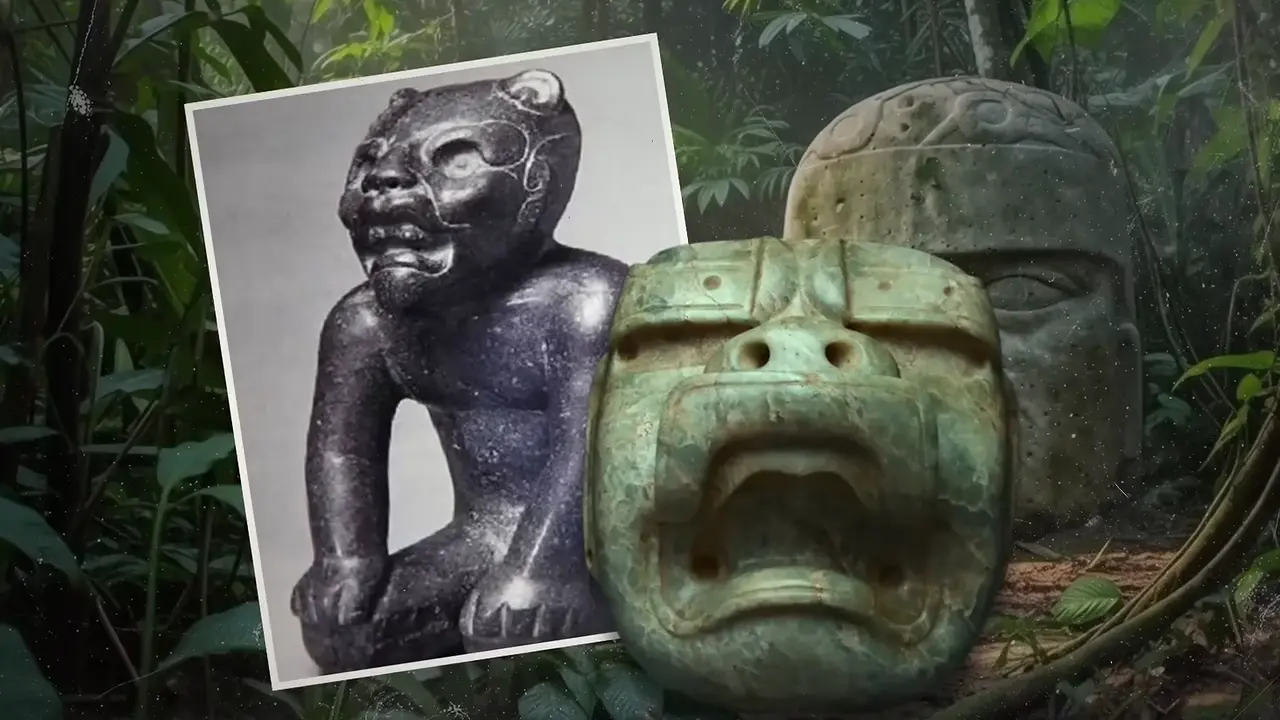
Were-jaguar imagery vastly outnumbers colossal heads in Olmec art, appearing across hundreds to thousands of artifacts across the Olmec heartland. The Olmec civilization flourished from roughly 1500 to 400 BC. A stunning cache at La Venta depicts a sacred procession of figures. 🐆
Were-jaguar cult predominates over colossal heads across hundreds of Olmec artifacts
Key facts
- Were-jaguar depictions are far more prevalent than colossal heads in Olmec art
- Found at La Venta, San Lorenzo, Laguna de los Cerros (western citadel), and Tres Zapotes (later epi-Olmec city, c. 200 BC)
- Olmec civilization spanned from approximately 1800 BC to about 200 BC
- Were-jaguar imagery appears on hundreds to thousands of Olmec artifacts from Tabasco to Mexico City
- A cache discovered beside La Venta was made of gray and red stones with five serpentine stools featuring carvings
- The cache depicts a sacred procession of approximately two dozen people
- The cache was found at the base of the Great Pyramid of La Venta in front of five or six stools, recreating a ritual event tied to the were-jaguar cult
Sources
Were-jaguars and jaguar babies in Olmec religionpublications.essex.ac.uk
The “Jaguar Baby” motif is inseparable in its motivation from all other known Olmec objects but has never been subject to scholarly consensus.
Standing Figure Holding a Were-Jaguar Babykimbellart.org
This masterfully carved jade statuette depicts an unclothed, standing Olmec male figure, possibly a ruler, holding an infant were-jaguar, a supernatural ...
Olmec Figure of a Werejaguar , c. 900 to 500 BCEbarakatgallery.eu
The Olmec were-jaguar was a popular theme in Olmec art, were almost entirely feline to entirely human. The Olmecs developed on the present-day Mexican southern ...
Werejaguaren.wikipedia.org
The werejaguar motif is characterized by almond-shaped eyes, a downturned open mouth, and a cleft head. It appears widely in the Olmec archaeological record, ...
Jaguar Cult — Down's Syndrome — Were-Jaguarpenn.museum
Penrose found an incidence of 27.5 per 1,000 births among women of 45-49 years of age. We theorize that the evolution of the were-jaguar cult among the Olmec ...
Was this story useful?
Keep exploring
Every site on this page sits on the globe, and the people who research them are on the Discord.
3D Globe · Sites by country · Story Archive · Research Library · Weekly Journal · Search
AI-generated text · images from the original sources · always verify with the sources.