

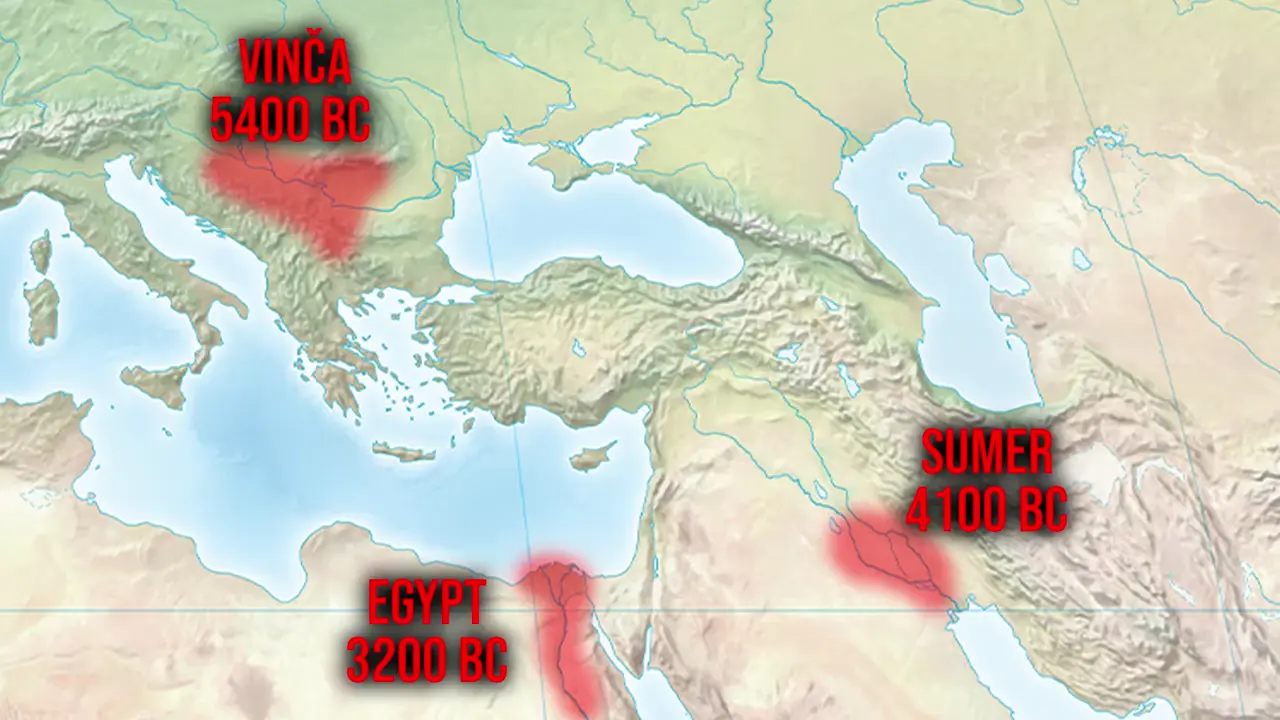
Vinča’s final phases are radiocarbon-dated to roughly 4550–4350 cal BC, with the transition commonly placed near 4500–4400 BC. Cooling around the 4200 BC Piora event, together with possible soil depletion and deforestation, are proposed contributors. Farming and metalworking continued in smaller post-Vinča communities such as Sutz and Gomolava. The wider “Old Europe” transition and the role of Khvalynsk- and Yamnaya-linked steppe movements remain debated. The video argues that a shared swastika shows contact between Yamnaya and Mesopotamian “Vinča successors”; archaeology does not establish that inference.
Vinča decline near 4500–4400 BC amid proposed climate and land-use stresses
 SerbiaGeneral
Key facts
- Radiocarbon-based chronologies place late Vinča phases roughly 4550–4350 cal BC; the transition is commonly placed around 4500–4400 BC, not a securely confirmed disappearance at exactly 4400 BC.
- The Piora Oscillation is associated with climate shifts around 4200 BC, not “4200 BP.” Its cooling, drying and agricultural effects are documented associations, but its role in Vinča’s decline remains a hypothesis.
- Soil erosion, nutrient depletion and deforestation following prolonged farming are proposed land-use mechanisms; the radiocarbon chronology does not prove eight centuries of continuous farming or establish these as causes.
- Post-Vinča communities, including Sutz and Gomolava, continued farming and metalworking on a smaller, more dispersed scale.
- The steppe-population explanation for the varied changes around 4000 BC remains debated. Khvalynsk and later Yamnaya are associated with the steppe-ancestry hypothesis for early Indo-European-speaking populations, but not with one uniform, proven “Old Europe collapse.”
- The claim that Yamnaya and “Vinča successors in Mesopotamia” shared a swastika and thereby had contact is not established. The motif was widespread, and no accepted archaeological category identifies Mesopotamian populations as Vinča successors.
Sources
The approximate spatial extent of the Vinča culture and ...researchgate.net
Vinča cultureen.wikipedia.org
Was this story useful?
Keep exploring
Every site on this page sits on the globe, and the people who research them are on the Discord.
3D Globe · Sites by country · Story Archive · Research Library · Weekly Journal · Search
AI-generated text · images from the original sources · always verify with the sources.