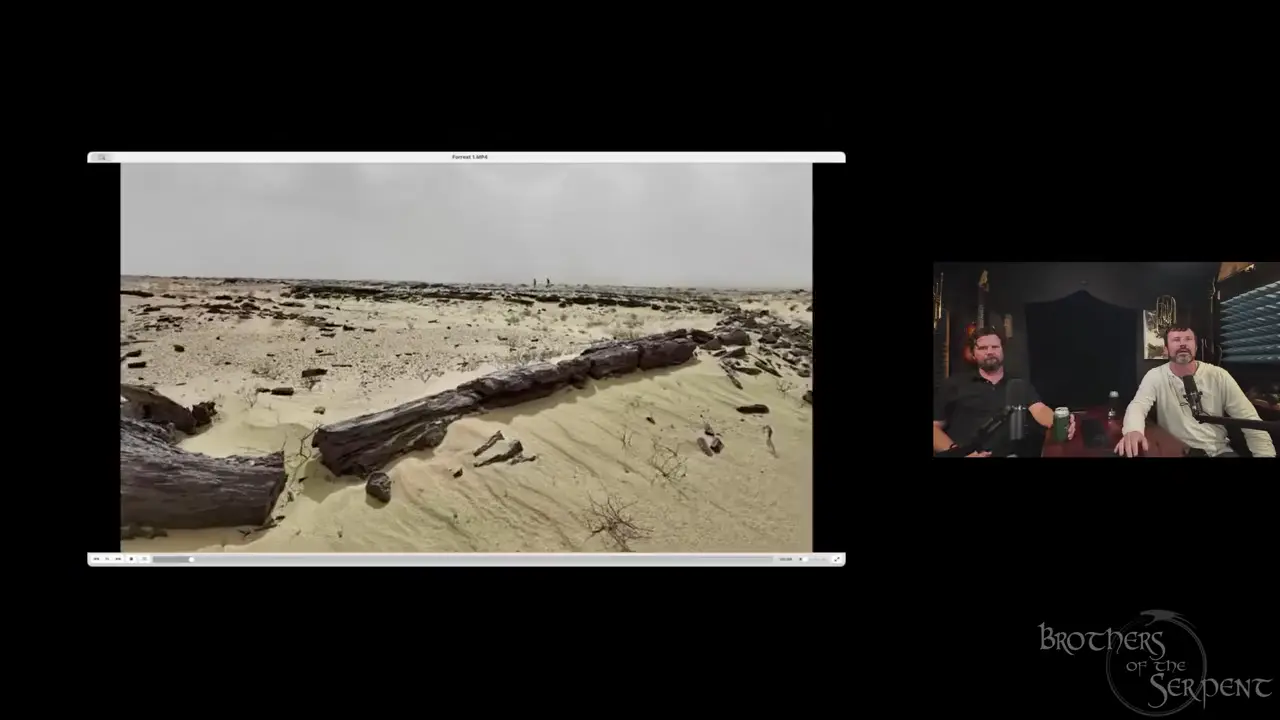
Wadi Al-Hitan (Whale Valley) in Egypt's Western Desert is a UNESCO World Heritage Site known for Middle Eocene whale fossils and a petrified forest. Basilosaurus and other early whales lived roughly 40 million years ago, and the fossil sequence documents whales' transition from land mammals to fully aquatic animals. UNESCO describes hundreds of fossil remains, not an established total of about 600 Basilosaurus specimens.
The video argues that Wadi Al-Hitan preserves a single catastrophic mass extinction in which volcanic activity poisoned the water and ash buried marine life and trees. That scenario is not established by UNESCO. The official record describes exceptional Eocene marine fossils and a fossil forest, not proof that all species occupied one layer, died simultaneously, or were killed by volcanic poisoning and ash.
Sources
The Valley of the Whales ( Wadi Hitan ) | Explore Fayoumfayoumegypt.comWadi Al-Hitan in Egypt's Western Desert is the only place in the world where the skeletons of families of archaic whales can be seen.
Wadi al Hitan - Wikipediaen.wikipedia.orgWādī al-Ḥītān is a paleontological site in the Faiyum Governorate of Egypt, some 150 kilometres (93 mi) south-west of Cairo. It was designated a UNESCO ...
Wadi Al Hitan: How To Visit Egypt's Valley Of The Whalespassportandpixels.comThe most commonly found fossil here is Basilosaurus, a prehistoric whale that lived about 40 million years ago. They've found around 600 of them in the Wadi ...
Discover Wadi El Hitan: Egypt's Whale Valley of Fossilsegypttoursportal.comExplore Wadi El Hitan, Egypt's UNESCO site with 40-million-year-old whale fossils, rare wildlife, striking geology, and the Middle East's ...
Guide 8 – Case Study: Wadi Al-Hitan (Egypt) - World Heritage Centrewhc.unesco.orgWadi Al-Hitan – also known as Whale Valley – is located in the Western Desert of Egypt. It is an 'open-air museum' of invaluable fossil remains.
Wadi El Hitan National Park - Egypt Tour Packages 2026marsaalamtours.orgWadi Al-Hitan (Whale Valley) is the largest and most important site in the world for whale fossils. Petrified Forest protector. Wadi Al-Hitan, Whale Valley, in ...
Wadi Al-Hitan (Whale Valley)whc.unesco.orgWadi Al-Hitan, Whale Valley, in the Western Desert of Egypt, contains invaluable fossil remains of the earliest, and now extinct, suborder of whales, ...
AI-generated text · images from the original sources · always verify with the sources.