

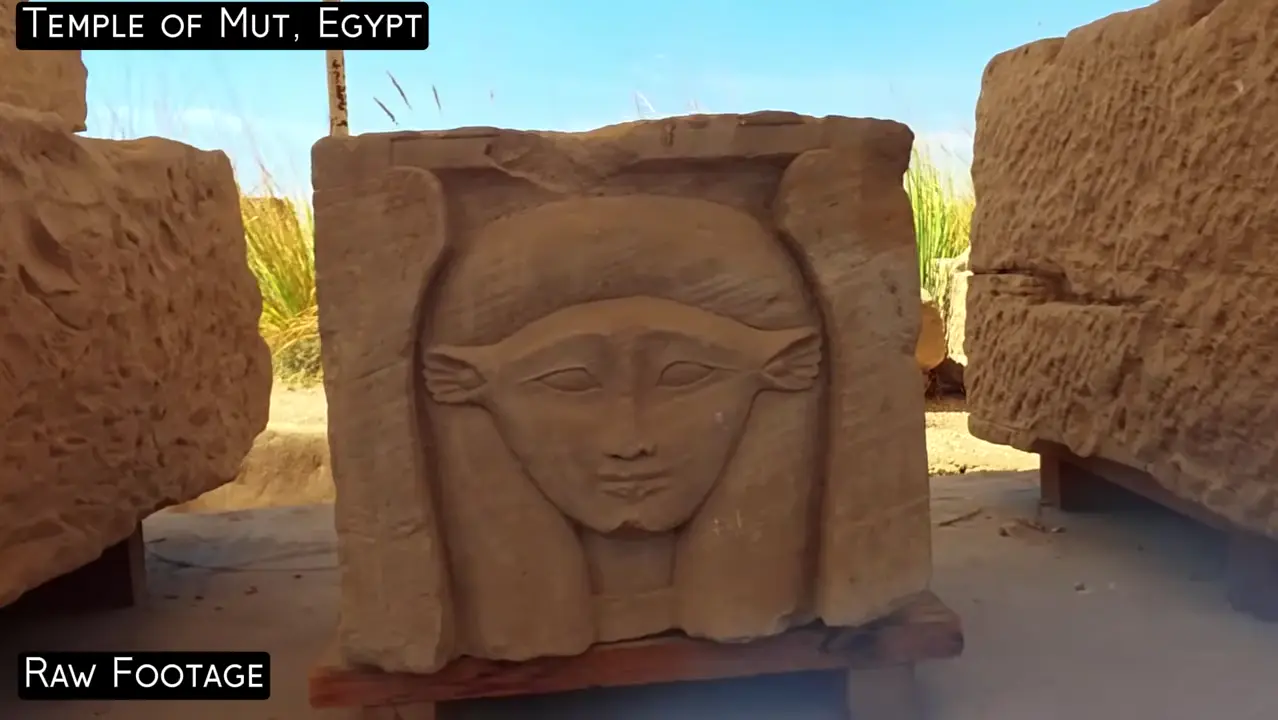
A video about statues from the Temple of Mut argues that unusual figures depict Hathor, pointing to their petal-shaped rather than conventional cow ears, elongated eyes, narrow noses, triangular faces, side-framing hair, slender necks and headdresses. The temple is well documented for its extensive Sekhmet statuary, and some statues survive without their heads. Identifying the unusual figures as Hathor is the video's interpretation, not an established attribution in the cited sources.
Video argues unusual Temple of Mut statues may depict Hathor
 EgyptArtifact
Site mentioned
Key facts
- The video argues that unusual statues from the Temple of Mut depict Hathor with petal-shaped rather than conventional cow ears.
- It describes elongated eyes, narrow noses, triangular faces, side-framing hair, slender necks and headdresses.
- Sekhmet statues form a major body of the documented statuary at the Temple of Mut.
- Headless and damaged statues survive at Mut; the search results specifically mention the colossal Ramesses III statues missing their heads.
- The Hathor identification and claimed contradiction of traditional iconography are the video's interpretation, not established conclusions in the cited sources.
Sources
Mut Temple In Luxor - Main Destinations in Egypt - egyptopia.comegyptopia.com
... Temple and it was used until the Greco-Roman Period. Today, the temple is in ruins and hundreds of statues are scattered all over its central part. The temple ...
Traces of Scenes and Artifacts Featuring Hathor - Joan Lansberryjoanannlansberry.com
The "Karnak Cachette", discovered by Georges Legrain, featured in addition to bronze statues, nearly 800 stone statues, among them more than 350 cube statues ( ...
Triad of Ramesses II - Egypt Museumegypt-museum.com
Pink granite triad statue depicting king Ramesses II seated between the god Amun and the goddess Mut represented with the attributes of the goddess Hathor.
Exhibition Objects - Divine Egypt - The Metropolitan Museum of Artmetmuseum.org
Group statue of Hathor in four of her aspects, Stone - Quartzite. Returned to lender. Group statue of Hathor in four of her aspects. ca. 1295–1070 BCE.
Mut Temple - ARCE - American Research Center in Egyptarce.org
Ramesses II added a forecourt and pylon fronted by two colossal alabaster stelae and two colossal statues, both usurped from Amunhotep III. The stelae, created ...
Sekhmet statuesen.wikipedia.org
The statues can be found throughout the temple of Mut and the mortuary temple of Amenhotep III that would be the kings eternal ritual calendar.
Egypt's Ageless Goddess - Archaeology Magazine Archivearchive.archaeology.org
Straight ahead were the ruins of the Mut Temple itself, with two front courtyards, halls, chapels, and the sanctuary in which the statue of Mut had stood.
Tag: Temple of Muttalesfromthetwolands.org
And at the front of the temple stood two colossal statues of Ramesses III, which are now missing their heads. The other of these shrines is ...
Was this story useful?
Keep exploring
Every site on this page sits on the globe, and the people who research them are on the Discord.
3D Globe · Sites by country · Story Archive · Research Library · Weekly Journal · Search
AI-generated text · images from the original sources · always verify with the sources.