

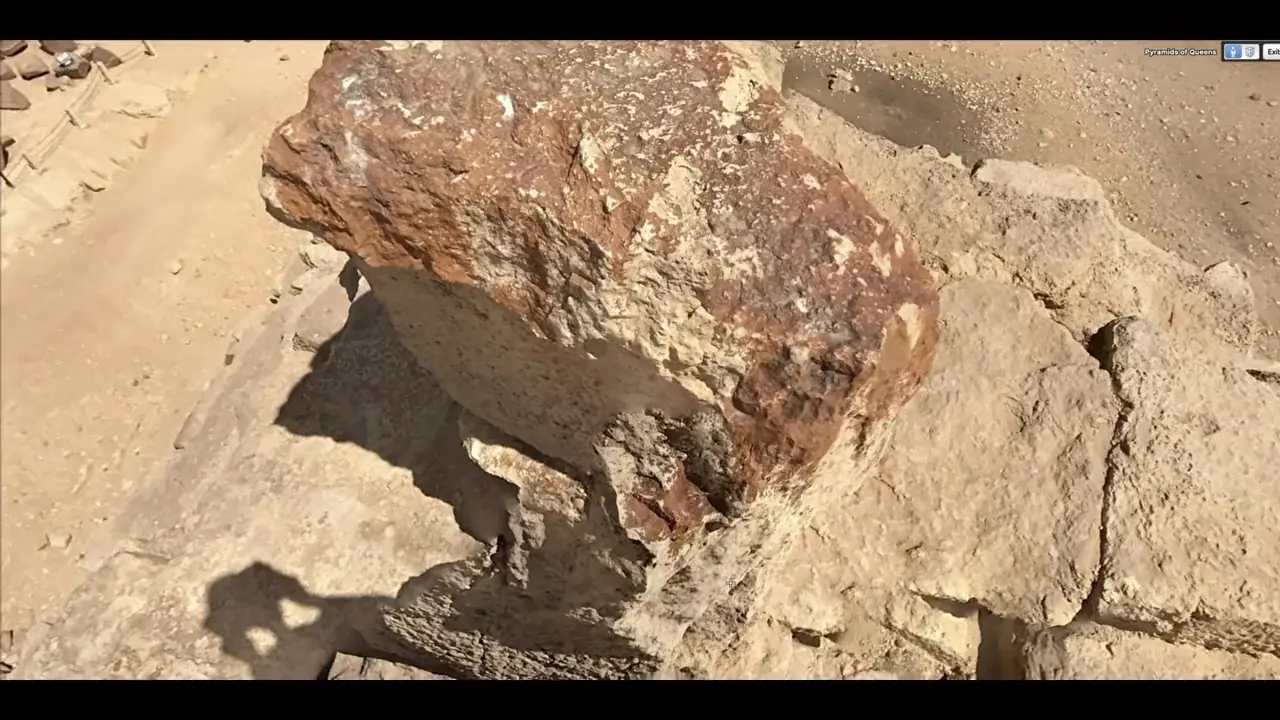
Old maps of Giza show anywhere from 2 to 11 pyramids, while today there are three main ones plus six subsidiary. Danish naval officer Frederic Louis Norden claimed a "fourth" dark stone pyramid near Menkaure. The video argues he was describing GIII-a, the easternmost of Menkaure's three subsidiary pyramids — the only true one — whose summit still carries a single squared block on a pedestal, just as Norden described. A theory, but a well-reasoned one. 🧱
Video argues Norden's "fourth black pyramid" was Menkaure's GIII-a subsidiary
 EgyptTheory
Key facts
- Maps of Giza from about 200 years ago show varying counts of pyramids (2, 3, 4, 7 and even 11), reflecting what each mapmaker counted
- Giza today comprises three main pyramids and six smaller subsidiary pyramids, nine in total
- Norden disputed John Graves's description in Pyramidia that Menkaure's pyramid was covered with basalt, stating that the black-stone pyramid was instead the fourth pyramid
- Norden wrote on page 146 that the fourth pyramid was built toward the middle of a stone darker and harder than common granite, with stones 'wanting' to it lying in a heap at the northeast corner and a summit of yellowish limestone like Portland stone terminating in a cube
- Norden wrote on pages 120-121 that the fourth pyramid stood about 100 ft lower than Menkaure, was without casing, closed, had no temple, lay out of line slightly to the west, and ended at the top in a single great stone serving as a pedestal
- Norden also stated the pyramids were about 400 paces apart and that one opened subsidiary pyramid contained a square chamber 30 ft deep
- Howard Vyse proposed that Norden was referring to GIII-a, the easternmost of Menkaure's three subsidiary pyramids and the only one that is a true pyramid, the others being stepped; the video agrees GIII-a is the most likely candidate
- The video argues that drifting sand buried a lower granite belt on Menkaure while dark granite casing rubble lying near the site made GIII-a look darker than Menkaure's limestone core
- A large squared single block standing on a pedestal is visible on top of GIII-a, matching Norden's description of the fourth pyramid's summit
- The video notes a pyramid placed by Norden's 400-pace spacing could hardly have vanished entirely before Vyse and Lepsius worked at Giza roughly a century later
Sources
archive.org
Linked in video description
Norden's four pyramids. | Download Scientific Diagramresearchgate.net
The Giza Big Dipper correlation hypothesis shows that there were six main pyramids at Giza. In turn, these six pyramids correspond to the first six planets, ...
Missing Fourth Great Pyramid of Giza may Finally Have ...thevintagenews.com
Norden's sketch from the 1700s showing 4 pyramids at Giza. Other experts, however, have long discounted the notion of a fourth pyramid ...
Diskerfery and the Alignment of the Four Main Giza Pyramidszenodo.org
Norden supplied 3 different diagrams showing the four pyramids, of which the 2D/3D map view is the most useful. This diagram (Figure 16), which ...
Putting Egypt on the map: Frederik Ludvig Norden's ...exploreyourarchive.org
They stayed in Egypt for another four months; Norden took the opportunity to revisit the pyramids. Everywhere he went, Norden had made plans ...
The Pyramid Age Settlement of the Southern Mount at Gizaresearchgate.net
They are made of limestone and basalt slabs or just hard clay and small stones. Numerous patches of cleaner sand indicated the presence of graves.
Was this story useful?
Keep exploring
Every site on this page sits on the globe, and the people who research them are on the Discord.
3D Globe · Sites by country · Story Archive · Research Library · Weekly Journal · Search
AI-generated text · images from the original sources · always verify with the sources.