

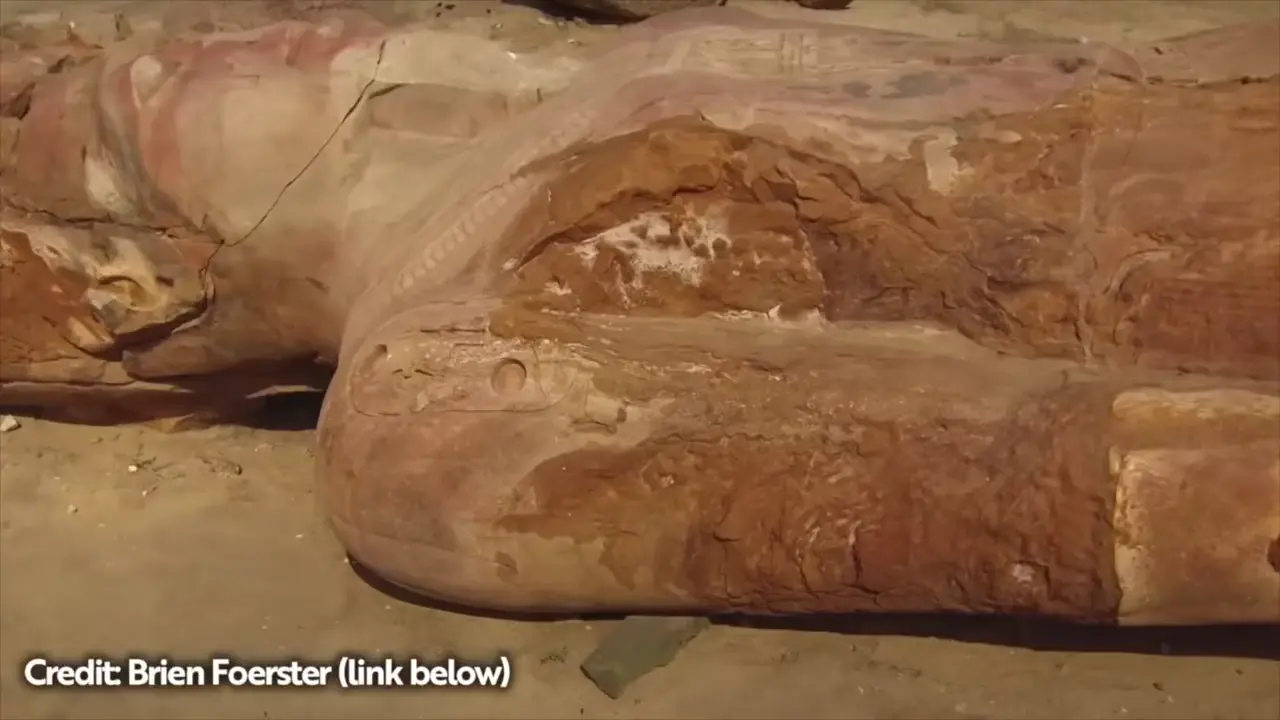
This presenter built the Greek fire hypothesis while researching Tanis (Egypt) in the Nile Delta, where 21st Dynasty statues reused from Pi-Ramesses show partial melting and discolouration. He links it to the Fourth Crusade's 1168-1169 invasion, when Amalric I of Jerusalem took Tanis (Egypt) by force. Unproven. 🤔
Video argues Greek fire explains the scorched statues of Tanis (Egypt)
 EgyptTheory
Site mentioned
Key facts
- The presenter developed the Greek fire hypothesis while researching the ancient Egyptian city of Tanis (Egypt) in the Nile Delta, to explain the burnt appearance of many of its statues.
- The large statues at Tanis (Egypt) date mainly to the 21st Dynasty, and many were reused from the older city of Pi-Ramesses.
- A violent earthquake is thought to have struck Tanis (Egypt) in the Byzantine era, destroying many of the giant statues and structures, after which the site contracted into a small bishopric.
- The video proposes a 7th-century scenario: the Persians captured Alexandria in the 7th century and a decade of violence followed, including the massacre of hundreds of monks, and the presenter asks whether a Persian-Byzantine battle at Tanis (Egypt) could account for the scorched statues.
- An alternative dating offered is the Fourth Crusade's invasion of Egypt between 1168 and 1169, when Crusaders under Amalric I of Jerusalem took Tanis (Egypt) by force and slaughtered the townspeople.
- The presenter suggests the Greek fire formula may have been shared with the Crusaders after 1167, when Amalric married a great-grandniece of a Byzantine emperor and an anti-Egyptian alliance was negotiated.
- A 14th-century Egyptian historian is cited as reporting that Egypt's defending vizier distributed tens of thousands of naphtha pots and 'lightning bombs' to the people of the capital Fustat; naphtha is a flammable liquid hydrocarbon mixture.
- The video states that the Tanis (Egypt) statues show localised fire damage, described as partial melting and discolouration of the rock in specific places, and presents Greek fire or another fire weapon as a possible but unproven explanation.
Sources
Pi-Ramessesen.wikipedia.org
The masses of broken Ramesside stonework at Tanis led archaeologists to identify it as Pi-Ramesses. Yet it eventually came to be recognised that none of these ...
Pi-Ramessesgoogle.com
The main temple in the city was that of Amun, Ramesses II's patron god, which was said to be massive and included enormous statues of Ramesses ...
Identifying Pi Ramessesgoogle.com
Corresponding to the archaeological site of Qantir in northeastern Egypt, Pi Ramesses became Egypt's capital during the reign of Ramesses II, ...
r/papertowns - Pi-Ramesses (Egypt) in the 13th century BCgoogle.com
Pi-Ramesses, meaning “House of Ramesses,” was the capital city built by Pharaoh Ramesses II in the 13th century BC during Egypt's 19th ...
Statue of Ramesses II at Tanisgoogle.com
Pierre Montet's excavations at Tanis uncovered a monumental group statue from the reign of Ramesses II showing the king as a child in classic ...
Was this story useful?
Keep exploring
Every site on this page sits on the globe, and the people who research them are on the Discord.
3D Globe · Sites by country · Story Archive · Research Library · Weekly Journal · Search
AI-generated text · images from the original sources · always verify with the sources.