

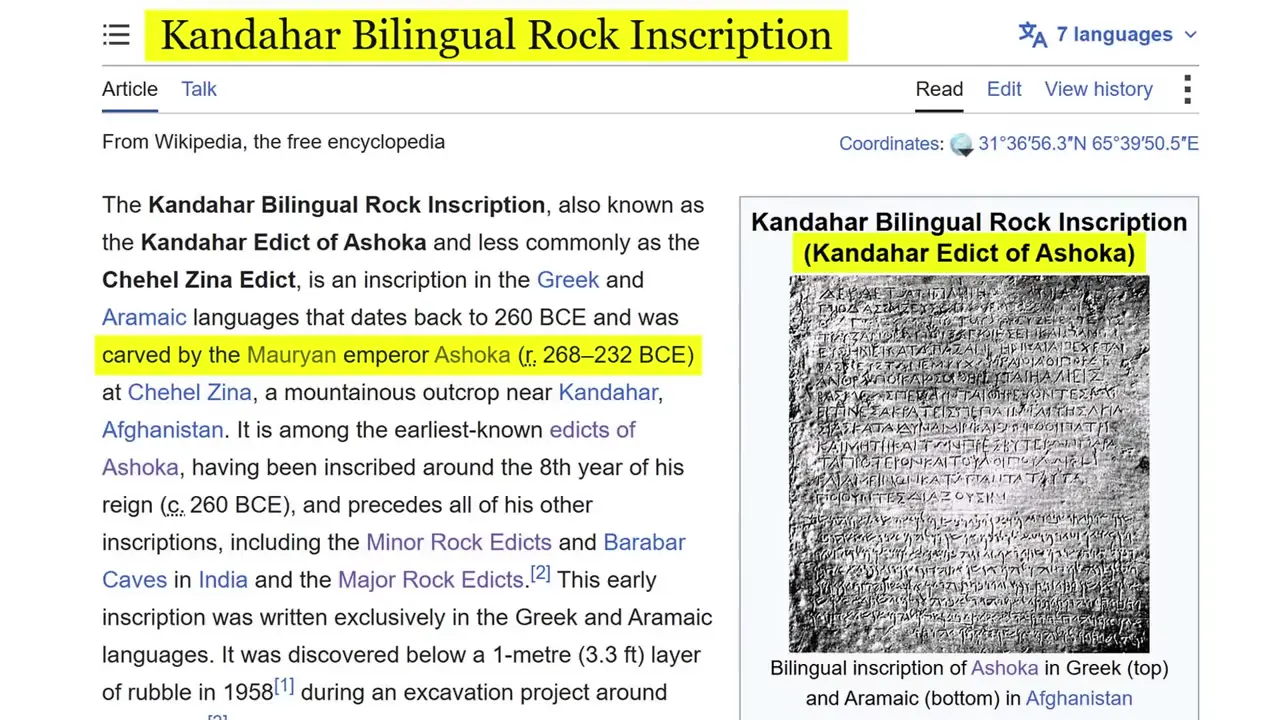
The video argues that the high polish on Ashoka's sandstone pillars came from Achaemenid masons displaced after Alexander's army burned Persepolis in 330 BCE. Mauryan polish is well documented, but the proposed Persian transfer is not established. The c. 260 BCE Kandahar bilingual, in Greek and Aramaic, records cultural and linguistic exchange under Ashoka; it does not confirm displaced craftsmen or the source of Mauryan stonework. Kharosthi does derive from Aramaic, while the claim of a sudden leap from timber to monumental stone remains an interpretation.
Video argues Achaemenid masons brought stone polish to Mauryan India
 IndiaArchitecture
Key facts
- Mauryan polish is a recognized smooth, lustrous finish on Mauryan sandstone. The Lion Capital at Sarnath and the life-size Didarganj Yakshi now in Bihar Museum are noted examples.
- Alexander's army sacked and burned Persepolis in 330 BCE during the Achaemenid Empire's collapse. No cited evidence establishes that displaced Persian masons carried the technique to Mauryan India.
- The Kandahar bilingual, dated about 260 BCE, is written in Greek and Aramaic. It records the languages and cultural forms used under Ashoka, not the identity of the craftsmen who made Mauryan stone monuments.
- Kharosthi derives from Aramaic, but that linguistic relationship does not establish Achaemenid authorship of Mauryan masonry.
- The supplied results do not substantiate a Bihar Museum statement calling Mauryan polish an imported Achaemenid technique, or the claim that pre-Mauryan monumental architecture was almost wholly timber, thatch and brick with no gradual stone development.
- Comparisons between Ashokan pillars and Persepolis are formal interpretations; they do not by themselves establish a transfer of craftsmen or technique.
Sources
bam-investigations.com
Linked in video description
bam-investigations.com
Linked in video description
lifeonweekends.com
Linked in video description
irna.fr
Linked in video description
lah.ru
Linked in video description
geolines.ru
Linked in video description
Mauryan polishen.wikipedia.org
Mauryan polish is found especially in the Ashoka Pillars. All known Mauryan pillars have the characteristic mirror-like polish, although most were left ...
Ashokan Pillars: Mauryan India's Imperial Art in Stonestudiomatrx.org
In the third century BCE, the Mauryan emperor Ashoka set up polished stone columns across his empire — each a single shaft of sandstone, ...
Was this story useful?
Keep exploring
Every site on this page sits on the globe, and the people who research them are on the Discord.
3D Globe · Sites by country · Story Archive · Research Library · Weekly Journal · Search
AI-generated text · images from the original sources · always verify with the sources.