The Tunguska airburst occurred at about 7:14 a.m. on June 30, 1908, over Central Siberia. Estimates put the object at 50–70 metres (165–230 feet) and the explosion energy at 10–15 megatons TNT. June 30 is now Asteroid Day. Chelyabinsk was about 20 metres (66 feet) wide in 2013 and injured roughly 1,500 people.
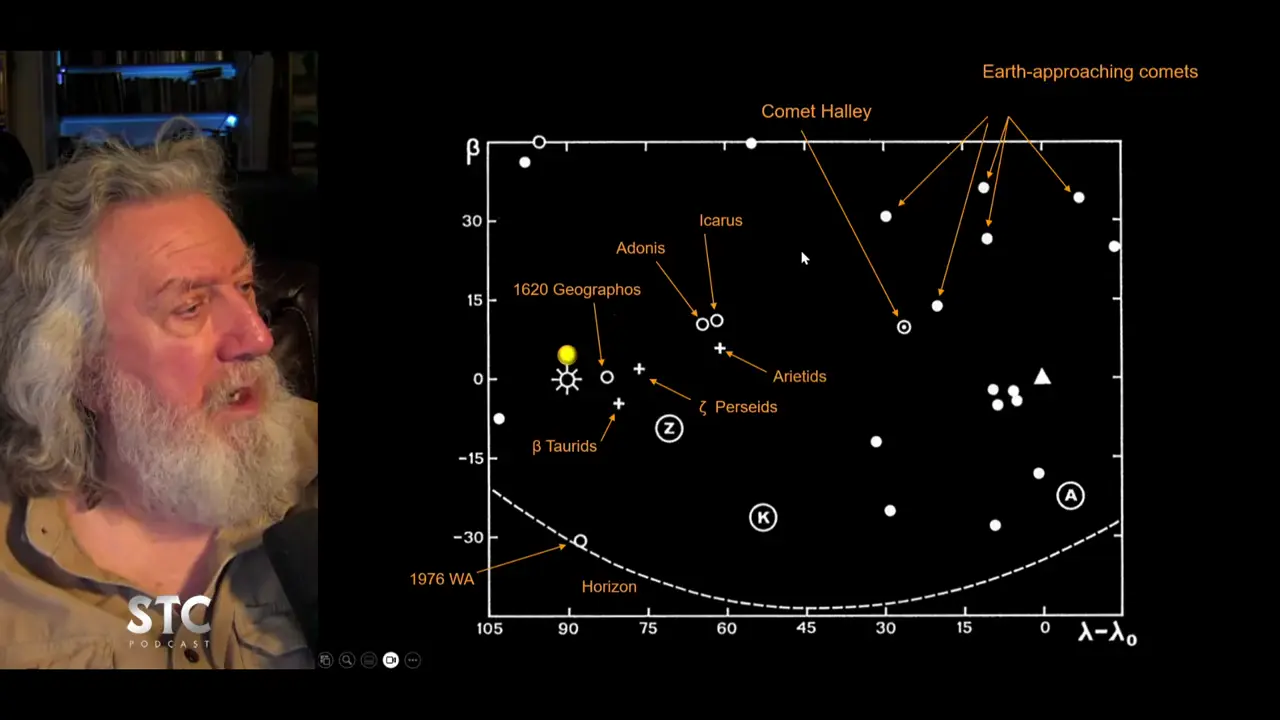
The video argues that its reconstruction of eyewitness bearings at points A, K and Z places Tunguska's radiant near the Taurid stream. That link remains disputed. Geographos, Icarus and Adonis do not share a 2.2-AU orbit. The video also cites a 1975 lunar impact swarm and a proposed 80-kilometre parent comet on a sub-Jovian orbit 25,000–30,000 years ago; neither establishes the Tunguska–Taurid connection.
Sources
THE TUNGUSKA EXPLOSION OF 1908icr.orgThe Tunguska explosion occurred on the morning of June 30, 1908 at 7:17 A.M. local time (0h 17m 11s U.T.) in the area of the Stony Tunguska River … velocity of ...
1908 SIBERIA EXPLOSION: Reconstructing an Asteroid Impact ...psi.eduAt 7:17 AM on the morning of June 30, 1908, a mysterious explosion occurred in the skies over Siberia. It was caused by the impact and breakup of a large ...
The Tunguska Mystery Explosion | Originsorigins.osu.eduOn June 30, 1908, a massive mysterious explosion of a cosmic body shook the skies of Tunguska (in Siberia), on a date that would come to be ...
Tunguska event - Wikipediaen.wikipedia.orgThe Tunguska event was a large explosion of between 3 and 50 megatons TNT equivalent … on the morning of 30 June [O.S. 17 June] 1908.
115 Years Ago: The Tunguska Asteroid Impact Event - NASAnasa.govOn June 30, 1908, an asteroid plunged into Earth's atmosphere and exploded in the skies over Siberia. reported seeing a fireball and hearing a ...
Tunguska Eventarmagh.spaceOn the morning of 30 June 1908, a massive explosion shook the sparsely-populated Eastern Siberian taiga. It was a visitor from outer space:
Tunguska event | Summary, Cause, & Factsbritannica.comThe Tunguska event on June 30, 1908, flattened some 2,000 square km (500,000 acres) and charred over 100 square km of pine forest near the ...
#24 — The Event of Tunguska | Asteroid Day 2026 Seriesasteroidday.orgThis event has passed. On June 30, 1908, a gigantic explosion shook Siberia and flattened nearly 80 million trees within seconds. No crater. No ...
AI-generated text · images from the original sources · always verify with the sources.