

In 1998, astronomer Duncan Steel proposed Stonehenge's earliest phase tracked meteor showers, not the Sun. Around 3500–3100 BCE, Earth crossed dense pockets of debris from Comet Encke—the Taurids. This timing aligns with the Cursus and Stonehenge's first construction. The Tunguska event of 1908 (830 sq miles flattened) may have been a Taurid fragment, suggesting these storms posed real ancient danger.
Stonehenge may have been built to predict meteor storms
 EnglandArchaeoastronomy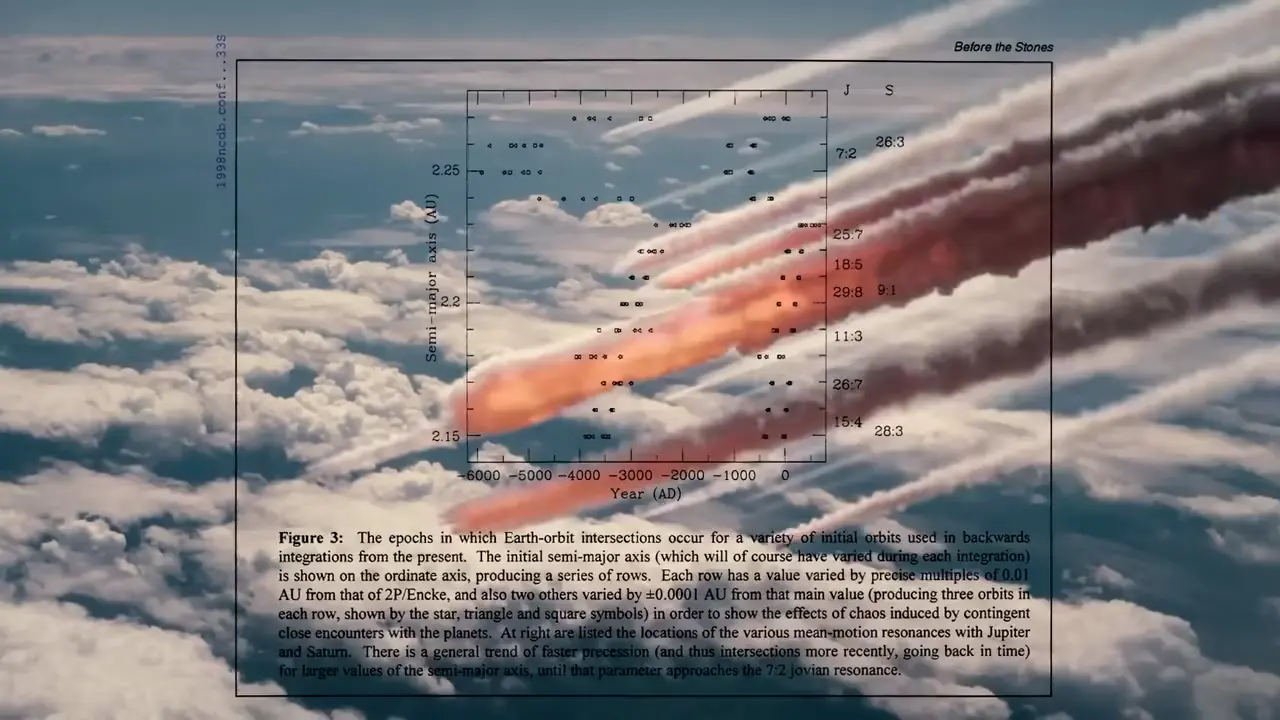
Site mentioned
Key facts
- In 1998, astronomer Duncan Steel proposed Stonehenge's earliest phase was built to predict meteor storms, not honor the Sun
- The theory concerns the Taurids, a meteor shower stretching across weeks, caused by debris from Comet Encke
- Around 3500 BCE and 3100 BCE, Earth likely crossed dense pockets of Encke's trail
- This timing matches when Neolithic builders constructed the Cursus and first bank and ditch of Stonehenge
- Around 3100 BCE, the meteor radiant sat north of the midsummer sunrise, aligning with solstice view
- The Tunguska airburst in 1908 flattened roughly 830 square miles of forest, possibly from a Taurid fragment
- Steel suggests the ancients watched for predictable patterns—stormy Junes followed by calm stretches
Sources
(PDF) Stone Transport of the Olmec - Academia.eduacademia.edu
ṣadr al-Sharī ˓ ah al-Thanī, ˓ Ubayd Allāh ibn Mas ˓ ūd (fl. Bukhārā, d. 747 AH/AD 1347), was a scholar and astronomer of the fourteenth century.
Before the Stones: Stonehenge I as a Cometary Catastrophe Predictorui.adsabs.harvard.edu
Steel, Duncan. Abstract. Publication: Natural Catastrophes During Bronze Age Civilisations: Archaeological, Geological, Astronomical and Cultural Perspectives.
Astronomers' Universe - Springer Naturelink.springer.com
never realize that Earth was going around the Sun, not vice versa. Over a ... culminating around 1800 b.c. with the fi nal phase of Stonehenge at the ...
Dragon Precession - DRAGON Labyrinth 2012-2014drakenberg.weebly.com
... Stonehenge Around 3100 BC ... Earth's orbital plane for some centuries around 3000-3500 BC." Was it Oljato's tail that swarmed Earth around 3100 BC?
Stonehenge - Scott's Astronomy Pagescottsastropage.com
So on to Stonehenge we went, and while the sky still had a “spring shower at any moment” look to it, the rain ended and we were able to thoroughly investigate ...
Was this story useful?
Keep exploring
Every site on this page sits on the globe, and the people who research them are on the Discord.
3D Globe · Sites by country · Story Archive · Research Library · Weekly Journal · Search
AI-generated text · images from the original sources · always verify with the sources.