

Trypillia lasted over two millennia, peaking around 4200-3600 BC. Megasites stopped functioning at scale around 3650-3500 BC, before Yamnaya expansion at 3500 BC and dramatic invasion at 3300 BC. Ecological models show they hadn't exhausted resources. Their genetic legacy persists in modern Romanian, Moldovan, and Ukrainian populations at 20-60%.
Trypillia culture declined around 3650-3500 BC before Yamnaya steppe interactions
 UkraineGeneral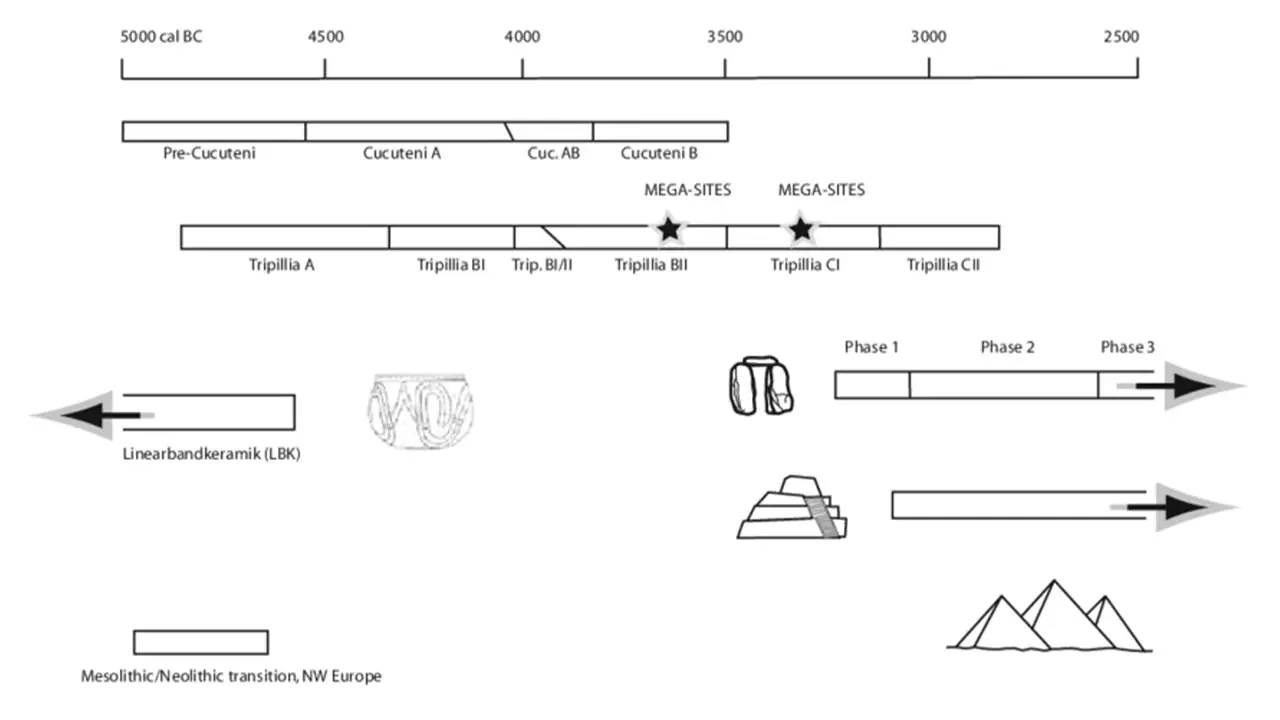
Key facts
- Trypillia culture lasted more than 2 millennia, from approximately 5000 to 2800 BC
- Peak period was around 4200 to 3600 BC
- Large settlements with thousands of houses stopped functioning at enormous scale around 3650 to 3500 BC
- Ecological modeling shows populations had not exhausted the forest steppe carrying capacity
- Drought may have played a role in some places but is insufficient to explain general decline
- Around 3700 BC, neighborhood-level assembly houses began disappearing, possibly indicating push toward centralization
- CT people from Moldova dating 3500 to 3100 BC still predominantly Neolithic farming populations though carrying steppe ancestry
- Yamnaya expansion of horses and wheeled transport began around 3500 BC
- Dramatic Yamnaya invasion happened around 3300 BC, after Trypillia megasites had already diffused
- Genetics of these Neolithic farmers remain in modern Romanian, Moldovan, and Ukrainian populations at 20 to 60 percent
Sources
pmc.ncbi.nlm.nih.gov
Linked in video description
sfb1266.uni-kiel.de
Linked in video description
Cucuteni–Trypillia cultureen.wikipedia.org
During its middle phase (c. 4100 to 3500 BC), populations belonging to the Cucuteni–Trypillia culture built some of the largest settlements in Eurasia, some of ...
2010-1.Introduction: Trypillian Civilization in the prehistory of ...trypillia.com
Scientists have found some traces of very old metallurgy, which flourished between 5000-4500 BC on the Balkans, graves with golden treasures, ...
Trypillia Cultureeuropeanheritagedays.com
It existed during the Eneolithic period from the 6th to the 3rd millennia BC ( Біфор Крайст)) on the territory of modern Ukraine, Moldova and Romania. As ...
Trypillia: 7000-year-old civilisation silenced by communistsbbc.com
The Cucuteni–Trypillia culture is one of the of the oldest civilisations in the world and dates back to 5,000 BC.
Cucuteni-Trypillia Civilization (Ukraine) - World Heritage Centrewhc.unesco.org
Chronology and periodization. The following chronological phases define this civilization: Precucuteni I (ca. 5000-4900 BC): unique to Romania's territory ...
Trypillian Culture Historical Periods | Eras & Timelinetrypillia.com
Spanning from 5500 to 2700 BCE, this ancient society was never static. 5500 – 4800 BCE ・ 4800 – 4000 BCE Middle Trypillia Golden Age ・ 4000 – 2700 BCE Late ...
Was this story useful?
Keep exploring
Every site on this page sits on the globe, and the people who research them are on the Discord.
3D Globe · Sites by country · Story Archive · Research Library · Weekly Journal · Search
AI-generated text · images from the original sources · always verify with the sources.