

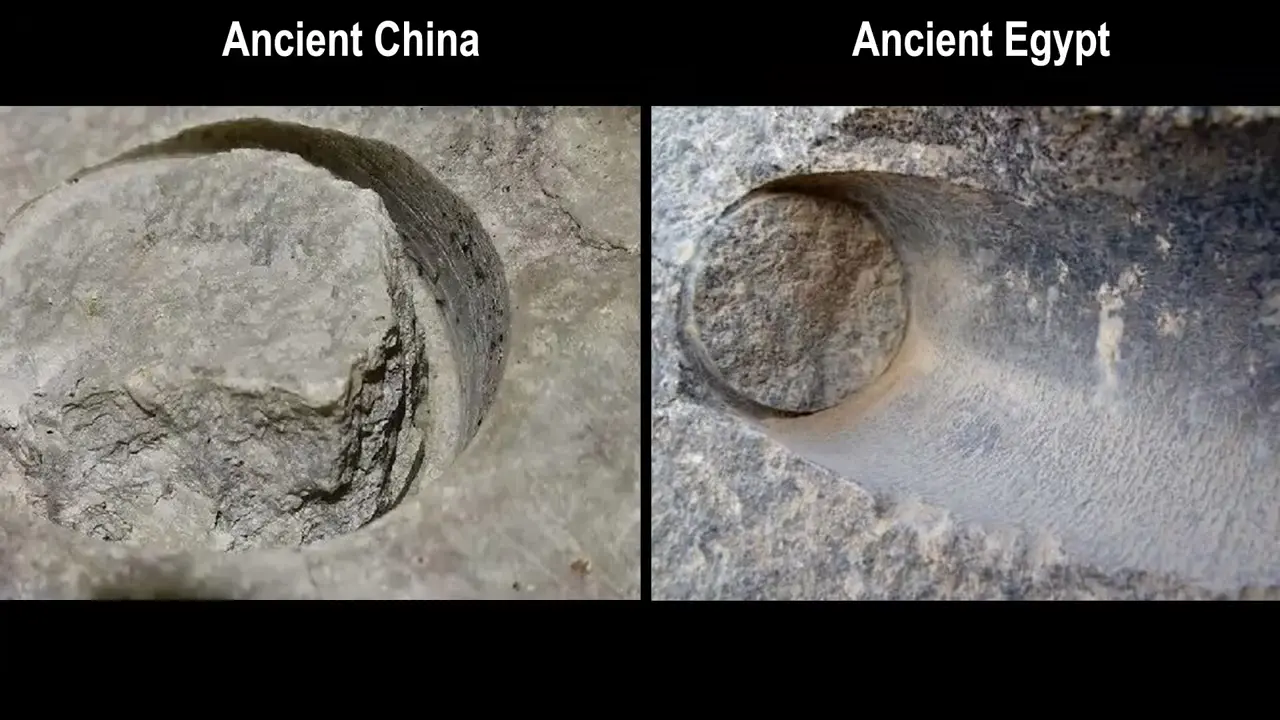
Ancient Egyptian stone artifacts display striking drill and saw marks—cone-shaped cores, concentric striations, and parallel cuts—demonstrating precision drilling and sawing techniques using tubular copper tools and abrasive minerals. The granite core published by Petrie was made by ancient Egyptians using a tubular drill, with each concentric line representing a single rotation of the drill. Long saw cuts through stone and vertical parallel saw marks next to each other are also documented in Egyptian stonework.
Tool Mark Similarities: Chinese Jade vs Egyptian Stone
Key facts
- Tubular drill marks on ancient Chinese jade resemble markings on Predynastic and Dynastic Egyptian stone vases and granite cores
- Liangzhu jade cores show concentric striations similar to Egyptian granite cores
- Both Chinese and Egyptian cores are cone-shaped, narrower at the bottom due to drilling dynamics
- The spiral concentric lines were caused by hard abrasive mineral grains during continuous rotational drilling
- Straight rigid saw marks on Chinese jade fragments resemble saw marks on ancient Egyptian stone items
- Both have straight parallel shallow marks
- Chinese used bamboo tube drills while Egyptians may have used copper tubes
Sources
Ancient Egyptian Stone Technology - Saw Marks - Spirit & Stonetheglobaleducationproject.org
In one place you can find many vertical parallel saw cuts right next to each other. In another place near those, you can see long saw cuts going through this ...
Expedition Magazine | Ancient Egyptian Stone-Drilling - Penn Museumpenn.museum
The granite core published by Petrie was made by the ancient Egyptians using a tubular drill. Note the similarity of the concentric lines (arrow) found on the ...
Was this story useful?
Keep exploring
Every site on this page sits on the globe, and the people who research them are on the Discord.
3D Globe · Sites by country · Story Archive · Research Library · Weekly Journal · Search
AI-generated text · images from the original sources · always verify with the sources.