

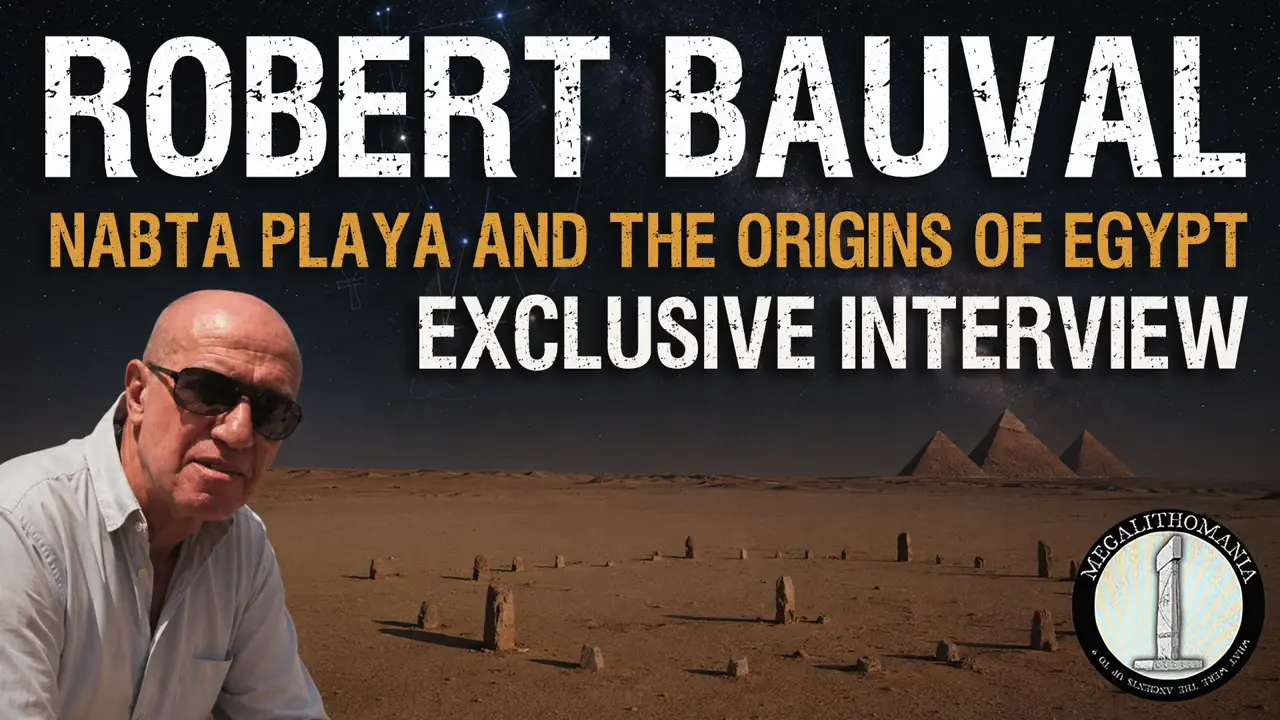
The video presents Robert Bauval’s Orion Correlation Theory. Bauval says he noticed the diagonal arrangement in 1983, formally presented the theory in 1989 and popularised it in his 1994 bestseller The Orion Mystery. He argues that Khufu, Khafre and Menkaure roughly correspond to Alnitak, Alnilam and Mintaka: Khufu and Khafre were similar in scale, while Menkaure was smaller and lay southwest. Bauval interprets the Great Pyramid’s southern shaft as pointing toward Orion’s Belt around 2450 BCE; the northern shaft has other proposed targets, including Thuban. His claimed Nile–Milky Way correspondence remains disputed. Alexandre Badawy had proposed the southern shaft’s Orion link in 1948, and any support from I. E. S. Edwards for an astronomical shaft reading did not confirm the broader theory.
The video presents Bauval’s disputed Orion–Giza archaeoastronomy theory
 EgyptGeneral
Key facts
- Bauval dates his initial observation to 1983 and formally proposed the Orion Correlation Theory in 1989; it remains a disputed hypothesis rather than an established archaeological finding.
- His proposed correspondences are Khufu–Alnitak, Khafre–Alnilam and Menkaure–Mintaka. Khufu and Khafre were similar in scale, not exactly equal, and the resemblance is approximate.
- The Orion-Belt claim chiefly concerns the Great Pyramid’s southern shaft, interpreted as aimed at Orion’s Belt around 2450 BCE. The northern shaft has other proposed astronomical targets, including Thuban.
- The claimed mirror between Giza’s position relative to the Nile and Orion’s Belt within the Milky Way is part of Bauval’s interpretation, not a confirmed result.
- Alexandre Badawy proposed the southern shaft’s Orion connection in 1948. I. E. S. Edwards was a former British Museum curator and UCL professor; discussion of astronomical shaft targets did not establish the broader Orion correlation theory.
- Bauval formally presented the theory in 1989 and popularised it in his 1994 book The Orion Mystery, which became an international bestseller.
Sources
robertbauval.co.uk
Linked in video description
Orion correlation theoryen.wikipedia.org
The Orion correlation theory was put forward by Robert Bauval, making up Orion's belt, in the Giza pyramid complex.
Archaeoastronomical Study of the Main Pyramids of Giza ...researchgate.net
Bauval, Gilbert, Orofino and Bernardini investigated the similarity between Orion's belt and locations of the three largest pyramids in the ...
Astronomical Integrity at Gizahallofmaat.com
Bauval and Gilbert mapped more than Orion's Belt onto the ground in northern Egypt. Other pyramids provided additional elements of the ...
A Master-Plan for the Three Pyramids of Giza based on ...academia.edu
The alignment of the Giza pyramids corresponds deliberately to the Belt of Orion's configuration. The three stars of Orion maintain a stable position over ...
Orion and the Giza pyramidshallofmaat.com
The pyramid of the next king, Khufu, was built at Giza and its position is defined by that of z Orionis (Alnitak) in Orion's belt.
(PDF) A quantitative astronomical analysis of the Orion ...researchgate.net
The link between the three major Giza pyramids and the stars of the Orion Belt has been since long time the subject of various qualitative speculations.
Robert Bauvalen.wikipedia.org
Bauval is specifically known for the Orion Correlation Theory (OCT), which proposes a relationship between the fourth dynasty Egyptian pyramids of the Giza ...
Was this story useful?
Keep exploring
Every site on this page sits on the globe, and the people who research them are on the Discord.
3D Globe · Sites by country · Story Archive · Research Library · Weekly Journal · Search
AI-generated text · images from the original sources · always verify with the sources.