

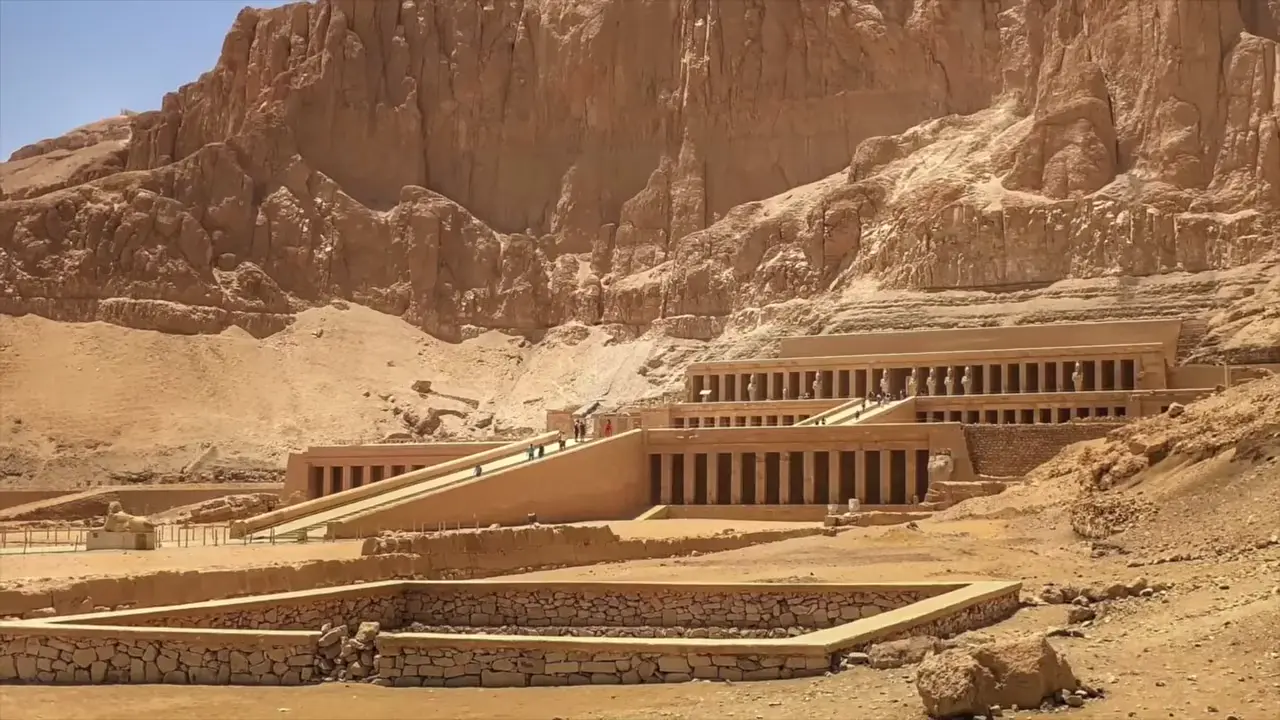
El-Qurn, the highest peak in the Theban hills, overlooks Deir el-Bahari and the Valley of the Kings, where Thutmose I became the first known king buried, in KV38. Meretseger, the guardian goddess of the Theban necropolis, was associated with the mountain. The video argues that El-Qurn functioned as a natural royal pyramid for Thutmose I and compares New Kingdom cliff-side mortuary temples with Old Kingdom pyramid complexes. It also cites Josef Wegner’s observation that the cliffs behind Senusret III’s Abydos complex resemble a freestanding pyramid from the east. 🔺👑
The video argues El-Qurn served as a natural pyramid for Thutmose I
 EgyptTheory
Key facts
- Abydos was a sacred landscape throughout dynastic history, with a predynastic settlement and an Early Dynastic royal necropolis.
- Senusret III’s Middle Kingdom mortuary complex at Abydos is generally interpreted as a cenotaph associated with Osiris rather than his burial place.
- Egyptologist Josef Wegner observed that the cliffs behind Senusret III’s Abydos complex, viewed from the east, resemble a freestanding, symmetrical pyramid.
- Ceiling texts in the Abydos complex refer to the site as the “mountain of Anubis.”
- El-Qurn is the highest peak in the Theban hills, overlooking Deir el-Bahari and the Valley of the Kings. Meretseger, meaning “she who loves silence,” was the guardian goddess of the Theban necropolis.
- Thutmose I was the first known king buried in the Valley of the Kings, in KV38 at the base of El-Qurn.
- A pyramid sign associated with the western cliffs in Hatshepsut’s temple may refer to their pyramid-like form.
- The video argues that El-Qurn functioned as a natural royal pyramid for Thutmose I and compares New Kingdom cliff-side mortuary temples with Old Kingdom pyramid mortuary complexes; these are interpretive claims rather than established equivalences.
Sources
Josef W. Wegner | Middle Eastern Languages and Culturesmelc.sas.upenn.edu
He is author of The Mortuary Temple of Senwosret III at Abydos (2007); co-author with D. Silverman and J. Houser-Wegner, Akhenaten and Tutankhamun ...
Mortuary Complex of Pharaoh Senwosret III at South Abydosarce.org
DirectorDr. Josef Wegner LocationSouth. Senwosret III, was a royal mortuary complex focused on a subterranean royal tomb at the base of the high desert cliffs.
Josef Wegner - University of Pennsylvania - Research Papersupenn.academia.edu
Josef Wegner, a researcher at University of Pennsylvania, researches Egyptology and Egyptian Archaeology, Senwosret III at Abydos. Senwosret III. the “Abydos ...
A Pharaoh's Massive Tomb Unveiledpopular-archaeology.com
Josef Wegner, Curator. He has been excavating in Abydos, where the tomb. Dated to 1850 BC, it is the largest tomb at Abydos. The tomb measures ...
THE ORGANIZATION OF THE TEMPLE NFR-K3 OF ...jstor.org
by J Wegner · 2000 · Cited by 40 — Years at South Abydos: Reconstructing the Temple of Senwosret III,. Expedition 42:2 (2000), 9-18. b J. Wegner, The Temple of Senwosret III at Abydos, volume in.
Abydos and its Relicsaustralian.museum
Abydos was possibly the capital at the very beginning of Egyptian history. the burial place of the earliest historic rulers of Egypt, First ...
The Serene Spirituality of Abydos Templethenotsoinnocentsabroad.com
The earliest pharaohs were buried here, as far back as 3000 BCE. Later, Abydos became a center of the cult of Osiris, the god of the underworld.
Abydos Archaeology Researchabydos.org
Abydos was the mythic burial place of the god Osiris and the ancestral home of their first kings. It was Egypt's single most sacred landscape for thousands of ...
Was this story useful?
Keep exploring
Every site on this page sits on the globe, and the people who research them are on the Discord.
3D Globe · Sites by country · Story Archive · Research Library · Weekly Journal · Search
AI-generated text · images from the original sources · always verify with the sources.