

Teotihuacan's entire layout sits 15.5 degrees off cardinal, aligning the Avenue of the Dead with Cerro Gordo. Ivan Šprajc proposed the two annual sunrises at this azimuth fall 260 days apart, matching the sacred Mesoamerican calendar. At latitude 15.5, those dates correspond to zenith passage, a pattern also seen at Copan.
Teotihuacan's 15.5-degree offset orientation may relate to the 260-day calendar
 MexicoArchaeoastronomy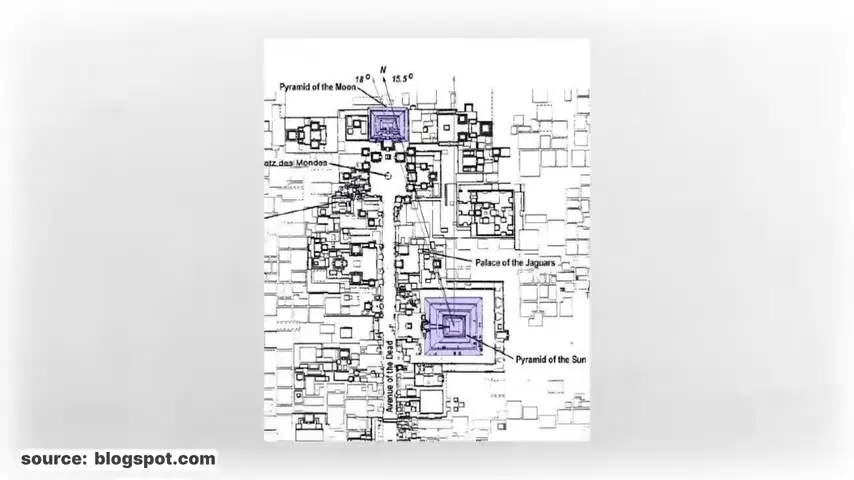
Site mentioned
Key facts
- Teotihuacan's entire city layout is oriented 15.5 degrees off cardinal directions, a pattern maintained from the first buildings through the grid road system
- The Avenue of the Dead and Pyramid of the Moon align with Cerro Gordo, the largest mountain on the horizon
- Ivan Šprajc proposed that 260 days pass between the two annual sunrises at the 15.5-degree azimuth, matching the Mesoamerican sacred calendar (the Maya Tzolk'in)
- At the latitude of 15.5 degrees, those same two sunrise dates correspond to days of zenith passage, when the sun passes directly overhead
- The Maya city of Copan, at latitude 15.5 degrees, shows alignments recognizing zenith passage, and Chocola, another Maya city at that latitude, has similar alignments identified by archaeologist Howie Green
- Copan represents the southernmost extent of Teotihuacan's known influence, raising the possibility of a connection between the city's orientation and its geographic sphere of influence
Sources
"Astronomical Alignments at Teotihuacan, Mexico" by Ivan Šprajcdigitalcommons.usf.edu
by I Šprajc · Cited by 69 — The two structures recorded sunrises and sunsets … included multiples of 20 days and a 260-day period.
Astronomical Alignments at Teotihuacan, Mexicojstor.org
by I Šprajc · 2000 · Cited by 69 — The interval from February 11 to October 29, as well as from August 13 to April 30, is exactly 260 days; 260 Teotihuacan length units of 83 cm each.
Astronomy at Teotihuacan | Springer Nature Linklink.springer.com
Located 37 km from Mexico City, during the first part of the first millennium AD, Teotihuacan was one of the world's largest and most populated cities.
Teotihuacan Astronomical Alignmentssatyori.com
The 260-day tonalpohualli is a fundamental cycle in Mesoamerican calendrics. It combines a cycle of 20 day-signs with a cycle of 13 numbers, yielding 260 unique ...
(PDF) Astronomical Alignments at Teotihuacan, Mexicoresearchgate.net
The two structures recorded sunrises and sunsets … included multiples of 20 days and a 260-day period. Šprajc 2000; Šprajc and Sánchez 2015).
Was this story useful?
Keep exploring
Every site on this page sits on the globe, and the people who research them are on the Discord.
3D Globe · Sites by country · Story Archive · Research Library · Weekly Journal · Search
AI-generated text · images from the original sources · always verify with the sources.