

The old story that Teotihuacan fell around 650 CE is crumbling. Revised evidence shows elite compounds were burned repeatedly starting in the 300s, with the city surviving roughly a century after the last fires. Archaeologist Ed Barnhart connects these burnings to an early New Fire Ceremony, renewing the world every 52 years.
Repeated burnings of Teotihuacan's center challenge the traditional fall date
 MexicoTheory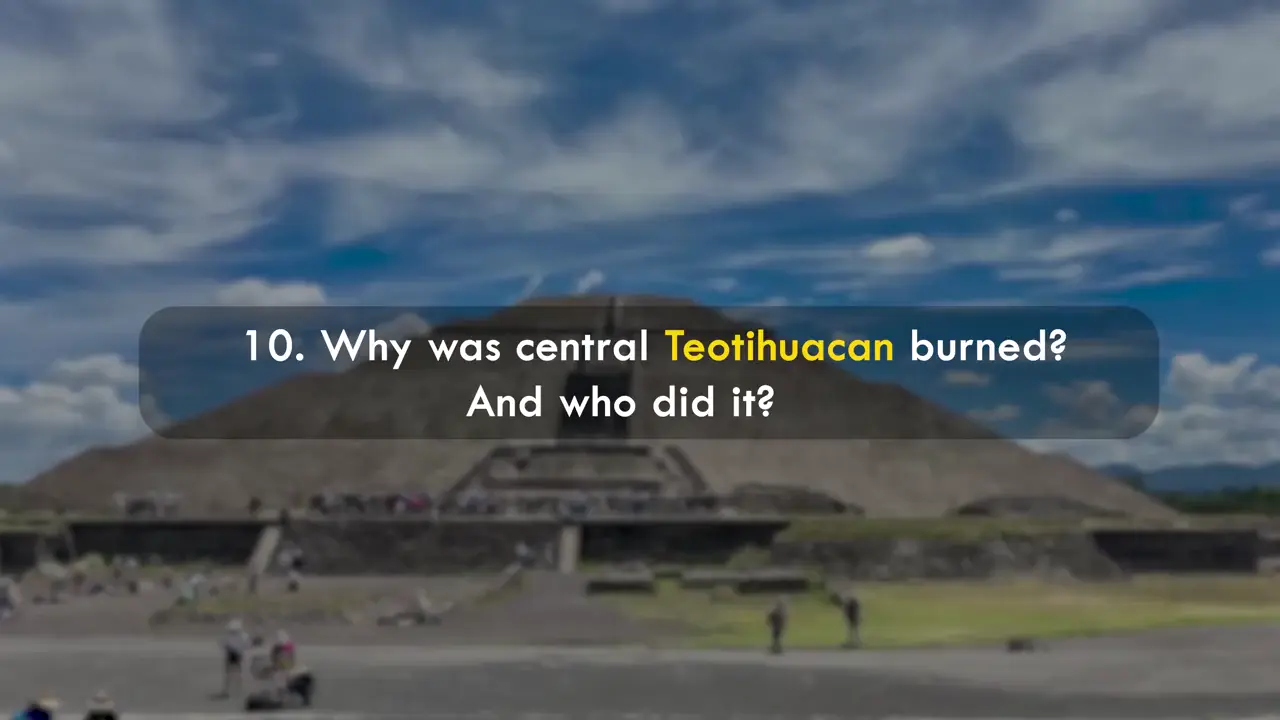
Site mentioned
Key facts
- Archaeologists discovered that elite compounds along the Avenue of the Dead were subjected to burning episodes
- The original narrative placed the burning around 650 CE as the event marking Teotihuacan's fall
- A reanalysis of the burning evidence revised the date earlier to approximately 550 CE
- A more in-depth study found that the burnings occurred repeatedly, with the earliest episode in the 300s CE
- The city itself survived for roughly a century after the last burning episodes, complicating the idea that burning marked the city's end
- One theory, favored by archaeologist Ed Barnhart, connects the burnings to an early version of the Aztec New Fire Ceremony, in which perfectly functional temples were burned every 52 years to renew the world and reset the calendar
- Teotihuacan notably lacked several features common to other Mesoamerican civilizations: no ball courts, no written language, and little evidence of adherence to the standard Mesoamerican calendar system
Sources
Mexico pyramid attack prompts new concerns beyond cartelsbbc.com
Mexican authorities say the Teotihuacán gunman acted alone and there was no apparent link to Mexico's widespread cartel violence. A graphic ...
Refining the absolute chronology of Teotihuacan (Mesoamerica)sciencedirect.com
by A Goguitchaichvili · 2022 · Cited by 7 — This new data, in combination with previous results, suggest that Teotihuacán experienced various fire episodes probably caused and controlled during…
Unearthing the Mysteries of Teotihuacan - UCR Newsnews.ucr.edu
One of the biggest discoveries yielded by Sugiyama and her team's excavations this past summer was evidence of a great fire. Charred walls and carbonized matter
Teotihuacan: City of Water, City of Fire | famsf-digital-storiesdigitalstories.famsf.org
Several sculptures from Teotihuacan, including this marble figure, exhibit evidence of violent destruction relating to a great fire that marked ...
Teotihuacanen.wikipedia.org
The city may have lasted until sometime between the 7th and 8th centuries CE, but its major monuments were sacked and systematically burned around 550 CE.
Was this story useful?
Keep exploring
Every site on this page sits on the globe, and the people who research them are on the Discord.
3D Globe · Sites by country · Story Archive · Research Library · Weekly Journal · Search
AI-generated text · images from the original sources · always verify with the sources.