

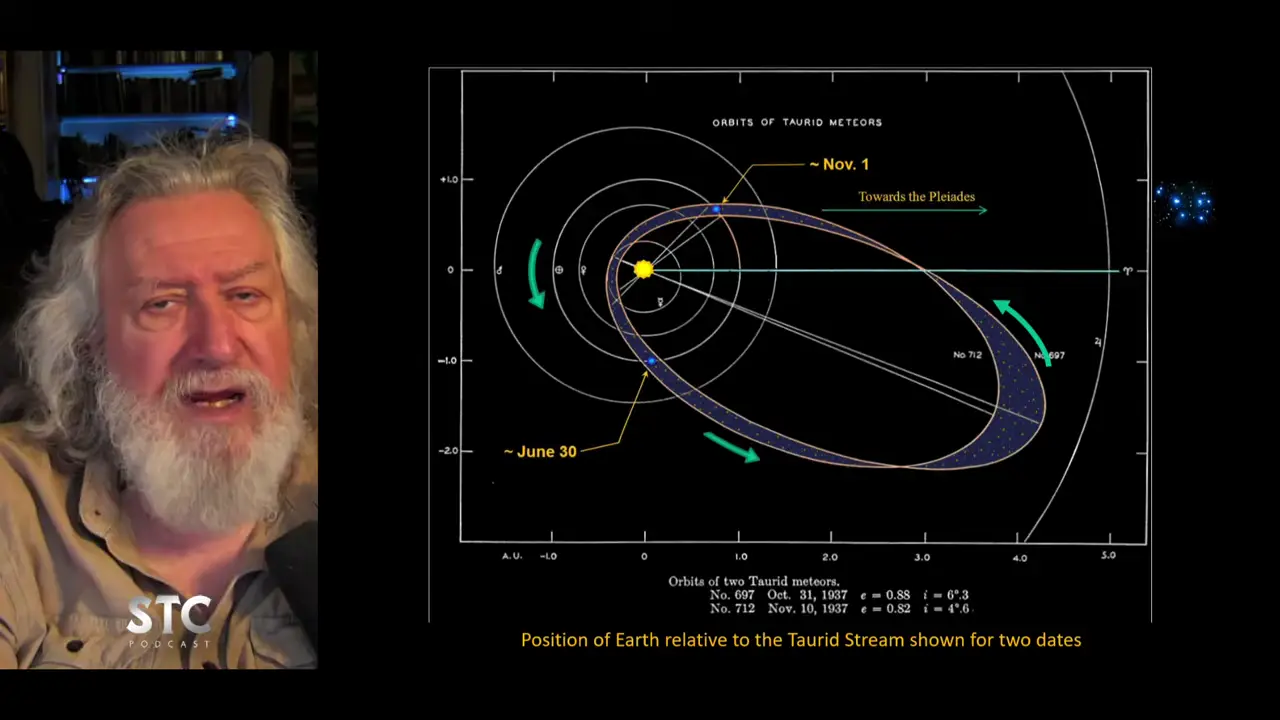
Earth's orbit crosses the Taurid meteor stream twice yearly — on June 30 (daytime) and late October/early November (visible). The November radiant centers on the Pleiades, the 'shoulder of the bull.' Strikingly, Jewish legend holds that the lost seventh star of the Pleiades, Kima, was thrown at Earth causing the Great Flood — a curious echo of the stream's June 30 crossing date. The stream's namesake, Encke's comet (first observed 1786 by Pierre Méchain; periodicity recognized by Johann Encke in 1819), has a 3.3-year period.
Taurid stream crossings correlate with ancient flood myths and Pleiades legends
Key facts
- Earth's orbit crosses the Taurid meteor stream twice yearly: on June 30 (daytime) and late October/early November (visible)
- The Taurid meteor stream is named after the constellation Taurus; its radiant point in November centers on the Pleiades (shoulder of the bull)
- Jewish legend holds that the lost seventh star of the Pleiades (Kima) was thrown at Earth, causing the Great Flood
- The Pleiades occupy the keystone of the Royal Arch of the zodiac, visible due south at midnight on Halloween from the northern hemisphere
- Encke's comet, discovered in 1818 with orbit calculated by Johann Encke, is the sole active comet in an Apollo-type orbit and never enters Jupiter's sphere of influence
- Encke's comet has an orbital period of approximately 3.3-3.4 years, is inclined only 12° to Earth's orbit, and approaches within 0.34 AU of the sun
- Clube's 1990 work identifies two causative links between the galaxy and Earth: galactic tides modulating comet influx, and disintegration products of giant comets
- Approximately 1,000-2,000 asteroids over one kilometer exist in Earth-crossing Apollo orbits; fewer than 50 have been discovered due to their extremely dark surfaces
Sources
Taurids - Meteor Section - Society for Popular Astronomypopastro.com
May-June daytime showers , related to Comet Encke, that produces a lowish but broad activity peak in the mid autumn.
Discovery of a new branch of the Taurid meteoroid stream as a real ...aanda.org
This stream produces at least four meteor showers on Earth: Daytime ζ-Perseids, and the Daytime β-Taurids, active in June and the first half of July ( ...
Beta Taurids - Wikipediaen.wikipedia.org
The Beta Taurids are an annual meteor shower belonging to a class of "daytime showers" that peak after sunrise. The Beta Taurids are best observed by radar ...
Beta Taurid meteors - Oxford Referenceoxfordreference.com
A daytime meteor shower following a similar orbit to Comet Encke, occurring between June 5 and July 18. Peak activity, detected by radar, occurs around the end ...
How To See The Taurid Meteor Showers - Farmers' Almanacfarmersalmanac.com
Two showers, one stream: Southern Taurids (Sep 10 to Nov 20, peak Nov 2-4) and Northern Taurids (Oct 20 to Dec 10, peak Nov 12-14).
Was this story useful?
Keep exploring
Every site on this page sits on the globe, and the people who research them are on the Discord.
3D Globe · Sites by country · Story Archive · Research Library · Weekly Journal · Search
AI-generated text · images from the original sources · always verify with the sources.