

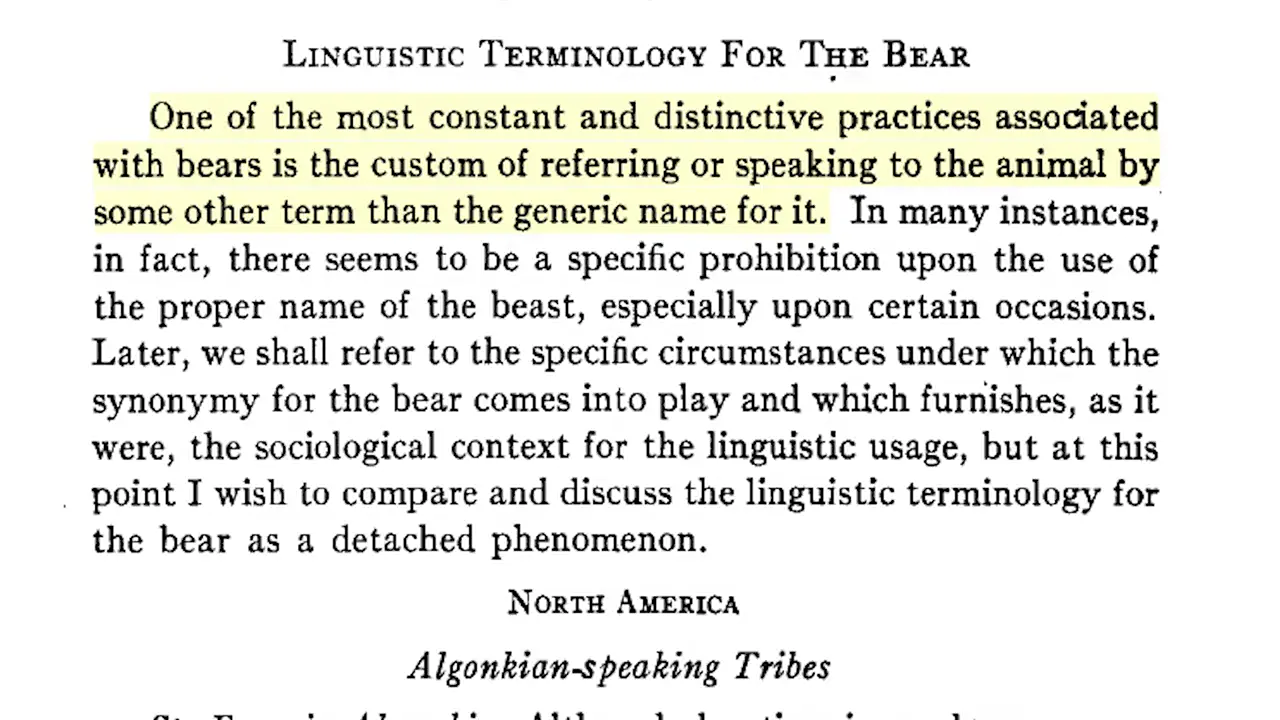
One of the most constant bear customs is never using its ordinary name. Hallowell traces the reconstructed root behind Greek arktos and Latin ursus, source of Ursus arctos; English 'bear' descends from a euphemism, Proto-Germanic *bero. Plains Cree use musa, 'the angry one'. 🐻
Taboo nicknames for the bear trace to a Proto-Indo-European root behind Ursus arctos
Key facts
- Hallowell calls it one of the most constant practices that the bear is referred to by a term other than its generic name, and notes the bear is the constant recipient of circumlocution terms across the whole area studied while the animals so named vary from tribe to tribe.
- The reconstructed Proto-Indo-European root (given as *h2orsos) is reflected in Greek arktos and in Latin ursus, the latter being the source of the species name Ursus arctos, the Eurasian brown bear.
- The video argues the English word 'bear' does not descend from that root but from a euphemism: Proto-Germanic *bero became Old English bera and then modern bear; other peoples substitute names such as 'honey eater' or 'the brown one'.
- Kinship euphemisms are widespread: 'cousin', 'brother', 'grandfather'; the Plains Cree use musa, 'the angry one' or 'wrangler', and elsewhere the bear is called 'four-legged human'.
- Hallowell cites the St. Francis Abnaki, among whom only the elderly still call the bear 'cousin' because the practice was being abandoned as European metaphysics subsumed the tribal worldview.
- Among the Thompson River Indians each animal's true name can be revealed only by a guardian spirit and is passed from father to son; a hunter who knows the grizzly's name gains power over it so that it becomes gentle and harmless.
Sources
Waking the Bear | Exchange for Local Observations and ...eloka.nsidc.org
Hallowell's classic work first introduced the academic world to bear ceremonialism as a circumpolar phenomenon.
Hallowell's “Bear Ceremonialism” and the Emergence of ...researchgate.net
Hallowell's survey of ethnographic literature on bears had the stated goal of understanding "man's relation to the animals of his environment ...
The songs and rituals of the Finno-Karelian bear huntbrepolsonline.net
by VM Piludu · 2023 · Cited by 2 — In this article, I will introduce the topic by analysing the classic studies of Hallowell and Sarmela on bear ceremonialism, the sources of Finno-Karelian bear ...
Bear in Human Imagination and in Ritualbearbiology.org
In 1926, U.S. anthropologist A.I. Hallowell examined the role of bear ceremonialism cross-culturally. Unfortunately, he had little access to the ...
Bear ceremonialism in the northern hemisphere ... [by] A ...siris-libraries.si.edu
Hallowell, A. Irving Bears. Bear ceremonialism in the northern hemisphere … rving (Alfred Irving), 1892-1974. Publisher: Philadelphia, 1926. 175 p. 26 cm. ...
Was this story useful?
Keep exploring
Every site on this page sits on the globe, and the people who research them are on the Discord.
3D Globe · Sites by country · Story Archive · Research Library · Weekly Journal · Search
AI-generated text · images from the original sources · always verify with the sources.