

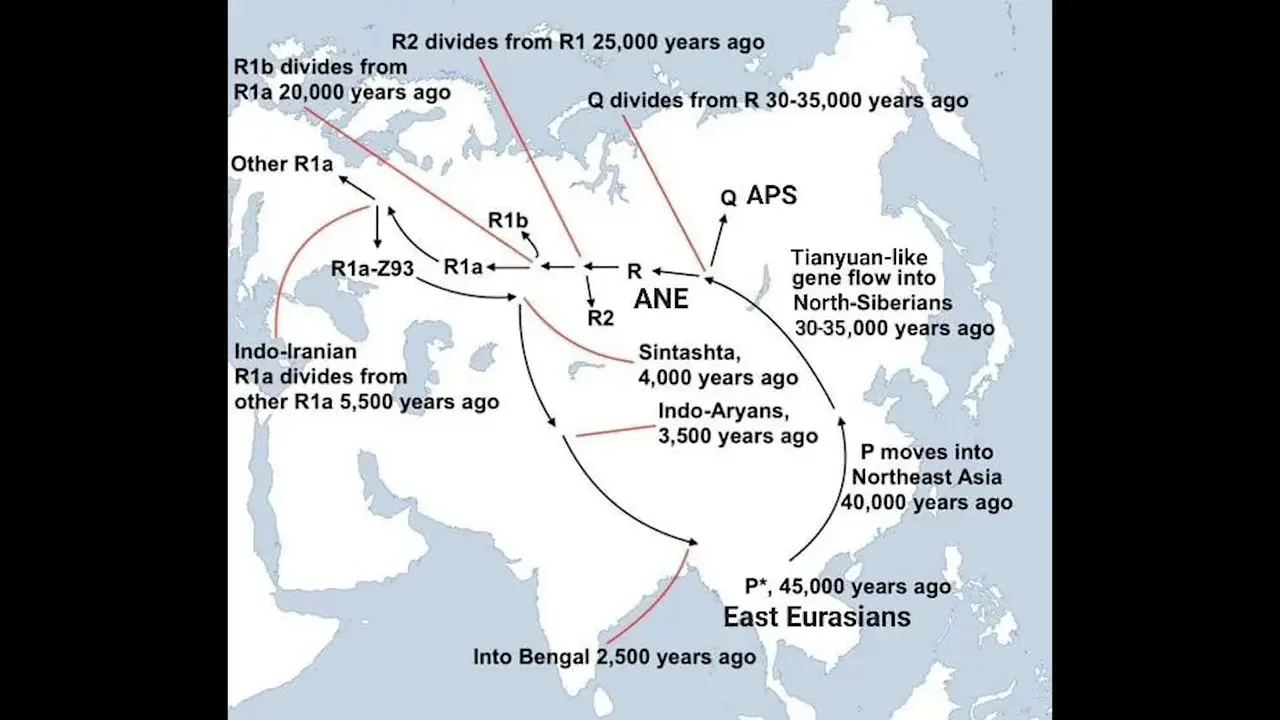
Hallowell concludes bear rites propitiate a supernatural controller rather than worship the animal, and ties the cult to an ancient Old World boreal culture of reindeer hunters. The presenter matches this to genetics: ancient North Eurasian ancestry around 20% in Europeans, 40% in Native Americans. 🧬
Hallowell traces the bear cult to an ancient boreal culture tied to reindeer
Key facts
- Hallowell concludes the ceremonies propitiate a supernatural controller of the bear so that more bears are released, and that the bear veneration of these peoples is therefore not animal worship in a narrow sense.
- Hallowell states the map of bear ceremonies is not a map of bear territory: where reverence exists the same elements recur, and Pueblo bear ceremonies of the North American southwest do not manifest the pattern he describes.
- He argues neither the psychological nor the economic hypothesis explains why the Ainu celebrate bear festivals while the Chukchi have only simpler ceremonies, whereas peoples geographically contiguous with the Ainu also hold periodic festivals.
- Hallowell rejects the economic explanation partly by noting that Eurasian groups living on domesticated reindeer venerated the bear rather than the reindeer.
- He concludes that a bear cult was one of the characteristic features of an ancient boreal culture, Old World in origin and closely associated with the pursuit of reindeer.
- The paper cites another researcher who argued that if other phases of culture were ignored, the caribou range should be taken as a single culture area.
- The presenter adds that this diffusion model matches modern genetics, citing an ancient North Eurasian component estimated at around 20% in Europeans and around 40% in Native Americans, and Siberian admixture dated to around 11,500 and around 5,000 years ago reaching the Sami (around 10%) and northern North America (around 50%).
- The presenter says he is researching Palaeolithic evidence of special treatment of bears, dating from more than 100,000 years ago to about 50,000 years ago.
Sources
The Ainu Bear Ceremonyvideo.alexanderstreet.com
In the bear ceremony, now no longer performed, a specially reared bear was reverently killed and its flesh and blood eaten by the participants.
Waking the Bear | Exchange for Local Observations and ...eloka.nsidc.org
This death is followed by an elaborate 'sending home' ceremony, in which the bear is made a guest in the house and celebrated for one or more days with songs, ...
An Introduction to Neil Gordon Munro's The Ainu Bear ...japanhouselondon.uk
This festival was one of the best-known ceremonies and most important of all Ainu rituals, however, it should be noted that it is no longer practised today.
Iomanteen.wikipedia.org
In the modern era, iomante generally refers to the sending performed on the brown bear, the only bear native to Hokkaido where the Ainu people were all ...
The Ainu Bear Ceremony and the Logic behind Hunting ...researchgate.net
This paper aims to reveal the Ainu conception of the bear and bear ceremony, which enables them to hunt the deified bear, in terms of the Ainu ...
Was this story useful?
Keep exploring
Every site on this page sits on the globe, and the people who research them are on the Discord.
3D Globe · Sites by country · Story Archive · Research Library · Weekly Journal · Search
AI-generated text · images from the original sources · always verify with the sources.