

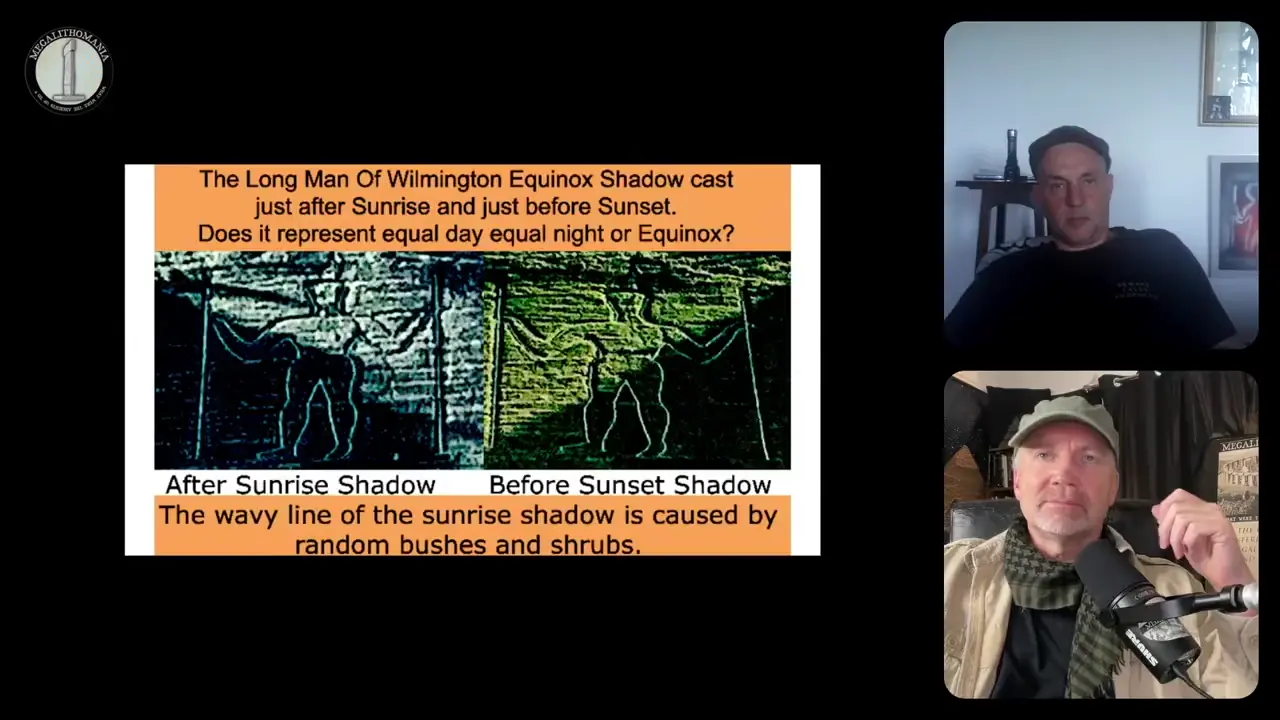
A striking pattern emerges worldwide: staff-wielding figure icons appear from ancient Egypt to pre-Colombian Peru, above doorways in Bolivia, Turkey, Afghanistan, Colombia, China, India, Indonesia, Nigeria, and beyond. The Long Man of Wilmington matches this 'godself' motif, with rays emanating from the head suggesting solar symbolism. The two staffs may represent duality: male/female, sun/moon, up/down. Holding two staffs physically creates perfect balance - the person becomes the stabilizing third point. A similar figure appears on the Finglesham Buckle found in Kent near Wilmington, bearing both sun and moon discs. Some scholars date this global motif back over 11,000 years, hinting at a forgotten ancient religion. 148:00-164:00
Staff god symbolism: figure holding two staffs found globally from Peru to Egypt
Key facts
- Richard Casaro documented that staff-wielding figure icons exist worldwide from ancient Egypt to pre-Colombian Peru
- The motif appears above doorways in Bolivia, Turkey, Peru, Afghanistan, Egypt, Colombia, North America, Sumba, Italy, Lebanon, China, India, Indonesia, and Nigeria
- The Long Man of Wilmington matches this 'godself' icon motif
- Staff gods were depicted with rays emanating from the head (solar symbolism)
- The staffs may represent duality: male/female, sun/moon, up/down
- Holding two staffs physically creates perfect balance - the person becomes the third stabilizing point
- The Finglesham Buckle found in Kent near Wilmington shows a similar staff-bearing figure with sun and moon discs
- This widespread motif suggests a forgotten global religion from the remote past
- Some scholars date this symbolism back over 11,000 years based on Sabir temple in Turkey
Sources
God Self Icon - Richard Cassarorichardcassaro.com
The GodSelf Icon depicts a human or human-like figure facing forward, holding twin objects symmetrically in each hand.
Third Eye in Ancient Egypt (Part 1 of 3) - Richard Cassaro Researchrichardcassaro.com
Rare insights into ancient megaliths, spirituality, mythology, magic, symbolism, secret societies, comparative religion and occult archaeology.
Long Man of Wilmington - Wikipediaen.wikipedia.org
The Long Man of Wilmington or Wilmington Giant is a hill figure on the steep slopes of Windover Hill near Wilmington, East Sussex, England.
The Long Man of Wilmington - Sewalotsewalot.com
The Long Man of Wilmington is set into an unnaturally flat-topped North-facing hillside that has been flattened and lays at 28 degrees. The Giant lays on a ...
A Short History of the Long Man of Wilmington - Sussex Pastsussexpast.co.uk
The Long Man of Wilmington is one of Sussex's most iconic features. At 72 metres, he's the largest depiction of a human figure in Europe and a Scheduled ...
Was this story useful?
Keep exploring
Every site on this page sits on the globe, and the people who research them are on the Discord.
3D Globe · Sites by country · Story Archive · Research Library · Weekly Journal · Search
AI-generated text · images from the original sources · always verify with the sources.