

Archaeologists excavating Shuruppak (modern Tell Fara), Iraq found evidence of an ancient city with multiple occupation layers. The site yielded a flood stratum (Schmidt, 1931) that corresponds to the flood stories found in the Epic of Gilgamesh and Atrahasis, which predate the Biblical Noah account. Shuruppak was an ancient Sumerian city situated about 55 km south of Nippur and 30 km north of Uruk on the Euphrates River.
Shuruppak excavation reveals massive flood layer below Sumerian cities
 IraqExcavation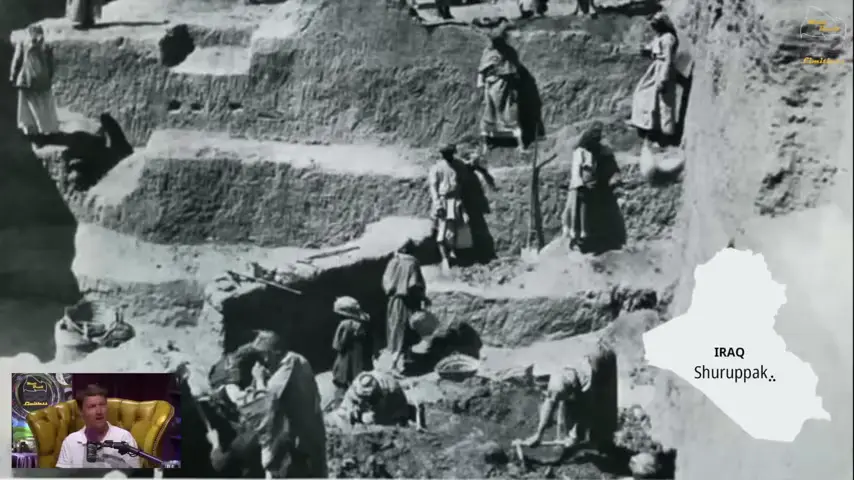
Site mentioned
Key facts
- Shuruppak is an ancient city in Iraq mentioned in Sumerian, Assyrian, Acadian, and Babylonian cuneiform tablets
- Penn Museum holds excavation records from 1931 Iraq excavations
- Archaeologists found Shuruppak at 15 feet down with evidence of two civilizations above it
- A massive flood layer (4 feet thick) was found above the Shuruppak layer with no human remains
- The flood layer corresponds to the flood stories in the Epic of Gilgamesh and Atrahasis
- The story predates the Biblical Noah account and originates from Mesopotamian narratives
Sources
Archaeologists forced by Iran war to leave Iraq digs despite vital workthearabweekly.com
Adelheid Otto of Germany's Ludwig-Maximilians-University started a long-planned dig at ancient Shuruppak, modern-day Tell Fara, on February 28.
Iraq's ancient ruins must wait a bit longer to be uncovered | Arab Newsarabnews.com
Adelheid Otto, 59, from the University of Munich, began a dig at ancient Shuruppak, modern-day Tell Fara, on Feb. 28 — the day the war began ...
Fara: a reconstruction of the ancient Mesopotamian city of Shuruppakcommons.library.stonybrook.edu
Martin, Harriet P., "Fara: a reconstruction of the ancient Mesopotamian city of Shuruppak" (1988). Archive of Mesopotamian Archaeological Reports (AMAR). 481.
The Museum Journal | Excavations at Fara, 1931penn.museum
Dr. Schmidt's account of the excavations at Fara gives an unusually clear and interesting picture of the conduct of archaeological work.
5,000-year old 'cultic space' discovered in Iraq dates ... - Live Sciencelivescience.com
Archaeologists in Iraq have discovered the remains of a 5000-year-old building that might have been used as a "cultic space" or temple for ...
Was this story useful?
Keep exploring
Every site on this page sits on the globe, and the people who research them are on the Discord.
3D Globe · Sites by country · Story Archive · Research Library · Weekly Journal · Search
AI-generated text · images from the original sources · always verify with the sources.