

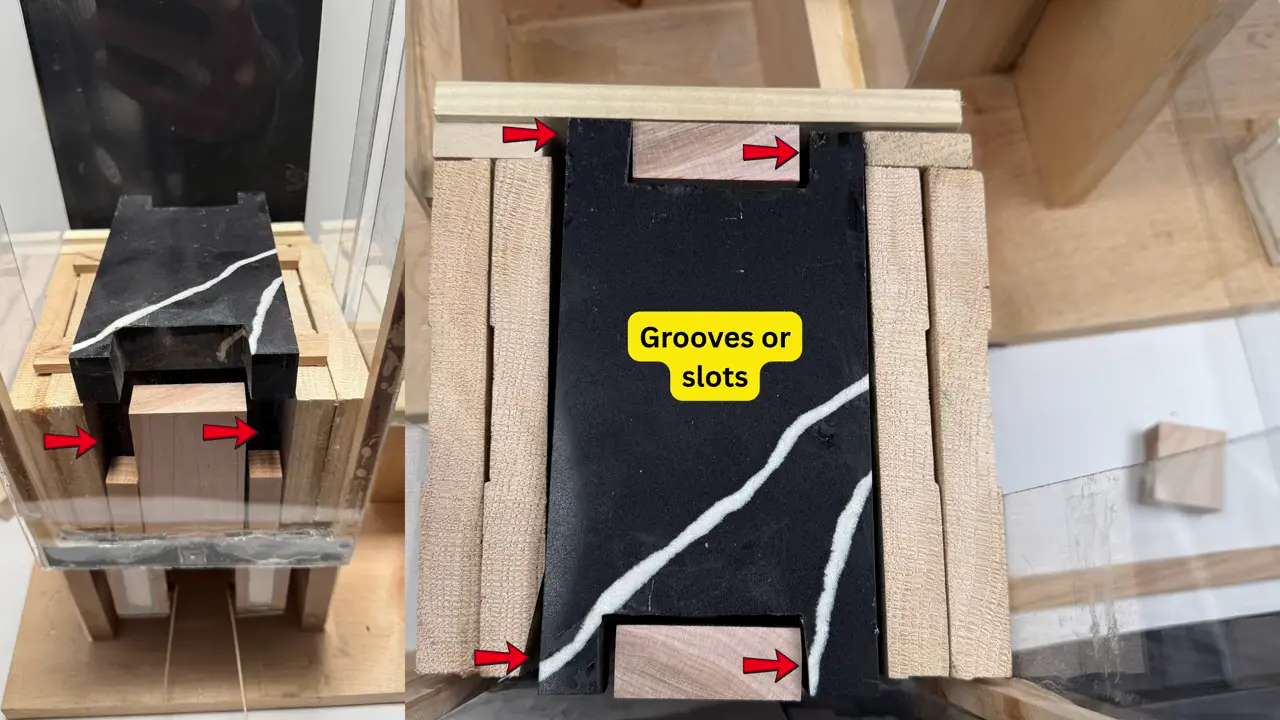
Second-stage lowering left the box still and dropped only the lid. At Saqqara Necropolis, a tall wall with vertical grooves and sockets, each pierced by a tiny drill hole that needed a plug, stood in the shaft, while four pockets under the floor lined up with the lid nubs. A nub alone doesn't prove sand — ropes and boards worked too. 🧩
Second-stage sand drain used wall sockets and floor pockets to close lids
 EgyptTechnology
Key facts
- After excavating the shaft floor, a pit about 3 or 4 feet deep was sunk at the tunnel end, and a main crawl space was cut under the shaft's centre line where the sarcophagus would rest several feet above the rock.
- Four smaller shafts or pockets were dug from the central tunnel so that each corner or end of the sarcophagus could be reached; the footprint of the sarcophagus was marked on the shaft floor so the pockets lined up under each nub on the lid.
- A small stone wall with tight clearance, higher than the sarcophagus when seated, was built in the main shaft, with vertical grooves slightly larger than the nubs cut or built into it, and a section left unfinished for worker access.
- A socket cut to an exact depth at the bottom of each groove sets the lower limit of lid travel; too deep is harmless but too shallow leaves the lid only partly closed.
- A smaller hole drilled at the bottom of each socket pierces into the pocket beneath the shaft floor and required a removable plug, which the presenter speculates could have been mud, wax, or a wad of linen.
- Unlike the first stage, which lowers box and lid together, the second stage leaves the box stationary and lowers only the lid, priming the mechanism for the burial.
- The presenter states these features occur mainly in Saite-period shaft tombs at Saqqara Necropolis, with a subset at Giza and examples at Abusir; lids in the Serapeum of Saqqara Necropolis have nubs removed, nubs intact, or sockets instead.
- The video stresses that a nub alone does not prove sand was used, since nubs were also used with ropes, boards and lighter lids, and were often removed after the second stage to make lids harder to reopen.
Sources
(PDF) The Discovery of the Sarcophagus of Djoser and the Restoration of the Step Pyramidresearchgate.net
Pyramid of Djoseren.wikipedia.org
Southern Tomb in Djoser funerary complex openedthehistoryblog.com
The Southern Tomb - Discover Egypt's Monumentsegymonuments.gov.eg
Was this story useful?
Keep exploring
Every site on this page sits on the globe, and the people who research them are on the Discord.
3D Globe · Sites by country · Story Archive · Research Library · Weekly Journal · Search
AI-generated text · images from the original sources · always verify with the sources.