

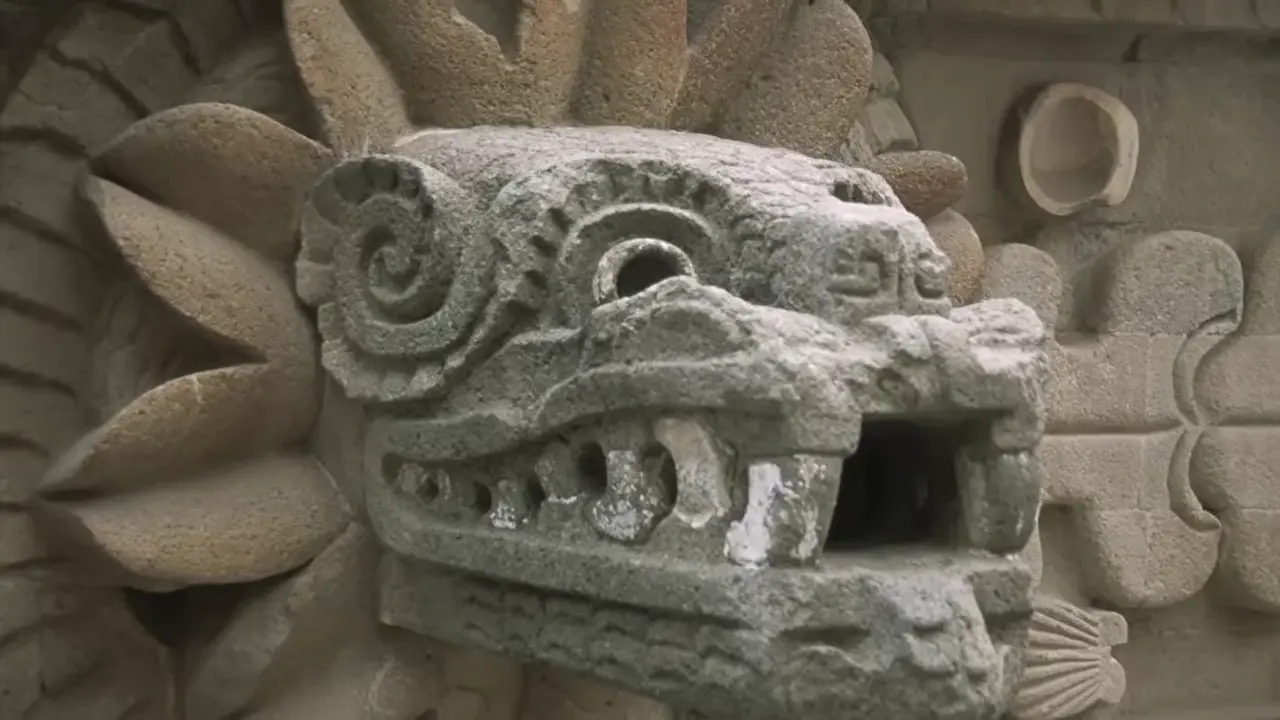
Quetzalcoatl, the feathered serpent, appears throughout Mesoamerican monumental art, murals, and codices from 300 BC to 900 AD. Depicted with horns, crests, and feathered plumes, this deity was connected to rain, cosmic authority, divine order, and fertility. His curled ramlike horns represent one of the clearest examples of this motif in world mythology.
Quetzalcoatl: Mesoamerican feathered serpent deity spans 300 BC to 900 AD
Key facts
- Quetzalcoatl (feathered serpent) appears in Mesoamerican monumental art, murals, and codices
- Dating range: 300 BC to 900 AD
- Depicted as snake-body with horns, crests and plumes
- Connected to rain, cosmic authority, divine order, and fertility
- Clearest examples of ramlike curling horns in world mythology
Sources
Teotihuacan - Smarthistorysmarthistory.org
The temple stands out for its sculptural ornamentation depicting the feathered serpent, known by its Aztec name Quetzalcoatl. The feathered serpent is ...
Temple of the Feathered Serpent, Teotihuacan - Wikipediaen.wikipedia.org
The Temple of the Feathered Serpent is the third largest pyramid [1] at Teotihuacan, a pre-Columbian site in central Mexico.
Temple of the Feathered Serpent | HistoricalMXhistoricalmx.org
The Temple of the Feathered Serpent is located at the south end of the three kilometers long Avenue of the Dead.
Teotihuacan: Ciudadela - The Metropolitan Museum of Artmetmuseum.org
The Feathered Serpent Pyramid was the third largest temple platform of the site after the Sun and Moon Pyramids. Though this complex is not as ...
Archaeologists Explore the Tunnel below the Pyramid of the ... - PBSpbs.org
The pyramid represents the heart of Teotihuacan, its central landmark. A tunnel leading directly underneath the Pyramid of the Feathered Serpent must have some ...
Was this story useful?
Keep exploring
Every site on this page sits on the globe, and the people who research them are on the Discord.
3D Globe · Sites by country · Story Archive · Research Library · Weekly Journal · Search
AI-generated text · images from the original sources · always verify with the sources.