

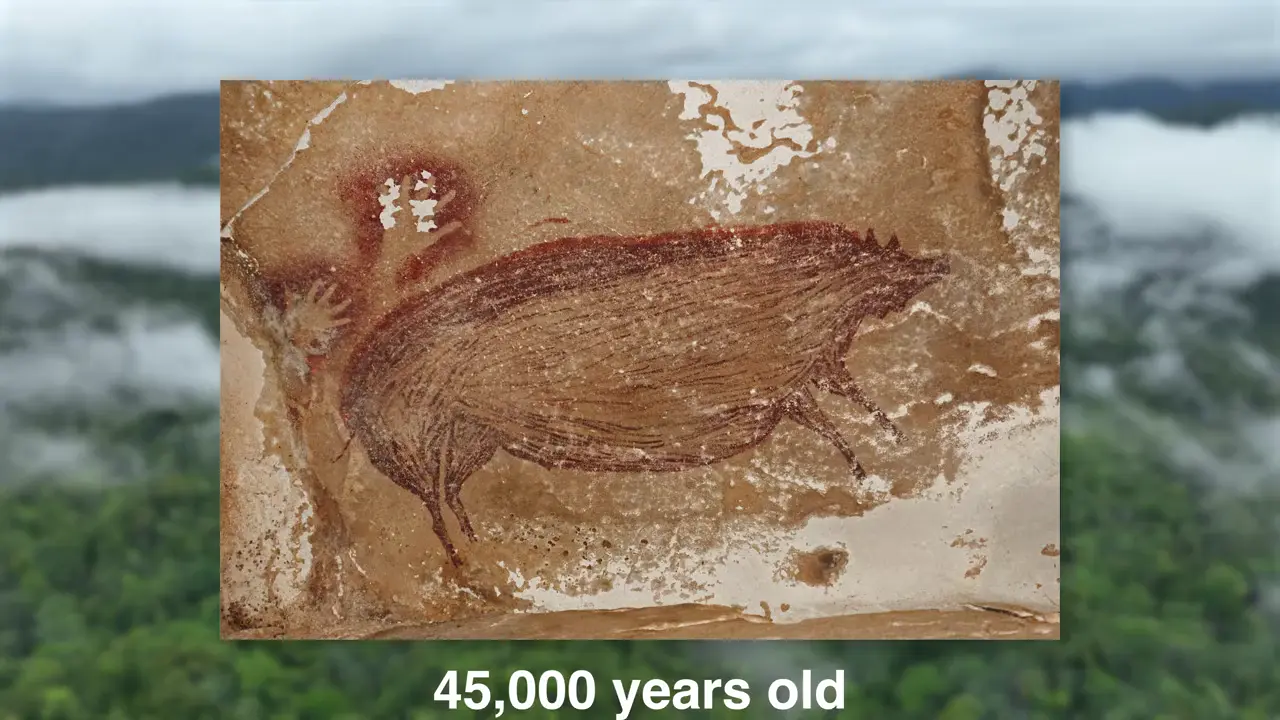
A painted pig in Sulawesi, Indonesia is at least 45,000 years old, cave art in France and Spain runs past 40,000 years, and abstract signs from around 60,000+ years ago are often attributed to Neanderthals. A species distribution model suggests the human niche widened near 70,000 years ago. All of it came from tiny hunter-gatherer bands — no towns yet 🖌️
Prehistoric art and human niche expansion precede civilization by tens of millennia
Key facts
- Caves in Sulawesi, Indonesia, contain a painted pig dated to at least 45,000 years ago.
- Cave art in France and Spain includes examples older than 40,000 years.
- Abstract cave images, colors and geometric signs in Europe, dated to around 60,000+ years ago, are attributed to Neanderthals.
- A study using a species distribution model applied to archaeological site locations suggests the human niche expanded around 70,000 years ago, with humans occupying more forested and desert environments during the out-of-Africa dispersal.
- Sewing needles appear around the same time, allowing fitted clothing and travel to higher latitudes.
- The presenter notes that all of this artistic evidence comes from small hunter-gatherer groups, with no towns or villages at any scale.
Sources
A Cave Painting of a Wild Pig Found on Sulawesi May be the Oldest Figurative Cave Arthistoryofinformation.com
Oldest cave art found in Sulawesi - PMC - NIHpmc.ncbi.nlm.nih.gov
Warty pig cave painting in Sulawesi, Indonesiasmarthistory.org
Was this story useful?
Keep exploring
Every site on this page sits on the globe, and the people who research them are on the Discord.
3D Globe · Sites by country · Story Archive · Research Library · Weekly Journal · Search
AI-generated text · images from the original sources · always verify with the sources.