

Attalus III's surprising will bequeathed his kingdom to Rome, creating the province of Asia — though Aristonicus revolted by promising freedom to slaves and calling followers "people of the sun" before his capture. Beyond politics, Pergamon housed 200,000 volumes in its famous library, gave us the word "parchment" (Pergamina), and sculpted masterpieces like the Dying Gaul that shaped Roman artistic traditions.
Pergamon (Aiolis)'s cultural legacy and political bequest to Rome
 TürkiyeGeneral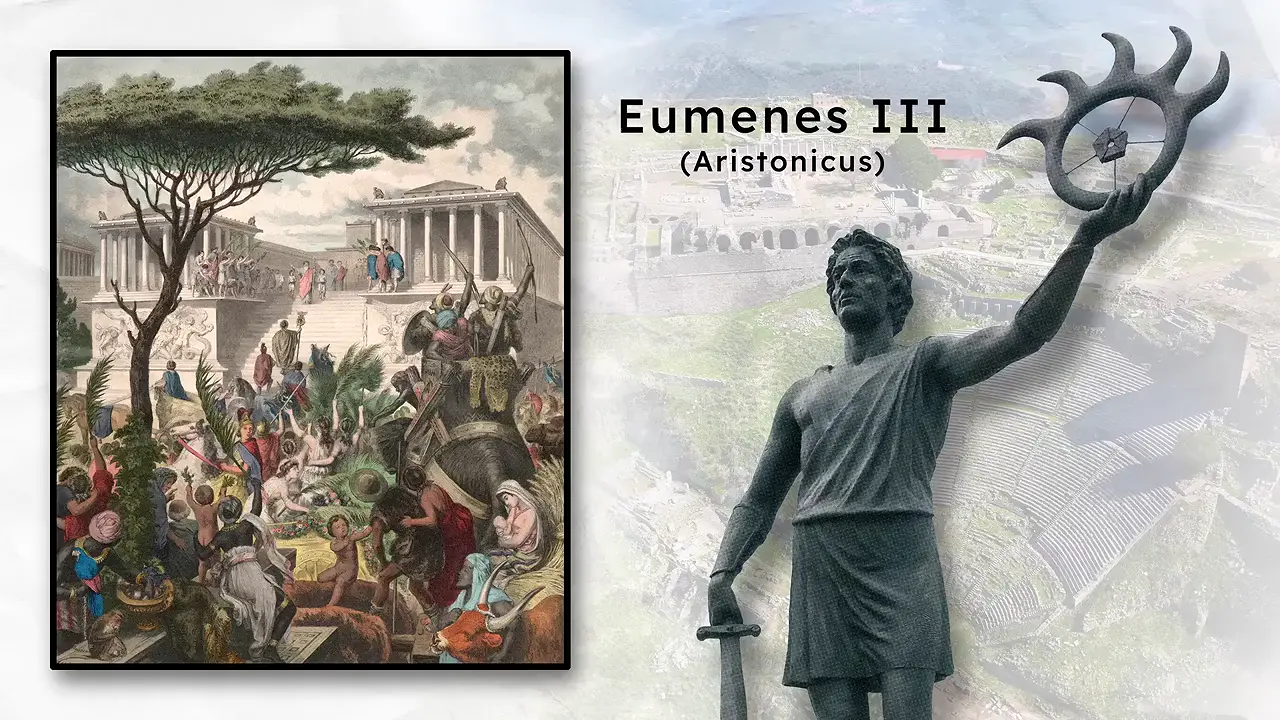
Key facts
- Attalus III wrote a treatise on agriculture quoted by Roman authorities for centuries
- Attalus III died after a 5-year reign and bequeathed his kingdom to the Roman people, leading to the creation of the Roman province of Asia
- Aristonicus revolted against the bequest, promising freedom to slaves and calling his followers 'people of the sun' before being captured and strangled in Rome's Mamertine Prison
- The Pergamene library reportedly contained 200,000 volumes, second only to Alexandria
- Parchment became so closely associated with Pergamon (Aiolis) that the Latin word became 'Pergamina'
- The Great Altar of Zeus, now partially reconstructed in Berlin's Pergamon (Aiolis) Museum, features a gigantomachy frieze depicting the battle of gods and giants on an unprecedented scale
- Pergamene sculptures such as the Dying Gaul set the tradition of copying Greek masterpieces in Roman art
Site mentioned
Sources
LacusCurtius • Varro On Agriculture — Book Ipenelope.uchicago.edu
I shall write for you three handbooks to which you may turn whenever you wish to know, in a given case, how you ought to proceed in farming.
Roman Farm Management: The Treatises of Cato and Varrogutenberg.org
At the beginning of the first Georgic (1-5) Virgil lays out the scope of the poem as dealing with three subjects, agriculture, the care of live stock and the ...
[PDF] ATTALOS III, KING AND SCULPTOR. AN APPENDIX TO ...journals.akademicka.pl
He was a natural scientist and author of learned treatises on gardening, agriculture, and medicinal herbs. He was also a sculptor who worked in stone and bronze ...
Treatise on Agriculture : Medieval Text Manuscriptstextmanuscripts.com
This influential text was a practical guide, in simple language, to the agricultural tasks to be performed in each season of the year.
ATTALUS : sources for Greek & Roman historyattalus.org
This site contains detailed lists of events and sources for the history of the Hellenistic world and the Roman republic. ... Attalus, Fourth century B.C.
Was this story useful?
Keep exploring
Every site on this page sits on the globe, and the people who research them are on the Discord.
3D Globe · Sites by country · Story Archive · Research Library · Weekly Journal · Search
AI-generated text · images from the original sources · always verify with the sources.