

So what were Herodotus's mysterious "pyramids in the lake"? Likely the Pedestals of Biahmu — two colossal seated statues built by Amenemhat III, roughly 60 ft tall, sitting on stone bases about 6 miles (10 km) from Hawara. A mirage may have made them appear to rise from water, and Egyptian guides reportedly exaggerated their height tenfold. The statues survived into the 13th century before treasure hunters and quarrying destroyed them. By the late 1600s they were gone entirely. 19th-century archaeologists found only the pedestals plus fragments — including a nose piece now in Oxford's Ashmolean Museum. The pharaoh "Moeris" is identified with Amenemhat III, who expanded a natural lake into the one bearing his name.
Pedestals of Biamu identified as source of lost pyramids legend
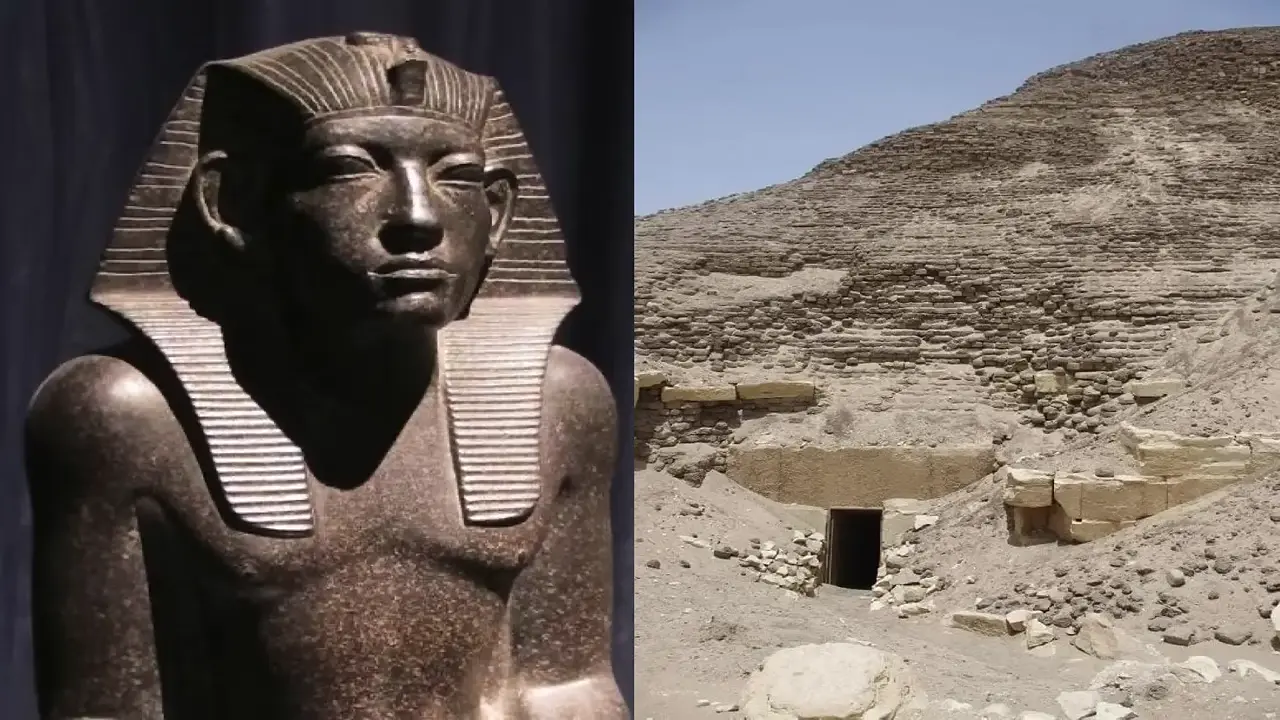
Site mentioned
📍 Pedestals of Biamu
Key facts
- From Hawara, Herodotus would have seen two colossal seated statues about 10 miles (16 km) away on stone bases
- The statues were constructed by Amenemhat III and are today known as the Pedestals of Biamu
- The statues are estimated to have been 60 ft (about 10 m) in height
- The best explanation for the misidentification as pyramids is that a mirage on a hot day extended the apparent water level to the statues, and Herodotus relied on Egyptian guides who reported them as 10 times their actual height
- The statues survived at least in some form into the 13th century, after which they were partially destroyed by treasure hunters and later quarried away
- By the late 1600s, the statues were completely gone
- 19th-century archaeologists found only the pedestals and small fragments of what had sat upon them
- Several dozen fragments are held in the Ashmolean Museum in Oxford, including a portion of one statue's nose
- The pharaoh known to the Greeks and Romans as 'Moeris' is now identified with Amenemhat III; the lake was named Moeris after the pharaoh dug an irrigation canal expanding a natural lake rather than creating an artificial one
Sources
Pedestals of Biahmu - Wikipediaen.wikipedia.org
The Pedestals of Biahmu (also spelled Biyahmū) are the basal remnants of two colossal statues erected by the ancient Egyptian pharaoh Amenemhat III.
What is a Sculpture Pedestal?premiersculpture.com
A sculpture pedestal is a base or stand that elevates and supports a sculpture, enhancing its visibility, stability, ...
A & B Home Decorative Pedestal Sculptures 73379homedepot.com
Add a touch of ancient splendor to your home with the 9 in. Corinthian Cap Decorative Pedestal featuring an elegant pattern with an aged finish.
Identify Buddhist Statues by Their Pedestals and Seated Basesbutuzou.com
Pedestals are not decoration; they signal the statue's identity, role, and the world it represents. Lotus bases often indicate a Buddha or high ...
Pedestal Statue Images – Browse 51002 Stock Photos, Vectors, and ...stock.adobe.com
Search from thousands of royalty-free Pedestal Statue stock images and video for your next project. Download royalty-free stock photos, vectors, ...
Was this story useful?
Keep exploring
Every site on this page sits on the globe, and the people who research them are on the Discord.
3D Globe · Sites by country · Story Archive · Research Library · Weekly Journal · Search
AI-generated text · images from the original sources · always verify with the sources.