

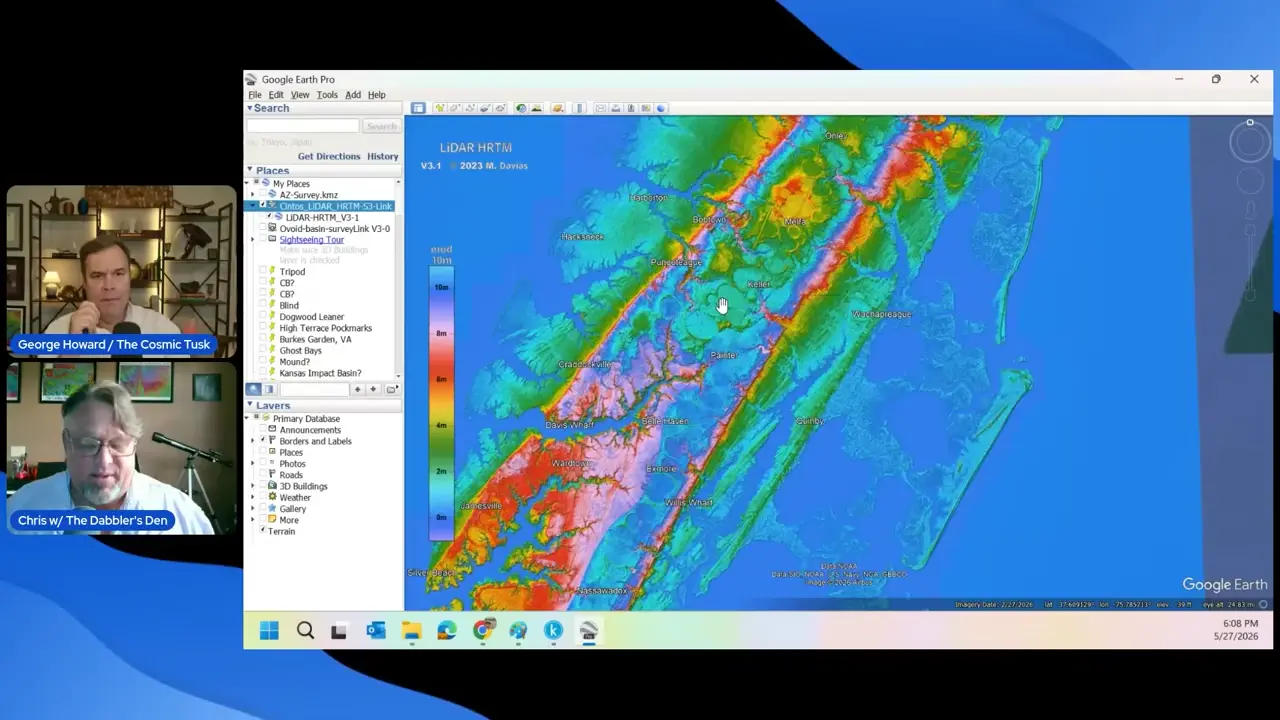
Cottrell and Zamora’s 2025 LiDAR study reports that sampled Carolina Bay rims fit ellipses within about 3%, and the authors argue this challenges an aeolian/lacustrine origin. OSL results cited for bay sediments reach roughly 300,000 years; an approximately 786,000-year reading is outside the reliable range. Firestone et al. included the bays in their 2007 Younger Dryas case, but Comet Research Group researchers later removed them. Moore and LeCompte argue that Clovis-related material on bay rims indicates the bays predate the Younger Dryas. 📏
Paper argues 3% ellipse fit challenges wind-and-water origin of Carolina Bays
Key facts
- Christopher William Cottrell and Antonio Zamora's 2025 paper reports least-squares fits of LiDAR-derived rim points from sampled Carolina Bays to ellipses, generally within about 3%. The authors argue that this precision challenges an aeolian/lacustrine origin; the measurement does not by itself rule out wind-and-water formation.
- The paper discusses OSL ages for bay sediments reaching roughly 300,000 years and treats a reported age near 786,000 years as beyond the method's reliable range. OSL dates the sediment, not directly the bay's formation.
- Firestone et al.'s 2007 Younger Dryas paper included Carolina Bays among proposed impact-related landforms. Comet Research Group researchers later removed the bays from their list of evidence for that event.
- Chris Moore reported Clovis-associated artifacts and waterfowl gizzard stones on Carolina Bay rims and argued that their context indicates the rims existed before the Younger Dryas. Malcolm LeCompte likewise opposed using the bays as Younger Dryas impact evidence.
Sources
Partially Formed Carolina Bays: Morphological Evidence of ...papers.ssrn.com
In this paper, it's assumed that an ideally formed Carolina Bay has a mathematically elliptical rim throughout the entirety of its circumference. Although ...
Antonio ZAMORA | Research profileresearchgate.net
Christopher Cottrell ... This paper describes the use of a Python program to fit ellipses to the Carolina Bays using a least squares method.
(PDF) Interpreting the Geomorphology of Carolina Bays as ...researchgate.net
This study examines the Carolina Bays and Nebraska Rainwater Basins, using high-resolution LiDAR elevation models to analyze their unique ...
Morphological signatures of shock wave propagation in ...sciencedirect.com
by AK Carlisle · 2026 — By assuming the rim of an ideally formed Carolina Bay is entirely elliptical, it was shown that non-ideally formed bays display three morphologies that are each ...
Interpreting the Geomorphology of Carolina Bays as ...journals.bilpubgroup.com
This study examines the Carolina Bays and Nebraska Rainwater Basins, using high-resolution LiDAR elevation models to analyze their unique shapes.
Carolina baysen.wikipedia.org
Carolina bays, also regionally known as Maryland basins and Delmarva bays, are elliptical to circular depressions concentrated along the East Coast of the ...
Reply to Holliday et al. regarding the Carolina Bayssciencedirect.com
by A Zamora · 2025 · Cited by 1 — Zamora A model for the geomorphology of the Carolina Bays Geomorphology (2017) Cottrell C., Zamora A. Journal of Environmental and Earth Sciences
Interpreting the Geomorphology of Carolina Bays as ...papers.ssrn.com
by CW Cottrell · Cited by 5 — Cottrell, Christopher William and Zamora, Antonio, Interpreting the Geomorphology of Carolina Bays as Secondary Impact Structures.
Was this story useful?
Keep exploring
Every site on this page sits on the globe, and the people who research them are on the Discord.
3D Globe · Sites by country · Story Archive · Research Library · Weekly Journal · Search
AI-generated text · images from the original sources · always verify with the sources.