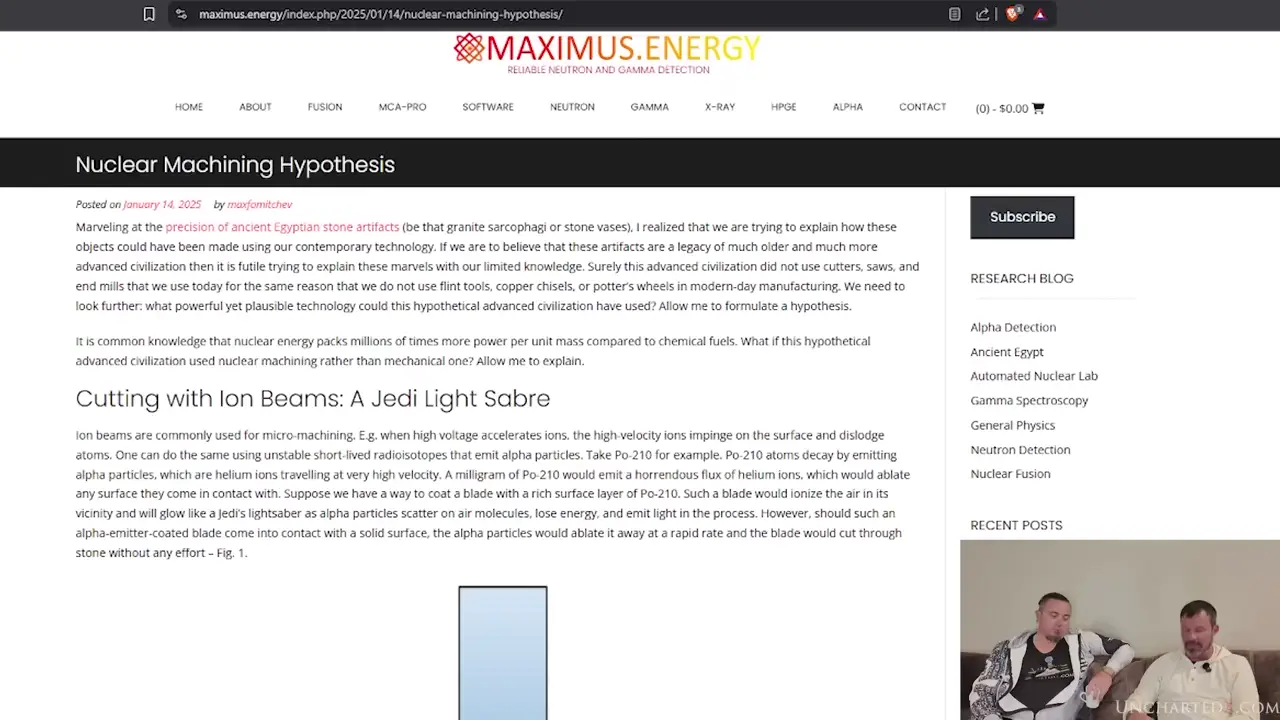
THEORY: A nuclear physicist proposes ancient precision artifacts may have been made using radioisotope tools. Alpha emitters like Polonium-210 could ablate stone surfaces without physical effort, turning material to gas or powder. Evidence would include foreign decay products, excess helium, or radioactivity anomalies in the crystal structure.
Key facts claimed:
- Nuclear physicist Dr. Max Fomitchev-Zamilov proposes nuclear machining hypothesis
- Suggests ancient precision artifacts were made using radioisotope tools
- Alpha emitters like Polonium-210 could be used for cutting stone
- Coated blade would ionize air and glow like a lightsaber
- Alpha particles would ablate stone surfaces without physical effort
Sources
The Making of the Atomic Bomb | Manifold @CUNYcuny.manifoldapp.orgDespite the fact that a lot of efforts were made towards nuclear weapons non-proliferation, we still live in a world that could be easily destroyed by using ...
Explainer: Polonium 210 | UK news - The Guardiantheguardian.comBecause polonium emits only alpha particles, it can be safely ... made, perhaps from a particle accelerator or a nuclear reactor.".
[PDF] Marie Curie and the Science of Radioactivityhistory.aip.orgUntil the radioactive atoms could be sorted out with traditional chemistry, some scientists were reluctant to call them new elements. HAT MADE THE TABLE ...
Alexander Litvinenko inquiry: What is the isotope polonium-210 ...ibtimes.co.ukAn independent inquiry into the death of former KGB agent Litvinenko will be published on 21 January 2016.
Nuclear Machining Hypothesis - Maximus Energymaximus.energyOne can do the same using unstable short-lived radioisotopes that emit alpha particles. Take Po-210 for example. Po-210 atoms decay by ...
AI-generated text · images from the original sources · always verify with the sources.