
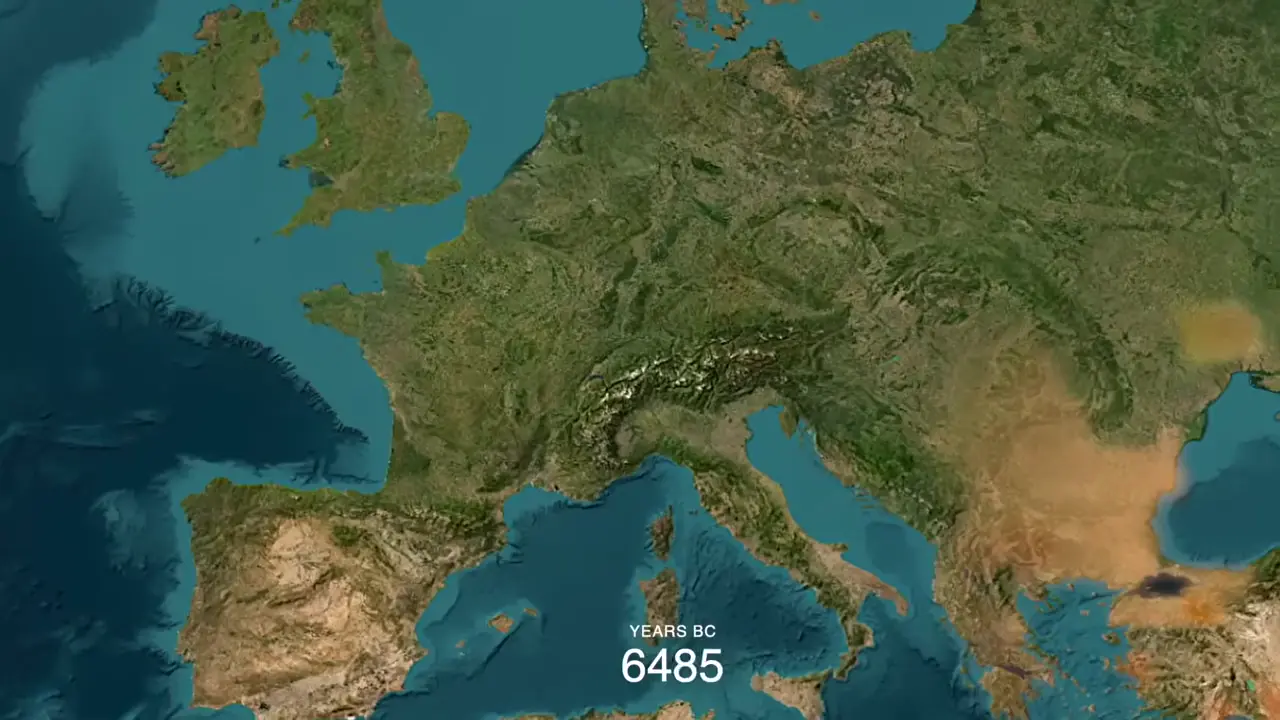
Around 5600–5000 BC, Anatolian-descended farmers pushed west via two routes: the Danubian/Balkans plains (Linearbandkeramik culture) and the Mediterranean coast. Both streams eventually reached western France — but neither brought any tradition of stone monument building 🏛️
Neolithic farmers from Anatolia expanded westward for 2,000 years before reaching Atlantic coast
Key facts
- Neolithic expansion occurred around turn of 5th millennium BC
- Farmers of Anatolian descent spread westward through two routes: Balkans/Danubian plains and Mediterranean coast
- Bandkeramik people advanced through Danubian route with timber long houses
- Mediterranean populations advanced up Atlantic seaboard
- Both strands of Neolithic advancement converged in Brittany region
- Incoming farmers carried no tradition of monumentalism or stone building
- Farmers brought timber houses but no tradition of large stone burials
Sources
Genomic Evidence Establishes Anatolia as the Source of the ...researchgate.net
Anatolia and the Near East have long been recognized as the epicenter of the Neolithic expansion through archaeological evidence.
The Lost World of Old Europe - The Danube Valley, 5000–3500 BC ...yumpu.com
The Lost World of Old Europe - The Danube Valley, 5000–3500 BC, by David W. Anthony. The Rise and Fall of Old Europe.
[PDF] The Lost World of Old Europe The Danube Valley, 5000–3500 bce-edu.nbu.bg
The exhibition The Lost World of Old Europe: The Danube Valley,. 5000–3500 bc (November 11, 2009–April 25, 2010) has been organized by the Institute for the ...
Process and Dynamics of Mediterranean Neolithization (7000–5500 ...jstor.org
Abstract. Why did the farming lifestyle appear and proliferate so rapidly through the Mediter- ranean basin between 7000 and 5500 bc?
Barbara Horejs (Eds.) The Central/Western Anatolian Farming Frontieraustriaca.at
The 12th volume of the Oriental and European Archaeology publication series presents the out- come of a workshop about 'The Central/Western ...
Was this story useful?
Keep exploring
Every site on this page sits on the globe, and the people who research them are on the Discord.
3D Globe · Sites by country · Story Archive · Research Library · Weekly Journal · Search
AI-generated text · images from the original sources · always verify with the sources.