

Mundigak, in Kandahar province, Afghanistan (~55 km northwest of Kandahar city), was occupied from c. 3000 BC to c. 1500 BC, spanning the Chalcolithic through Bronze Age phases of the Helmand culture. The settlement evolved from early mud‑brick houses to denser, smaller rooms, suggesting a shift in building functions over time. A large cemetery (Mound C) and evidence of a possible temple (Mound G) were identified, with later female figurines and seals appearing in the archaeological record, suggesting possible religious or symbolic practices.
Mundigak (Mundagok) Site, Subsistence, and Cultural Indicators
 AfghanistanGeneral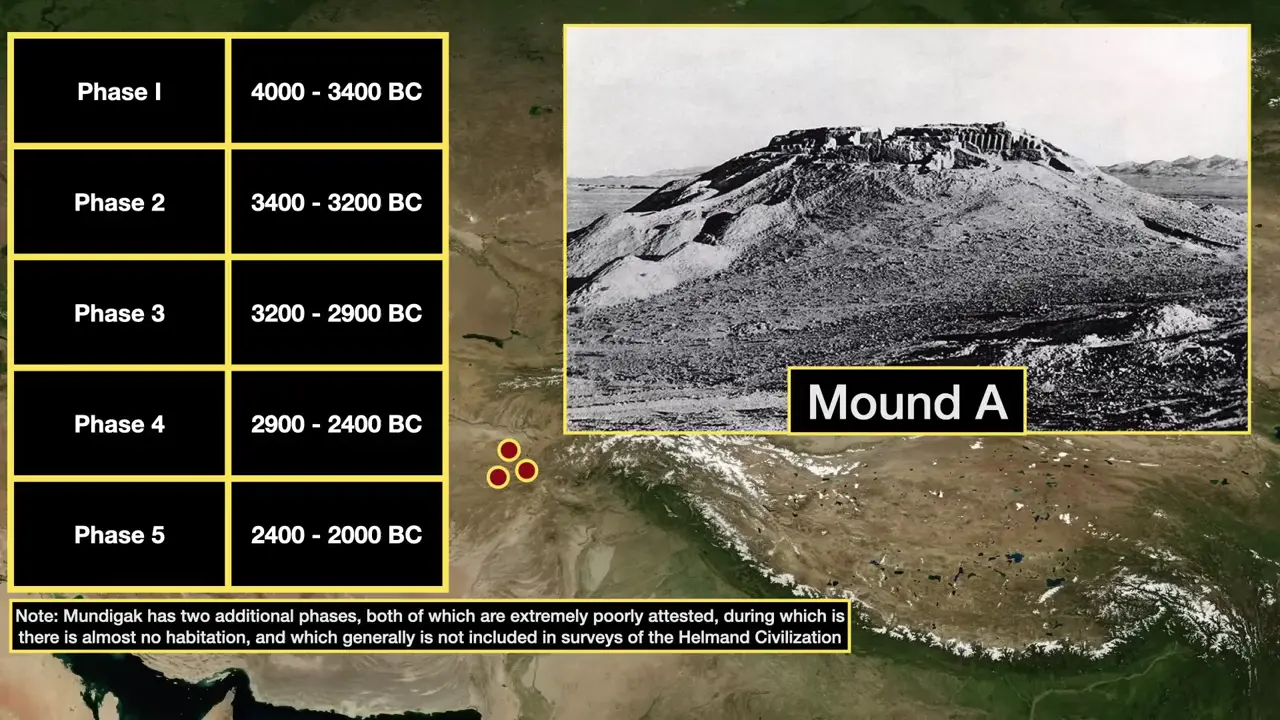
Key facts
- Located near Shahari Sukta; occupied from early phases (3500 BC) through ~1000 BC.
- Shows transition from mud‑brick houses to denser, smaller rooms and a shift in building functions.
- Contains a large cemetery (Mound C) and evidence of a possible temple on Mound G.
- Distinctive female figurines and seals appear in later phases, suggesting possible religious or symbolic practices.
Site mentioned
Sources
Mundigak Palace II 5 - Harappaharappa.com
... Mundigak anticipated Kandahar as the regional centre. In this connection it is worth observing that a village and site just 3 km to the south of Mundigak ...
Mundigak - Archaeological site in Kandahar, Afghanistan - Around Usaroundus.com
The site was inhabited between 3000 and 1500 BCE and served as a major Bronze Age center in Central Asia. Archaeological layers reveal that the ...
Figure 4 - from A Review of Chalcolithic/Bronze Age - Academia.eduacademia.edu
Mundigak is situated about 55 Km to the northwest of modern city of Kandahar. The site comprises of a series of mounds (approx. 21 ha), was subjected to ...
The Pre-Historic Period in Afghanistan - alamahabibi.netalamahabibi.net
Ancient relics dating back five thousand years, excavated in 1966 at the Mundigak mound, 66 km southwest of Kandahar, represent a pre-historic civilization in ...
Mundigak - Wikipediaen.wikipedia.org
During the Bronze Age, it was a center of the Helmand culture. It is situated approximately 55 km (34 mi) northwest of Kandahar near Shāh Maqsūd, on the upper ...
Was this story useful?
Keep exploring
Every site on this page sits on the globe, and the people who research them are on the Discord.
3D Globe · Sites by country · Story Archive · Research Library · Weekly Journal · Search
AI-generated text · images from the original sources · always verify with the sources.