

Moundville, south of Tuscaloosa, Alabama, is the largest surviving Mississippian pyramid city in the state and second only to Cahokia overall. Its central plaza covered about 320 acres, ringed by 29 earthen pyramids; Mound B was the biggest at 60 ft over 2 acres, with Mound A in the middle. A palisade over a mile long and 10–12 ft high enclosed three sides, the fourth being the Black Warrior River — about 1,000 people lived inside, but with outlying villages and farmsteads the community exceeded 10,000. It began as a Late Woodlands village between 800 and 900 CE; around 1200 houses were burned to clear the grand plaza and the layout came to resemble Cahokia's. Population declined after about 1300 and the site was abandoned by the late 1300s, though people kept returning to bury the dead in old house foundations until the mid-1400s. The carved rattlesnake disk was dug up by local farmers in the 1860s; an 1866 sheriff's claim of a 9-foot skeleton sold to the Smithsonian looks like a possible scam. Clarence Moore excavated ~850 sites between 1891 and 1918, then pot hunters dug until the University of Alabama bought the land in 1933. A 1934–1938 CCC dig under Walter Jones and David DeJarnette turned up 75 houses and 2,050 burials. Christopher Peebles' 1970s reanalysis of 2,000+ burials argued for three tiers — commoners, an elite class in the plaza mounds, and a chiefly class whose seven burials in Mounds C and D carried more copper than elite graves. Decapitated skeletons in Mound C are read as honors for a chief, and paired mounds — a flat-topped platform beside a burial mound for the same family — match contact-period descriptions. In 1540 de Soto met King Tuscaloosa atop a pyramid; his trap sprung at the Battle of Mabila and he was never found. Moundville was long abandoned by then, so it wasn't his capital. 🐍
Moundville's 320-acre plaza and Peebles' three-tier social hierarchy
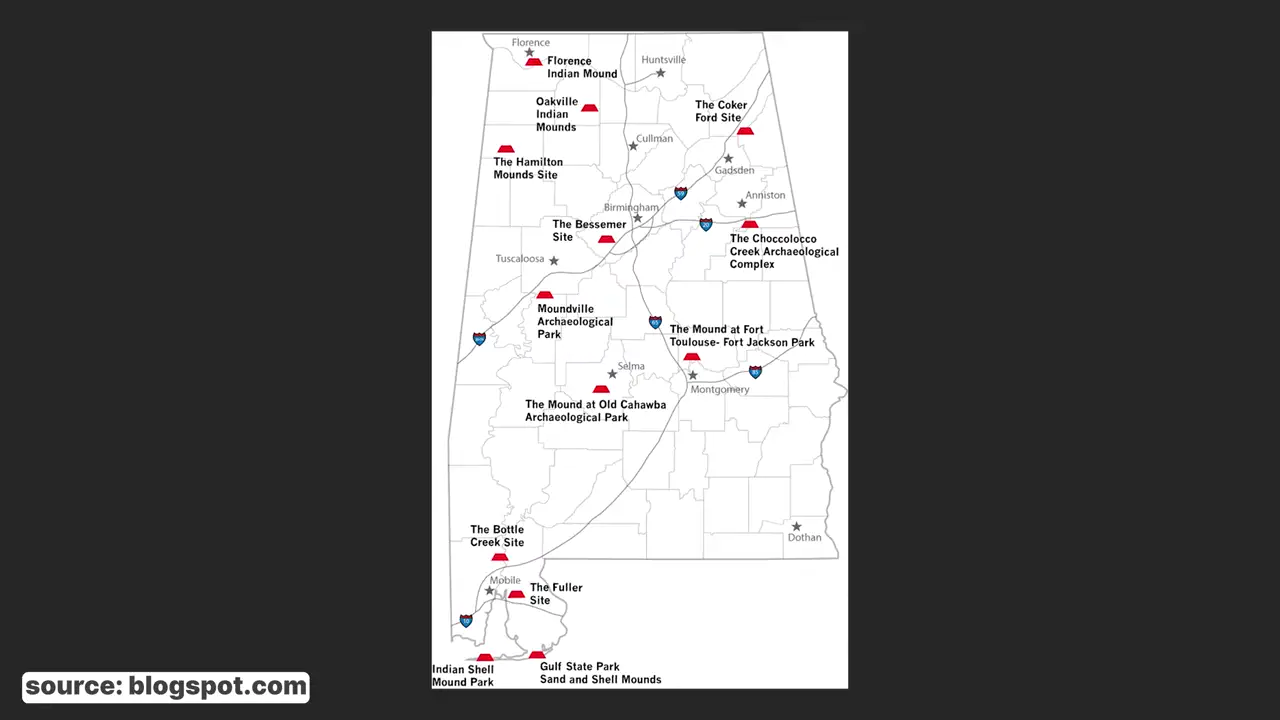
Site mentioned
📍 Moundville
Key facts
- Moundville, south of Tuscaloosa, Alabama, is the largest surviving Mississippian pyramid city in the state and second in size only to Cahokia.
- Its central plaza covered about 320 acres and was ringed by 29 earthen pyramids; Mound B was the largest at 60 ft tall over 2 acres, with Mound A standing in the middle of the plaza.
- A palisade wall over a mile long and 10-12 ft high enclosed three sides, the fourth being the Black Warrior River; about 1,000 people lived inside the walls, but outlying villages and farmsteads brought the community to over 10,000.
- Moundville began as a Late Woodlands village between 800 and 900 CE; Cahokia-type artifacts, two new pyramid mounds and smaller trench-walled, clay-plastered houses with grass thatch roofs appear by 1100.
- Around 1200 houses were burned to clear space for the grand plaza, more than 20 new pyramids were built and a mile-long palisade was erected, so the layout came to resemble Cahokia.
- Population declined after about 1300 and the site was abandoned by the late 1300s, though people returned to bury the dead in abandoned house foundations until about the mid-1400s.
- The rattlesnake disk, a stone disk about 12 inches in diameter carved with two intertwined rattlesnakes ringing a hand with an eye in its palm, was dug up by local farmers in the 1860s; an 1866 claim by sheriff Hezekiah Powell of a 9-foot-tall skeleton sold to the Smithsonian is considered possibly a scam.
- Clarence Moore excavated about 850 sites between 1891 and 1918 and spent 35 days at Moundville in 1905; pot hunters then dug the site until the University of Alabama bought the property in 1933.
- A 1934-1938 Civilian Conservation Corps excavation under Walter Jones and David DeJarnette dug 75 houses and 2,050 burials and recovered tens of thousands of artifacts.
- Christopher Peebles reanalyzed more than 2,000 burials in the 1970s without new fieldwork, arguing for a three-tier ranked society: a large commoner class, an elite class buried in the central plaza mounds, and a chiefly class whose seven burials in Mounds C and D carried more copper artifacts than elite burials.
- Decapitated skeletons in Mound C near elite graves are generally interpreted as sacrifices honoring a chief; Peebles also showed the mounds were paired, a flat-topped platform for elite residences beside a burial mound for the same family, matching contact-period descriptions of southeastern settlements.
- In 1540 de Soto met King Tuscaloosa, who greeted the Spanish from the top of a pyramid mound; at the Battle of Mabila the king's trap was sprung, the city burned and the king was never found, and the Alabama city of Tuscaloosa was named for him. Moundville was abandoned nearly two centuries earlier, so it was not his capital.
Sources
Moundville, the Ancient Citychickasaw.tv
... 320-acre site had a 10-foot tall protective palisade and a large central plaza that featured 29 earthen mounds, ranging from 3 to 57 feet high.It is ...
Ancient Site - Moundville Archaeological Parkmoundville.museums.ua.edu
Within the enclosure, surrounding a central plaza, were twenty-six earthen mounds, the larger ones apparently supporting noble's residences alternating with ...
Moundville Archaeological Parkbritannica.com
The park now encompasses 320 acres (130 hectares) and is operated by the University of Alabama. ... A central ceremonial plaza provided the nucleus of a ...
Moundville Archaeological Sitesah-archipedia.org
Altogether the complex encompasses some 320 acres, 185 of which are preserved ... central plaza—a conceptual form repeatedly seen at Mississippian sites.
Alabama Review - Project MUSE - Johns Hopkins Universitymuse.jhu.edu
by GA Waselkov · 2010 — Highlights of Blitz's tour of Moundville at its peak, circa 1250, include an enormous central plaza ringed by huge, flat-topped earthen mounds supporting ritual ...
Was this story useful?
Keep exploring
Every site on this page sits on the globe, and the people who research them are on the Discord.
3D Globe · Sites by country · Story Archive · Research Library · Weekly Journal · Search
AI-generated text · images from the original sources · always verify with the sources.