

Sir Arthur Evans named the Minoan civilization after King Minos after excavating Knossos palace on Crete. The culture emerged around 3100 BC and flourished until roughly 1100 BC. Minoan political structure remains debated among scholars, with some arguing the culture was largely egalitarian without traditional monarchs. Their writing system Linear A remains undeciphered. Minoans even appeared on Egyptian temple walls.
Minoan civilization named after King Minos emerged on Crete (Greece) around 3100 BC
 GreeceGeneral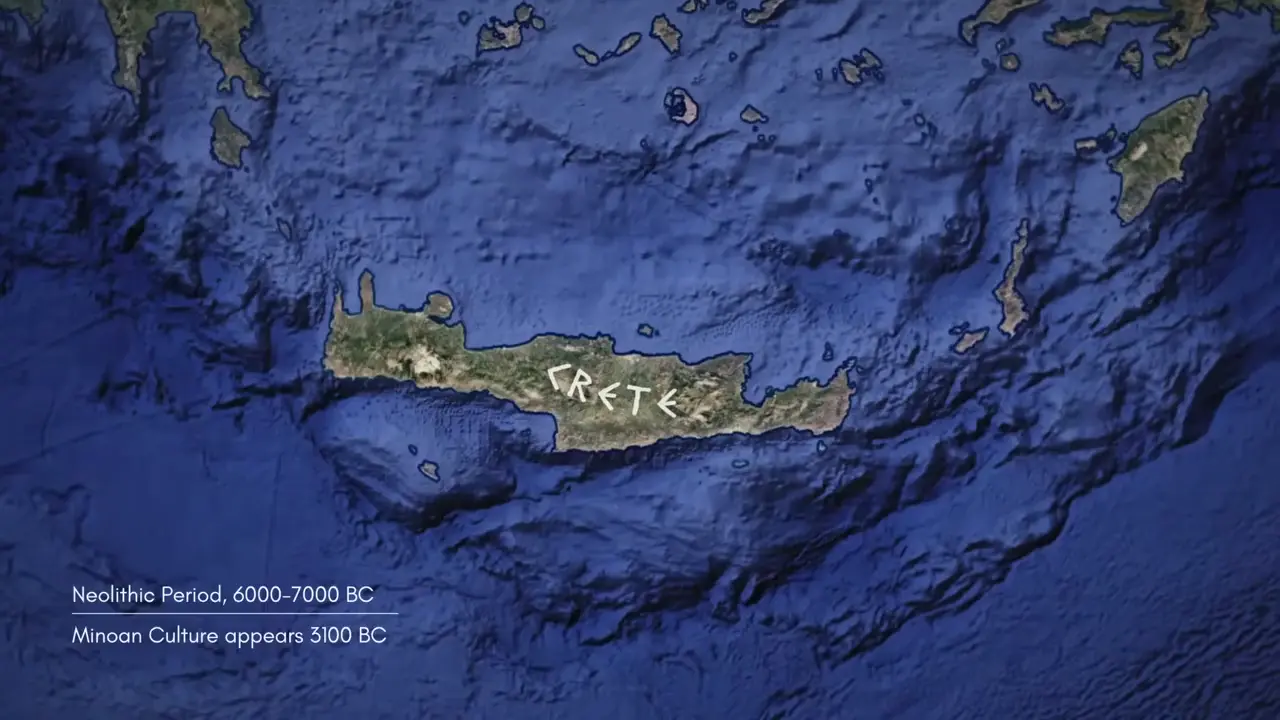
Site mentioned
Key facts
- Sir Arthur Evans discovered and excavated Knossos palace on Crete (Greece) and named the civilization Minoans after King Minos
- Crete (Greece) was first inhabited by Neolithic cultures around 6000-7000 BC, evolving into recognizable Minoan culture around 3100 BC
- Minoan civilization spanned four phases: Pre-Palatial (3100-1900 BC), Proto-Palatial/Old Palace (1900-1700 BC), Neopalatial/New Palace (1700-1450 BC), Post-Palatial (1450-1100 BC)
- Minoans left no deciphered writing system (Linear A remains unread), and archaeologists have found no evidence of kings or rulers
- Minoans appeared on Egyptian temple walls during sacred processions and international festivals
Sources
Evans Discovers Crete's Minoan Civilization | Anthropology - EBSCOebsco.com
Arthur Evans, a British archaeologist, is renowned for his discovery of the Minoan civilization on the island of Crete, a culture that flourished from ...
Minoan Crete - The Metropolitan Museum of Artmetmuseum.org
Sir Arthur Evans, the British archaeologist, characterized the Bronze Age culture of Crete as Minoan, after the legendary King Minos. From ...
Rise and Fall of the Mighty Minoans | National Geographicnationalgeographic.com
Perhaps the inspiration for Atlantis, Minoan civilization born on the island of Crete spread throughout the Mediterranean before it mysteriously collapsed.
Sir Arthur Evans: Archaeology visionary - Hektoen Internationalhekint.org
During these excavations he discovered a sophisticated Bronze Age civilization which he named “Minoan” after the mythical King Minos. The ...
Minoan civilization - Wikipediaen.wikipedia.org
The term "Minoan" was coined by Arthur Evans, who excavated at Knossos and recognized it as culturally distinct from the mainland Mycenaean culture. Soon after, ...
Was this story useful?
Keep exploring
Every site on this page sits on the globe, and the people who research them are on the Discord.
3D Globe · Sites by country · Story Archive · Research Library · Weekly Journal · Search
AI-generated text · images from the original sources · always verify with the sources.