

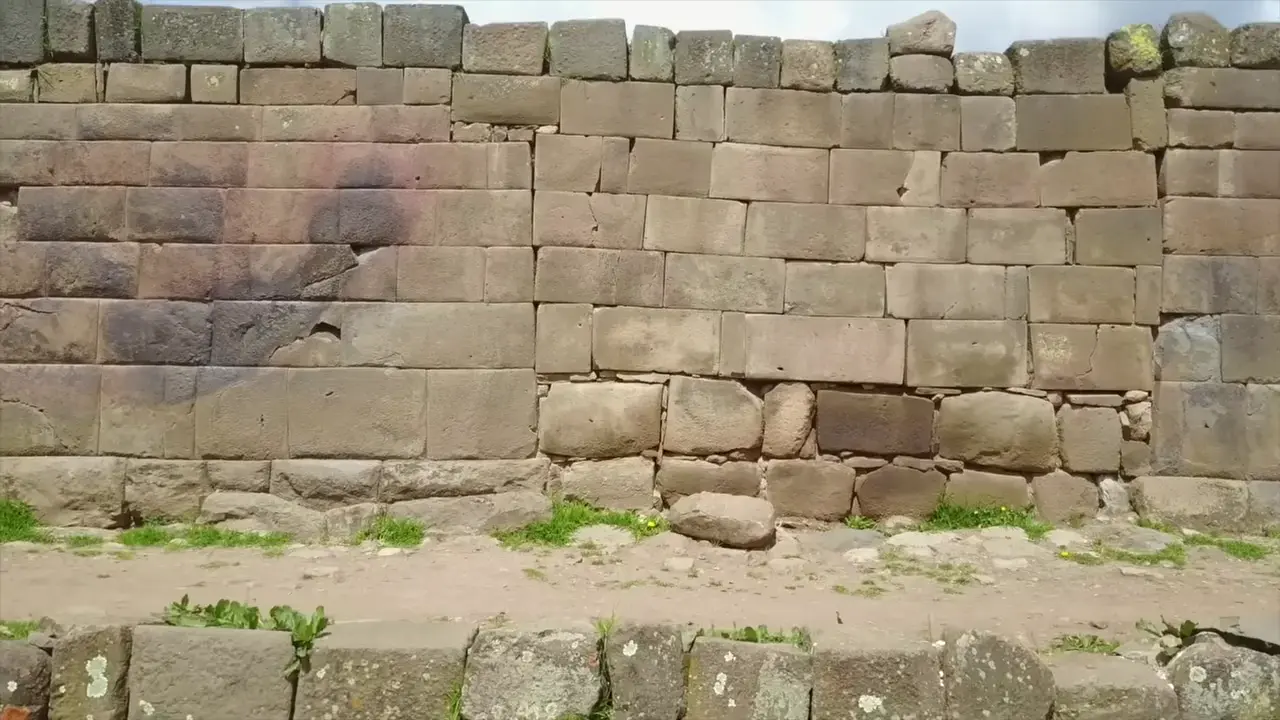
Stones at Vilcashuamán in Ayacucho, Peru, have been described as cracked and deformed, with surfaces that appear melted. Basalt melts at roughly 1,000–1,200°C, not at least 2,000°C, and no dating evidence links the stones to a 12,800-year-old cataclysm. Boston University professor Robert M. Schoch proposes that intense plasma-discharge events involving the sun could have damaged ancient sites worldwide. That remains his hypothesis, not an established cause.
Melt-like stones at Vilcashuamán do not establish a 12,800-year cataclysm
 PeruTheory
Site mentioned
Key facts
- Vilcashuamán is in Ayacucho, Peru. Its unusual stones have been described as cracked and deformed, with melt-like surfaces.
- Basalt melts at roughly 1,000–1,200°C, not at least 2,000°C.
- No dating evidence links the stones to cataclysmic events around 12,000 or 12,800 years ago.
- Robert M. Schoch is an associate professor of Natural Sciences at Boston University.
- Schoch proposes that intense plasma-discharge events involving the sun could have damaged ancient sites worldwide; this is his hypothesis, not an established cause.
- The site contains megalithic and Inca-era remains, but proximity does not establish the age or cause of the stone damage.
Sources
Younger Dryas cosmic impact of 12800 years ago (2018)news.ycombinator.com
A cosmic/stellar event such as what is theorized to happen during the Younger Dryas set our species back thousands of years.
The Great Sphinx - Robert M. Schochrobertschoch.com
A moat theory explains the water weathering of the Sphinx without hypothesizing that it dates back to an earlier period of more rainfall than the present.
Notes and Photographs on the West-Schoch Sphinx Hypothesishallofmaat.com
Schoch hypothesis that the Great Sphinx of Giza is eroded by rain and, therefore, dates to Epipaleolithic or early Neolithic times, I would like to offer here ...
The Story of Controversial Archeologist: Robert M. Schochinterestingengineering.com
Schoch claims that these solar outbursts hitting glaciers, oceans and lakes, caused melting and evaporation, which led to torrential rains as in ...
Vilcashuamánen.wikipedia.org
Vilcashuamán or Vilcasguaman is the capital of Vilcas Huamán Province, Ayacucho region, Peru. It is located at an altitude of 3,490 m on the eastern slopes ...
Expedition Magazine | The “Tired Stones” of Lake Titicacapenn.museum
Unlike Kanamarka's stones, these appeared natural, lacking the pockmarks of the bounce-worked stones. From the ridge top we looked down on Kanamarka and saw ...
Robert M. Schoch | PR Socialbu.edu
Robert M Schoch. Associate Professor of Natural Sciences, College of General ... schoch@bu.edu; Phone 617-353-2531; Education BA Anthropology, The George ...
Robert M. Schochscholar.google.com
College of General Studies, Boston University - Cited by 2231 - Ancient civilizations - paleontology - geology - environmental science ...
Was this story useful?
Keep exploring
Every site on this page sits on the globe, and the people who research them are on the Discord.
3D Globe · Sites by country · Story Archive · Research Library · Weekly Journal · Search
AI-generated text · images from the original sources · always verify with the sources.