

In 1938, Matthew Stirling made his first field trip to Mexico and learned of a giant head half-buried in a field at Tres Zapotes — the same head José María Melgar y Serrano had discovered in 1862. With Smithsonian backing, his 1939 expedition mapped the entire ancient city and unearthed a second head nearby. No proper roads existed — only muddy horseback paths.
Matthew Sterling discovers Tres Zapotes colossal head in 1938
 MexicoExcavation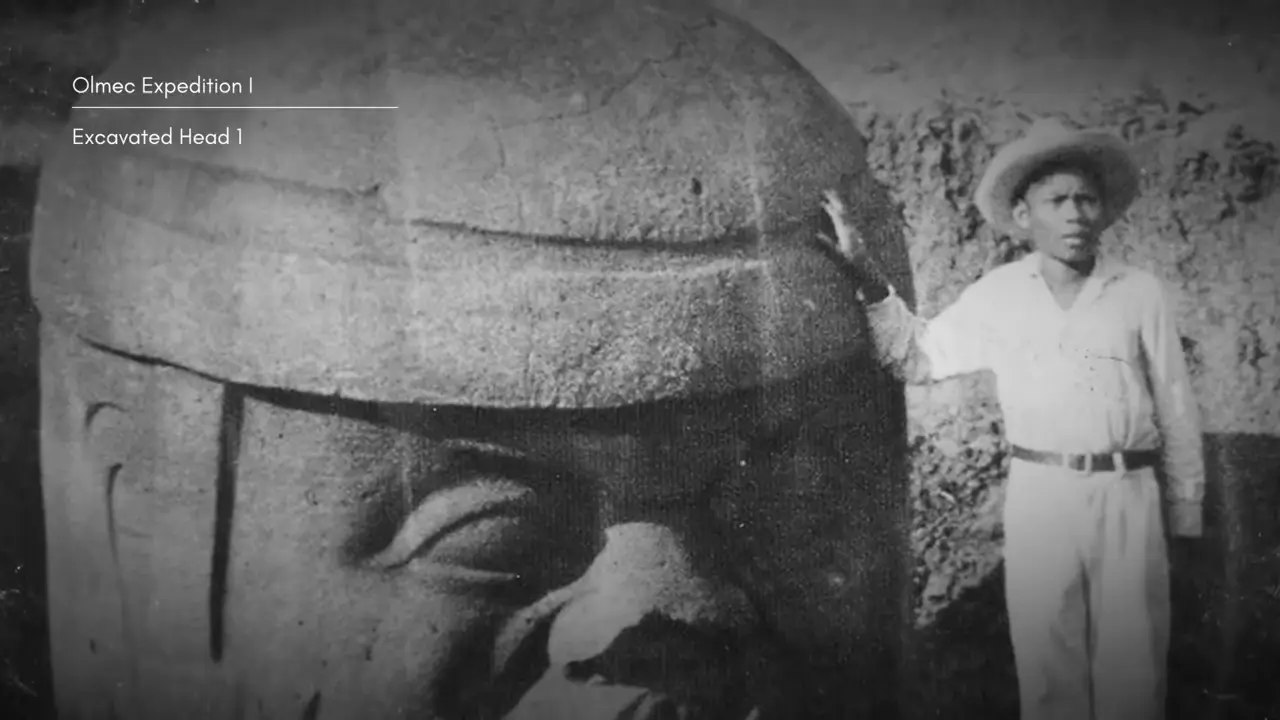
Key facts
- In 1938, Matthew Sterling and Marian Sterling made their first field trip to Mexico
- Sterling learned of a giant head half-buried in a field outside the village of Tres Zapotes
- This was the same colossal head that Jose Maria had seen in 1862
- In 1938, there were no proper roads to Tres Zapotes - only muddy horseback paths
- Sterling convinced the Smithsonian and National Geographic to sponsor an expedition
- The first official Olmec expedition launched in December 1938
- By spring 1939, they mapped the entire ancient city with its pyramids
- They discovered a stela fragment with markings similar to the Mesoamerican bar and dot dating system
- They fully unearthed the original mysterious colossal head and found a second head nearby
Site mentioned
Sources
[PDF] Untitled - Smithsonian Institutionrepository.si.edu
In general appearance this head, although considerably larger, is very similar to the Colossal Head of Tres Zapotes. The features are realistically ...
Olmec Heads, The Giant Stone Sculptures Of Early Mesoamericaallthatsinteresting.com
In 1862, an explorer named José María Melgar y Serrano discovered the first Olmec colossal head at Tres Zapotes. This news was not widely ...
What These Epic Sculptural Heads Teach Us about Mexico ... - Artsyartsy.net
In 1858, a peasant discovered a massive stone head in the ground at Tres Zapotes in southeast Mexico, on the Gulf Coast. It had smooth ...
Digging Their Past: Archaeological Labor in Tres Zapotes, Veracruz ...archaeologybulletin.org
In his initial visit in 1938, he was informed that the colossal head was not close to the Hacienda headquarters as his predecessors had mentioned, but to the ...
Why the Olmec Colossal Heads Are One of Archaeology's Greatest ...earthlymission.com
While the first Olmec colossal head was discovered at Tres Zapotes in 1862 by José María Melgar y Serrano, it was Matthew Stirling's 1938 ... buried ...
Was this story useful?
Keep exploring
Every site on this page sits on the globe, and the people who research them are on the Discord.
3D Globe · Sites by country · Story Archive · Research Library · Weekly Journal · Search
AI-generated text · images from the original sources · always verify with the sources.