

🐚 Riparo Mochi, a rock shelter at Balburi near Ventimiglia on the Italian-French border in Liguria, sits on the coastal corridor any traveller from France into Italy had to pass. Fabio Santielli's team (Sant'Anna School for Advanced Studies, University of Trento) found a tiny marine snail shell wedged between fallen blocks beneath the Noeillian layers, surrounded by more than 7,500 worked flints. Since hearth charcoal went missing, they dated the shell from ash, correcting for seawater carbon: 29,900–30,000 years ago. That makes it the earliest directly dated Noeillian site in northern Italy, alongside Grotta del Cavallo at ~31,000–30,000 years. Modelled dates suggest a wave: northern Spain ~34,000, Pyrenees ~32,000, Italy ~30,800. Wear shows the burins cut meat and hide, not bone. ⚠️ One shell, one layer.
Marine shell date pushes earliest Noeillian presence in northern Italy back to ~30,000 years ago
Site mentioned
📍 Riparo di Monrupino🌍 Show on the globe
Key facts
- Riparo Mochi is a rock shelter at Balburi near Ventimiglia on the Italian-French border in Liguria, lying on the coastal corridor from Provence that any group travelling from France into Italy had to pass.
- The site is associated with the Noeillian, a Middle Gravettian toolmaking tradition defined by small flint burins with a chisel edge.
- Work led by Fabio Santielli of the Sant'Anna School for Advanced Studies, University of Trento, found a small marine snail shell wedged between fallen blocks at the base of the Noeillian layers, with more than 7,500 pieces of worked flint around it.
- Microscopic wear shows the burins were used to cut meat and hide rather than to carve bone as once thought; a microgravette tip still showed traces of a handle, some flint came from more than 200 km away, and the site is interpreted as a short-term hunting camp with weapons repaired beside a fire.
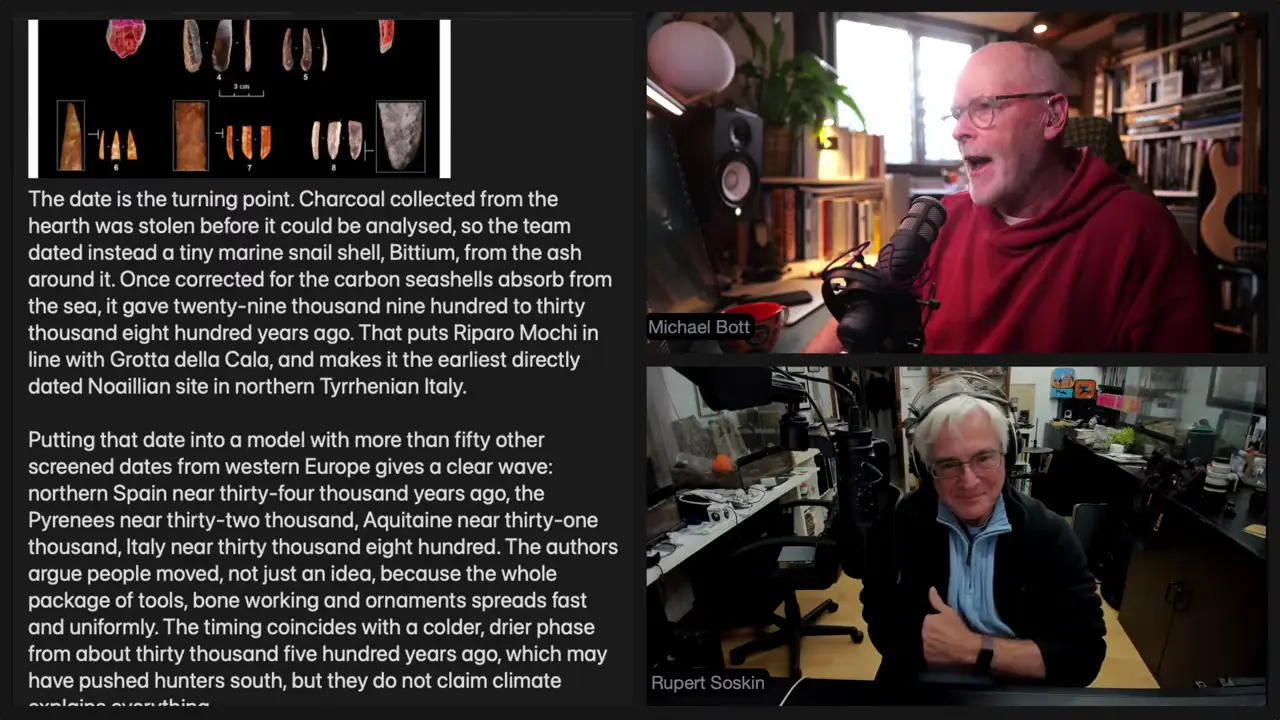
- Charcoal from the hearth was stolen or mislaid before analysis, so the team dated the tiny marine snail shell from the ash; corrected for carbon taken up from seawater, it gave 29,900-30,000 years ago.
- This makes Riparo Mochi the earliest directly dated Noeillian site in northern Italy and puts it in line with Grotta del Cavallo in Campania, dated to about 31,000-30,000 years ago.
- Modelling the date with more than 50 screened dates from Western Europe gives a dispersal wave: northern Spain near 34,000 years ago, the Pyrenees near 32,000, Aquitaine near 31,000 and Italy near 30,800.
- The timing coincides with a colder, drier phase about 30,500 years ago that may have pushed hunters south, although the authors do not claim climate explains everything.
- Caveats stated: the date rests on a single shell in one layer, and the burins were missing from the layer even though the same blade technique was present; there could be more camps, including a coastline now under the sea.
Sources
A new chronostratigraphic framework for the Upper ...semanticscholar.org
A refined chronology for the Middle and early Upper ...pubmed.ncbi.nlm.nih.gov
A refined chronology for the Middle and early Upper ...researchconnect.stonybrook.edu
Was this story useful?
Keep exploring
Every site on this page sits on the globe, and the people who research them are on the Discord.
3D Globe · Sites by country · Story Archive · Research Library · Weekly Journal · Search
AI-generated text · images from the original sources · always verify with the sources.