

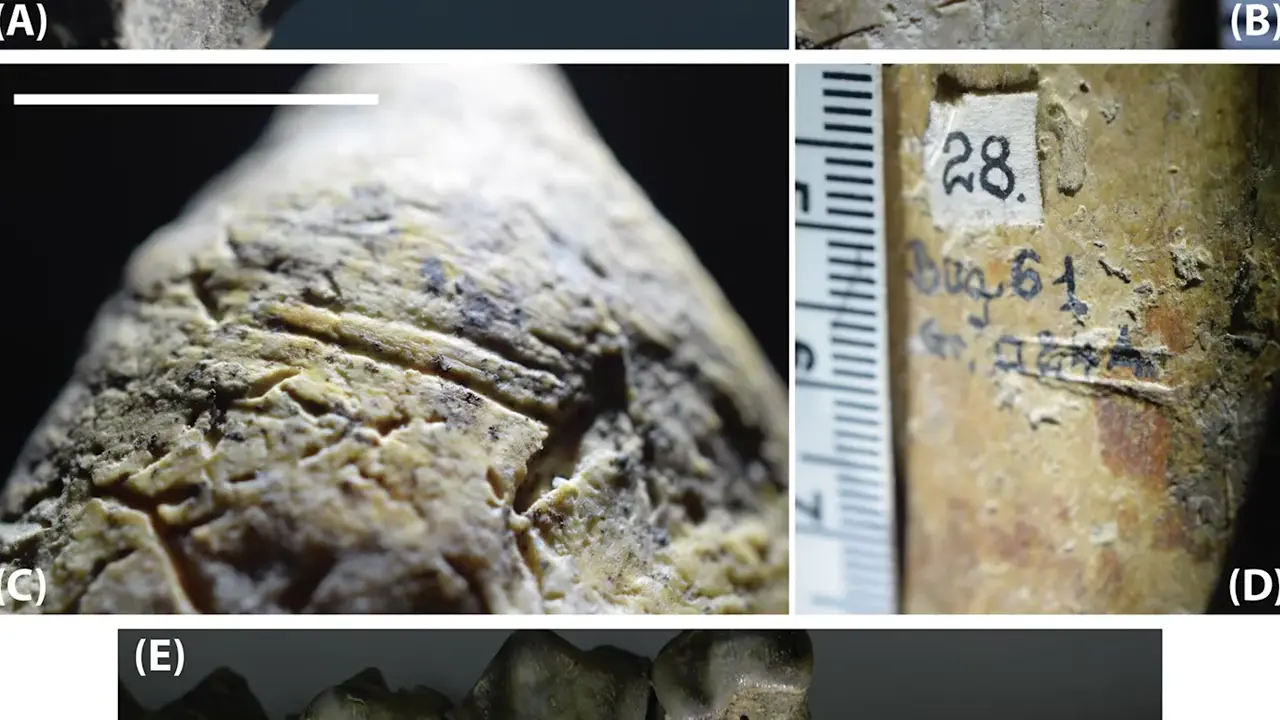
Grăunceanu in southern Romania yielded 4,983 animal bones once interpreted as a natural river deposit. Clear cut marks on 20 bones from a layer dated to about 1.95 million years ago provide among Europe's earliest evidence of hominin activity. No stone tools or hominin remains were found. The video argues the makers may have been small-brained, Homo habilis-like hominins with greater habitat flexibility than expected. 🔪
Grăunceanu: 1.95-million-year-old cut marks push back European hominin date
Site mentioned
📍 Grăunceanu
Key facts
- Grăunceanu is in southern Romania, near the Bulgarian border.
- Researchers examined 4,983 excavated animal bones from Grăunceanu, previously interpreted as a natural river accumulation.
- Clear cut marks consistent with stone-tool butchery were identified on 20 bones; the associated layer is dated to roughly 1.95 million years ago.
- The site yielded no stone tools or hominin remains, making it evidence of hominin activity rather than a direct hominin fossil find.
- The video argues that these hominins may have been small-brained, Homo habilis-like and more flexible in their habitat choices than expected; this is the presenter's interpretation.
Sources
Oldest Human Traces in Europe Found in Romaniaromaniajournal.ro
Tiny cut marks on animal bone fossils reveal that human ancestors were in ...leakeyfoundation.org
Oldest hominin evidence in Europe found in Romania, dating back 1.95 ...archaeologymag.com
Animal bones as a key to everyday lifecarnuntum.at
Romanian Animal Fossils Reveal Hominin Spread Into ...discovermagazine.com
Was this story useful?
Keep exploring
Every site on this page sits on the globe, and the people who research them are on the Discord.
3D Globe · Sites by country · Story Archive · Research Library · Weekly Journal · Search
AI-generated text · images from the original sources · always verify with the sources.