

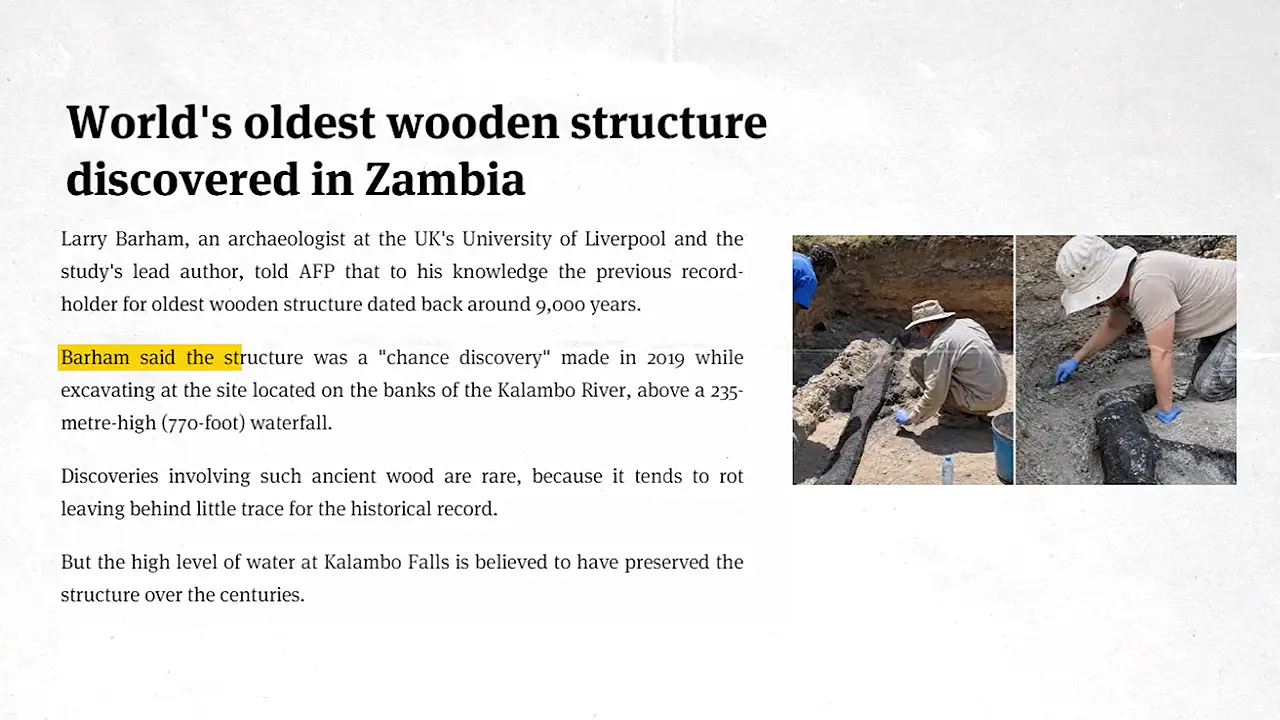
In 2019, Larry Barham's team at the University of Liverpool excavated a waterlogged riverbank at Kalambo Falls in northern Zambia and found two logs locked together. The upper one is ~141 cm long with a U-shaped notch cut across the grain using stone tools; the trunk beneath was shaped to pass through it so the top can't slide. Suggested uses: a raised platform, a walkway, or a dwelling base.
Kalambo Falls jointed logs date to at least 476,000 years, showing planned woodwork
Site mentioned
📍 Kalambo Falls
Key facts
- In 2019 a team led by Larry Barham of the University of Liverpool excavated a waterlogged riverbank at Kalambo Falls in northern Zambia and found two logs locked together.
- The upper log is about 141 cm long and has a U-shaped notch cut across its grain with stone tools; the trunk beneath was shaped to pass through the notch, preventing the top log from sliding.
- The team suggests possible functions of the joint include a raised platform, a walkway, or the base of a dwelling.
- Sand surrounding the wood was dated to at least 476,000 years, roughly 160,000 years before the Jebel Irhoud individuals.
- No human bones were found with the logs; Barham suspects Homo heidelbergensis, but the makers remain unknown.
- Other rare organic finds mentioned: birch bark tar on two stone flakes from Italy of about 200,000 years old, attributed to Neanderthals because Homo sapiens was not yet known in Italy, and a polished wooden plank from Israel around 300,000 years old.
- The preservation of the Kalambo wood is attributed to waterlogged, air-excluding ground conditions, which almost never occurs.
Sources
Kalambo structureen.wikipedia.org
Oldest wooden structures almost 500000 years oldhumanorigins.si.edu
Was this story useful?
Keep exploring
Every site on this page sits on the globe, and the people who research them are on the Discord.
3D Globe · Sites by country · Story Archive · Research Library · Weekly Journal · Search
AI-generated text · images from the original sources · always verify with the sources.