

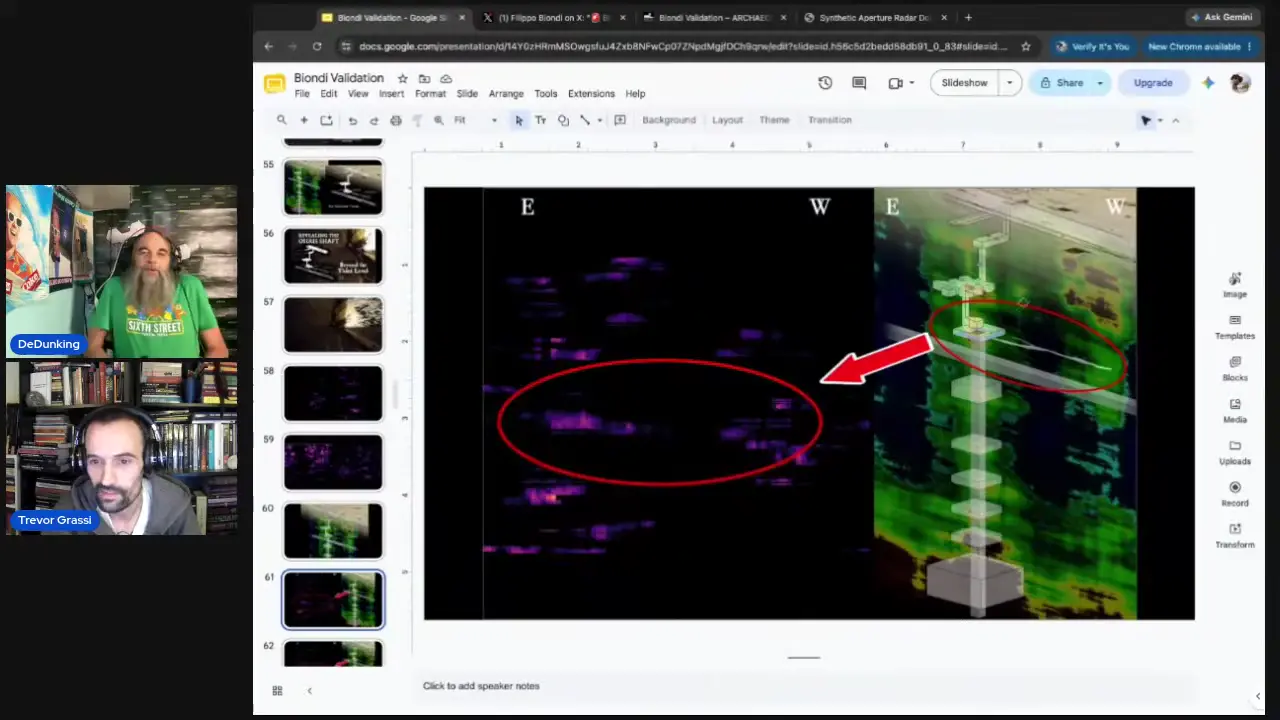
A researcher known as Manu re-implemented the proprietary Beyond Protocol processing from public data and re-scanned the Osiris Shaft inside the Great Pyramid. His SAR images put the three known upper chambers exactly where Zahi Hawass's survey put them, and seem to add unexcavated chamber-like anomalies deeper down plus a lateral tunnel running roughly 50 m west toward a second shaft. 🏛️🔍
Independent SAR re-scan reproduces Osiris Shaft chambers and new anomalies
 EgyptRemote Sensing
Key facts
- The Beyond Protocol, a synthetic-aperture-radar (SAR) remote-sensing method, was applied to the Osiris Shaft inside the Great Pyramid at Giza; Manu, an independent researcher with a PhD and a dermatology academic background who has studied Egypt for decades, re-implemented the processing from publicly published data without access to the proprietary software.
- The Osiris Shaft was chosen as a control test because its three upper chambers are known from physical access while every level below the third is unexcavated; Zahi Hawass's survey of the first three chambers was used for comparison.
- Manu's scans covered a 150 m line along the Sphinx causeway, first to about 50 m depth and later to 100 m depth; one high-resolution product is labelled with a pixel count of 3360.
- Results were compared against ground-penetrating radar (GPR), electrical resistivity tomography (ERT) and seismic testing, which the presenters describe as two of the most trusted remote-sensing techniques; the known chambers appear in the same positions in Manu's scans as in the published surveys.
- The presenters state that the scans reveal additional chamber-like anomalies below the third level of the Osiris Shaft that no one has ever entered, plus a lateral tunnel reaching a second shaft roughly 50 m to the west.
- Tomography by Thomas Dobecki in 1996, run at the base of the ladder on the third level, detected an 8-ft-wide domed tunnel about 9 ft below the surface running toward the Sphinx and the Great Pyramid.
- The method relies on co-registering multiple SAR scans and detecting subtle deviations between them, a phenomenon Manu calls pixel instability, which causes fuzziness in the processed images.
- A 2006 GPR survey along the Great Pyramid's eastern base edge, associated with Bill Brown, was compared with the Coffer Project model, with some modelled tunnels appearing in both datasets.
Sources
Digital Giza | Homegiza.fas.harvard.edu
What Really Lies Beneath the Pyramids ...papers.ssrn.com
Is there really a secret city under Egypt's Giza pyramids?nationalgeographic.com
Was this story useful?
Keep exploring
Every site on this page sits on the globe, and the people who research them are on the Discord.
3D Globe · Sites by country · Story Archive · Research Library · Weekly Journal · Search
AI-generated text · images from the original sources · always verify with the sources.